
Academic guides · Guide
CERN Doctoral Studentship: 2027 Application Guide
StatusOpen
CERN pays doctoral students CHF 3,907 a month net to research at its Geneva lab. A verified guide to eligibility, funding, and applying.
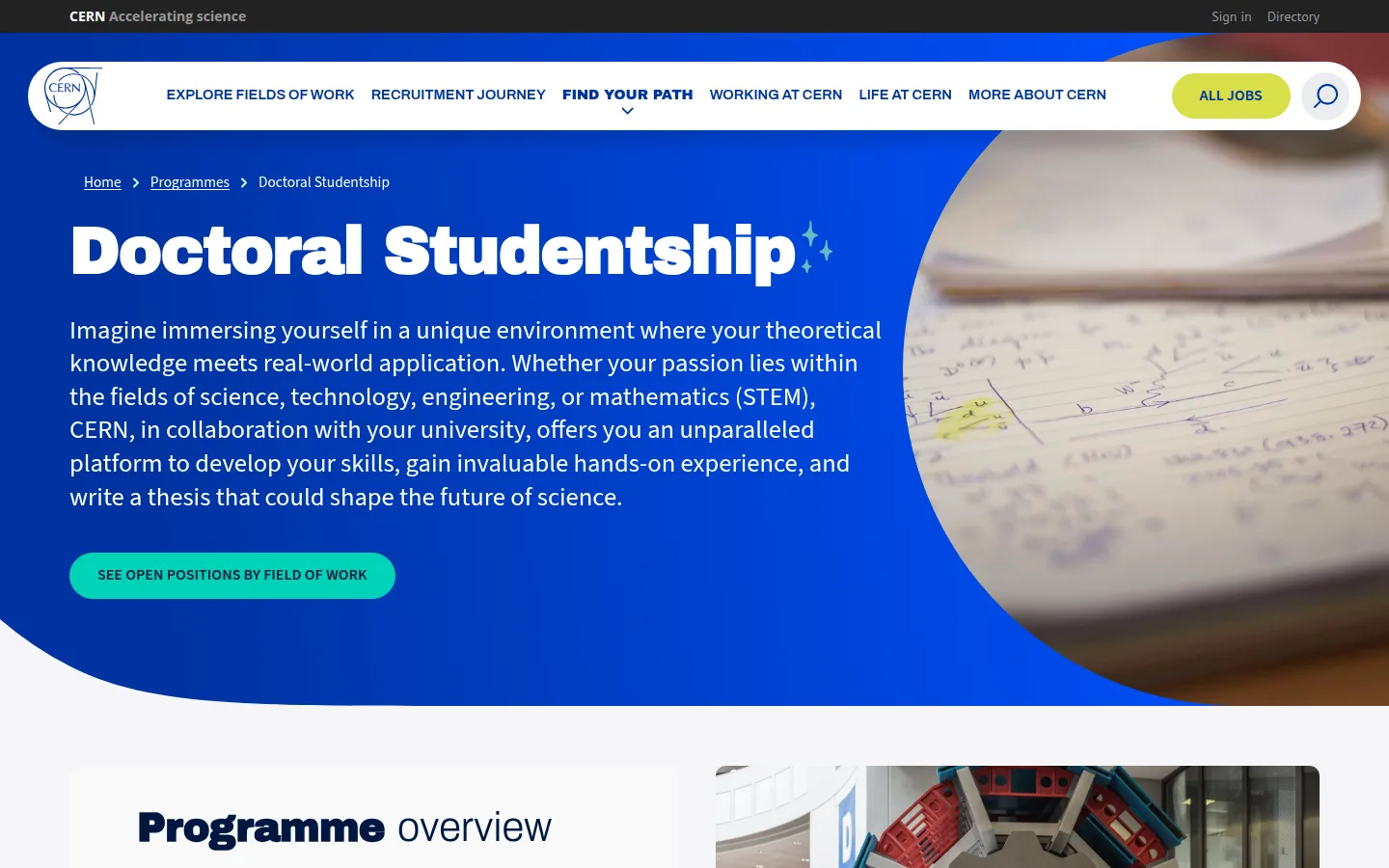
CERN's Doctoral Studentship is a paid doctoral research programme for PhD students who want to carry out thesis research at CERN, the European Organization for Nuclear Research, near Geneva. CERN's official page uses both "Doctoral Studentship" and "Doctoral Student Programme"; the 2027 cycle is widely searched as the CERN Doctoral Student Programme 2027. As of 11 November 2026, CERN listed no open positions and no 2027 application deadline. This guide explains what the programme offers, who can apply, and how the process works when a call opens.
The short answer
CERN publishes a monthly net allowance of CHF 3,907 and requires the research at CERN to form part of your doctoral thesis. Applicants must be nationals of a CERN Member or Associate Member State, have started or be about to start a doctoral programme, and have a university that accepts the CERN work as part of the thesis. The 2027 call is not open: CERN's programme page showed no open positions and no deadline on 11 November 2026. Treat any third-party 2027 deadline as unconfirmed until CERN publishes one.
Is the CERN Doctoral Studentship open for 2027?
Not as of 11 November 2026. CERN's official programme page stated that there were no open positions for the Doctoral Studentship's fields of work, and it did not publish a 2027 application deadline.
That does not mean the programme has been cancelled. CERN advertises doctoral positions when teams have openings, and the programme page is where those calls appear. The useful action now is to prepare your eligibility and thesis case, then check the official page rather than relying on a third-party deadline.
Our verified listing at /opportunities/cern-doctoral-studentship records the same status and will be updated when CERN publishes a call. The blog's research programmes directory links to that listing and to other verified programmes.
What the CERN Doctoral Studentship is
The Doctoral Studentship is CERN's programme for PhD students who want to do part of their doctoral research at CERN while remaining enrolled at their home university. CERN describes it as a collaboration between the laboratory and the university: the university must accept that the research conducted at CERN contributes to the doctoral thesis in one of CERN's fields of work.
CERN's fields of work include applied physics, civil engineering, data science and AI, electrical engineering, electronics engineering, health, safety, environment and sustainability, chemical, materials and process engineering, mechanical engineering, information technologies, and technology transfer and innovation. The programme page does not publish a fixed project list. When positions are open, they are advertised by field of work, and the team and project are described in the individual call.
The environment is explicitly international. CERN says doctoral students collaborate with leading scientists and engineers in a multicultural community. That is useful context, but it is not a substitute for checking the specific position: the day-to-day work, supervisor, and thesis contribution are defined by the team that advertises the role.
What CERN pays doctoral students
CERN publishes the core package directly on the programme page. The figures below are the ones to use; a commonly circulated figure of CHF 3,881 does not match the current official page.
| Benefit | What CERN publishes |
|---|---|
| Monthly allowance | CHF 3,907 net per month |
| Health insurance | Coverage by CERN's Health Insurance Scheme; the contribution is deducted from the allowance |
| Family supplement | A supplement to the subsistence allowance, depending on individual circumstances |
| Travel | Travel expenses to Geneva when joining CERN, depending on individual circumstances |
| Leave | 30 days of paid leave per year plus two weeks of annual closure |
| Contract | Six months, renewable up to three years, with the possibility of spreading the appointment over a maximum of four consecutive years |
The word "net" matters. CERN describes the allowance as net, but it also says the health insurance contribution is deducted from it. Budget for that deduction rather than treating CHF 3,907 as the amount that arrives in your bank account untouched. The family supplement and travel contribution are not fixed amounts; CERN says they depend on individual circumstances.
CERN's page does not publish a USD equivalent, a tax ruling for every nationality, or a guaranteed relocation package. Those details can change with your personal situation and with CERN's internal rules. Ask CERN during the process if you need a definite answer for your case.
Who is eligible for the CERN Doctoral Studentship?
CERN's eligibility rules are short and specific. The table below reproduces the published requirements and adds the practical question to check for each one.
| Requirement | What CERN publishes | What to check |
|---|---|---|
| Nationality | You are a national of a CERN Member or Associate Member State. | Check CERN's current member-state list before you prepare an application. |
| Current exclusions | CERN cannot consider applications from Pakistani, Lithuanian, Latvian, Cypriot, Croatian, or Turkish nationals because the ceiling under Article II.5 of the Associate Membership Agreement has been reached. | Confirm that the exclusion still applies when the call opens; CERN updates the page. |
| University requirement | Your university must accept that research at CERN contributes to your doctoral thesis in one of CERN's fields of work. | Talk to your supervisor and doctoral school before applying. |
| Student status | You have started or are about to start a doctoral programme at a university. | You do not need to have completed a PhD; you need to be enrolled or about to enrol. |
| Language | You have a good knowledge of English or French. | The page does not publish a test score; prepare to work in one of those languages. |
| Documents | A CV in English or French and a completed online application. An academic reference letter and transcript are optional. | Follow the document list in the specific call. |
CERN's programme page does not publish a minimum GPA, a TOEFL or IELTS score, an age limit, or a separate non-Member State quota. Those numbers appear in some third-party summaries, but they are not part of the published eligibility criteria. If a guide quotes them, ask for the CERN source. The safest approach is to treat the official page as the only eligibility list.
What CERN looks for in an application
The published criteria are the baseline, not a ranking formula. CERN does not publish a points system, a preferred programming-language list, or a publication requirement for the Doctoral Studentship. That means you should not treat C++, Python, ROOT, CUDA, or a conference paper as a formal requirement. They can still help you explain your preparation, but they do not replace the eligibility rules.
What the page does make clear is the thesis connection. Your application has to make sense as doctoral research that CERN can host. In practice, that means being able to say:
- what area of CERN's work your thesis connects to;
- what you have already studied or built that prepares you for it;
- why the work needs CERN's environment, instruments, or teams;
- how your university will supervise and examine the thesis.
CERN's fields of work give you the vocabulary for that case. Read the field descriptions on the programme page before you write your CV, and use the language of the field rather than a generic "research" label.
How to apply, step by step
The process below follows CERN's published recruitment steps. It applies when a call is open; there is no application window to enter on 11 November 2026.
- Confirm that a position is open. Start at the official Doctoral Studentship page. If the open-positions section shows no roles, there is nothing to apply to yet.
- Check your nationality against the member-state list. CERN's rule is nationality-based, and the current exclusions are listed on the programme page.
- Secure your university's agreement. The thesis must be accepted as part of your doctoral research. This is an eligibility requirement, not a formality to arrange after an offer.
- Prepare a CV in English or French. Keep it specific about your research preparation, technical work, and the field you are targeting.
- Add the optional documents if they help. CERN lists an academic reference letter and a transcript as optional. Use them if they make your case clearer.
- Complete the online application before the deadline. The call will state the deadline and the application link. Do not send a speculative application when no position is advertised.
- Prepare for a possible online interview. CERN says your application will be reviewed and you may be invited to an online interview with the hiring manager or managers. The interview is also a chance for you to test whether the team and project fit your thesis.
- Respond to the offer and onboarding steps. If you are successful, CERN says you will receive an offer; onboarding begins after you accept.
How the selection process works
CERN's published process has three stages: application review, a possible online interview with the hiring manager or managers, and an offer followed by onboarding. The page does not publish a fixed number of interview rounds, a scoring rubric, or a decision date for the 2027 cycle.
That matters for planning. Some third-party guides describe an April selection committee and May offers for 2027. CERN's programme page did not publish those dates on 11 November 2026, so this guide does not treat them as confirmed. When a call opens, use the dates in that call and the messages you receive from CERN.
The programme page also includes first-person stories from former doctoral students. They are useful for understanding the day-to-day experience, but they are not a timeline or a statement of eligibility for the next call.
What to prepare now
The gap between calls is the best time to work on the parts that do not depend on a deadline.
- Read the official page end to end. Note the eligibility rules, the fields of work, and the documents CERN asks for.
- Talk to your supervisor early. Ask whether your university would accept CERN-based research as part of the thesis, and what the doctoral school needs in writing.
- Map your thesis to a field. Choose two or three fields of work where your preparation is strongest, and be ready to explain the connection.
- Draft your CV in English or French. Lead with research work, technical skills, and outputs that a CERN team can evaluate.
- Ask for the optional reference letter in advance. A supervisor or mentor who knows your research can write a more specific letter than one requested at the last minute.
- Check your language readiness. CERN asks for good knowledge of English or French. If you need to improve, start before the call opens.
- Watch the official page, not aggregators. A listing can be copied and outdated within days. The CERN page is the source of truth.
If you need a visa or relocation information, wait for the specific call or offer and ask CERN directly. The programme page does not publish a universal visa or relocation package.
Common mistakes to avoid
Using a deadline that CERN has not published. A date in a third-party article is not an official deadline. If CERN's page does not show it, do not plan around it.
Applying when no position is open. The programme page's open-positions section is the signal. A speculative application is not the published process.
Confusing the programme names. CERN's page uses "Doctoral Studentship" and "Doctoral Student Programme." Check that you are on the doctoral page, not a summer-student or technical programme with different rules.
Assuming a non-Member State route. CERN's published rule is nationality of a Member or Associate Member State. The page does not describe a separate non-Member State application route.
Treating preferred skills as requirements. C++, Python, ROOT, CUDA, and publications can strengthen a case, but CERN does not publish them as formal eligibility criteria for this programme.
Assuming the role is remote. CERN's job listings for the programme describe the positions as fully onsite. The research and the collaboration take place at CERN.
Quoting an old allowance. Use CHF 3,907 from the current official page, not the older CHF 3,881 figure that still circulates online.
Sources and verification
This guide was checked against CERN's official programme page on 11 November 2026. The page showed no open positions and no 2027 deadline at that time. CERN can change the page at any time; check it before you rely on a date, amount, or eligibility rule.
- CERN, "Doctoral Studentship," accessed 11 November 2026
- CERN, "Member States," accessed 11 November 2026
- Feynman Research Labs, "CERN Doctoral Studentship" listing
- Feynman Research Labs, "Academic guides"
If you are comparing programmes, start with the research programmes directory. It links to the canonical listing for each opportunity rather than copying the provider's page.
Frequently asked questions
- Is the CERN Doctoral Studentship open for 2027?
- CERN's official programme page listed no open positions and no 2027 deadline on 11 November 2026. The next call will appear on the official CERN careers page when it opens.
- How much does the CERN Doctoral Studentship pay?
- CERN publishes a monthly net allowance of CHF 3,907. The package also includes health insurance coverage with the contribution deducted from the allowance, a family supplement and travel expenses depending on individual circumstances, and 30 days of paid leave per year.
- Who is eligible for the CERN Doctoral Studentship?
- Applicants must be nationals of a CERN Member or Associate Member State, have started or be about to start a doctoral programme, have a university that accepts the CERN research as part of the thesis, and have a good knowledge of English or French.
- Can non-Member State nationals apply?
- CERN's published eligibility rule requires nationality of a Member or Associate Member State. The programme page does not currently describe a separate non-Member State application route.
- Is the CERN Doctoral Studentship remote?
- No. CERN's job listings for the programme describe the positions as fully onsite, and the research is carried out at CERN's laboratory sites.
- What documents do I need to apply?
- CERN asks for a CV in English or French and a completed online application. An academic reference letter and transcript are optional.
- How long is the CERN Doctoral Studentship?
- The contract is for six months, renewable up to three years, with the possibility of spreading the appointment over a maximum of four consecutive years to allow time at the university.
Official application link
Check the official CERN Doctoral Studentship page
CERN listed no open positions and no 2027 deadline on 11 November 2026. The next call and application form will appear on the official programme page.
Open official page

