
Academic guides · Guide
EMBL EIPOD-LinC Fellowship 2027: A Verified Application Guide
StatusOpen
EMBL's EIPOD-LinC fellowship pays €3,228–€4,238 a month in year one, by site, and closes on 1 February 2027. A verified guide to eligibility and applying.
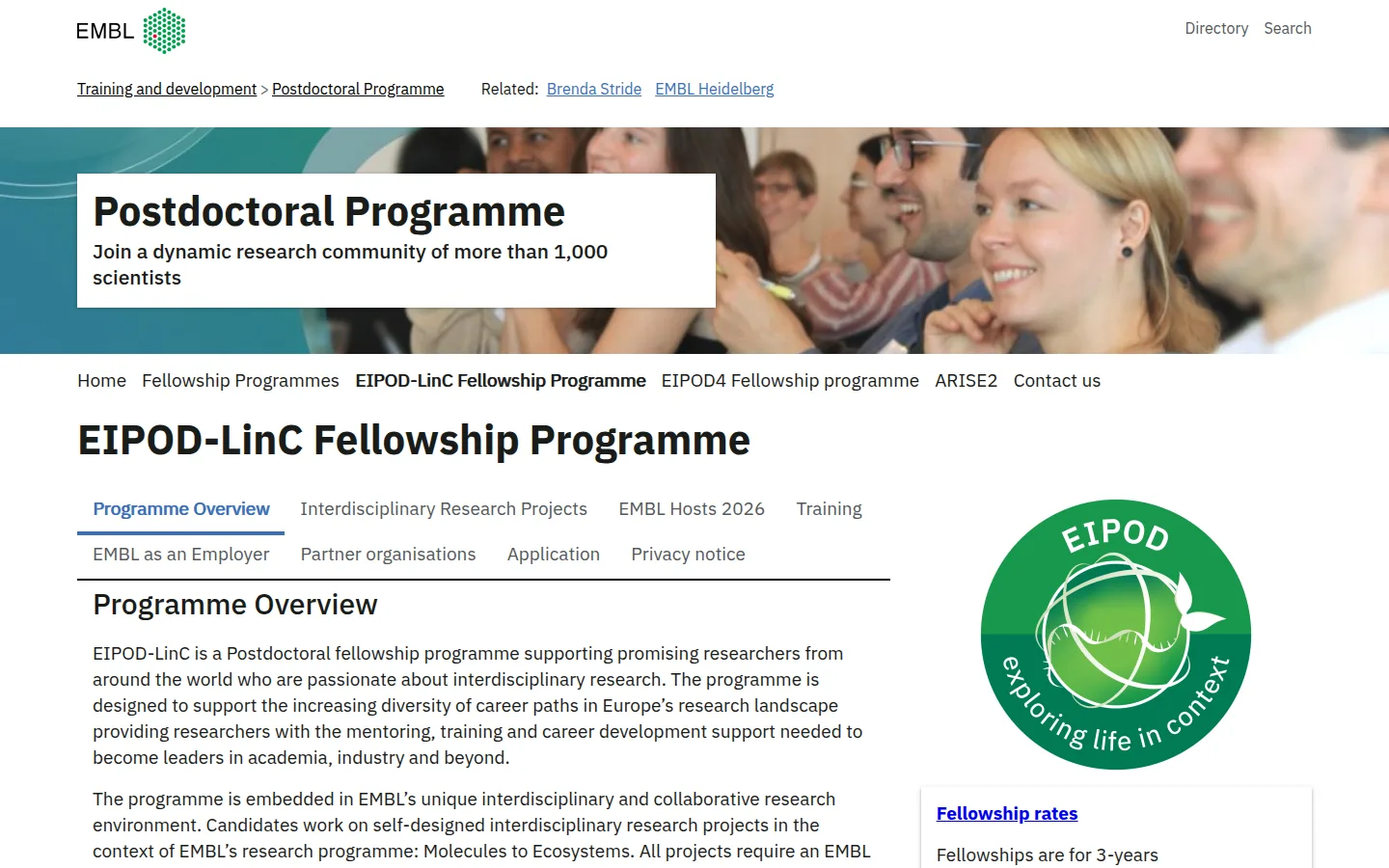
EMBL's EIPOD-LinC fellowship is a three-year, fully funded postdoctoral programme for researchers who want to design an interdisciplinary life-sciences project across an EMBL host laboratory and a partner lab in an EMBL Member, Associate, or Prospect Member State. EMBL labels the current round the 2026 call: applications open on 25 November 2026, close on 1 February 2027, and interviews take place on 12 April 2027. This guide uses EMBL's programme page, its Guide for Applicants, and its published 2026 fellowship rates. It also corrects several figures and dates that are circulating in third-party summaries.
The short answer
EIPOD-LinC is open to researchers of all nationalities who hold a PhD by 1 February 2027, have no more than eight years of research experience since the PhD, and can build a project with an EMBL host and a partner lab in an EMBL Member, Associate Member, or Prospect Member State. The contract is for three years, with a secondment of three months to one year at the partner lab. First-year monthly stipends range from €3,228.38 in Italy to €4,237.89 in Germany, according to EMBL's 2026 rate table. The application window is roughly ten weeks, and EMBL does not publish a time of day for the closing date.
What the EIPOD-LinC fellowship is
EIPOD-LinC is one of EMBL's postdoctoral fellowship programmes. Its theme is "Exploring Life in Context": fellows design their own interdisciplinary project rather than applying to a fixed list of advertised positions. Each project must sit within one of four areas linked to EMBL's research programme, Molecules to Ecosystems:
- Molecular Mechanisms — how genetic, epigenetic, and environmental changes affect molecular function, modifications, and macromolecular complexes.
- Human Health — molecular insights into human biology, disease models, antimicrobial resistance, infectious disease, and the interplay between genetics and environment.
- Planetary Ecosystems — interactions between microbes, plants, animals, and their environments at the molecular level.
- AI and Theory — mathematical models, physics principles, and AI applied to biological processes from molecules to populations.
Every project needs two supervisors: an EMBL host and a co-supervisor from a partner lab in an EMBL Member State, Associate Member State, or Prospect Member State. The partner can be an academic institute, an industry lab, or a clinic. Fellows spend between three months and one year at the partner lab on research secondment. The point is not simply to add a collaborator: EMBL says the project must let the fellow gain new skills that contribute to an interdisciplinary skill set.
The 2026 call lists participating hosts at EMBL Barcelona, EMBL-EBI in Hinxton, EMBL Grenoble, EMBL Hamburg, EMBL Heidelberg, and EMBL Rome. The host and collaborator lists are updated when the call opens, so check the programme page rather than relying on a list from an earlier year. EIPOD-LinC receives funding from Horizon Europe's Marie Skłodowska-Curie programme under grant agreement No. 101217201.
What the fellowship pays
EMBL publishes a separate 2026 Postdoctoral Fellowship Rates table, effective from 1 July 2026. The first-year monthly stipend for postdoctoral fellows is set by the EMBL duty site:
| EMBL site | Country | First-year monthly stipend |
|---|---|---|
| Heidelberg | Germany | €4,237.89 |
| Hamburg | Germany | €4,237.89 |
| Barcelona | Spain | €3,396.55 |
| Grenoble | France | €3,711.87 |
| Hinxton (EMBL-EBI) | United Kingdom | €3,535.78 |
| Rome | Italy | €3,228.38 |
The same table lists higher second- and third-year rates. In Germany, for example, the monthly stipend rises to €4,661.67 in year two and €4,731.59 in year three. EMBL's Guide for Applicants describes the payment as a monthly salary calculated on the duty site and subject to annual increases; the rate table calls it a stipend. The table does not label the figures as gross or net, so treat a third-party "gross" or "net" label as unconfirmed and ask EMBL about deductions for your site.
The package also includes:
- Social security — pension, health insurance, accident-at-work insurance, and unemployment insurance.
- Leave — 2.5 days of leave per month of service, plus sick, maternity, paternity, and special leave.
- Family allowances — a monthly dependent allowance for fellows in a union, and a children's allowance for each dependent child.
- Travel and accommodation support — support to visit partner labs, whether EMBL or external.
- Conference funding — support for participating in a conference.
- Training — core workshops in year one, a specialised innovation or science-policy workshop in year two, the EMBO Lab Leadership Course in year three, and career-development support.
- Part-time options — EMBL says part-time is a possibility for fellows returning from parental leave.
Two limits matter. First, the programme page does not describe a general relocation allowance or a blanket housing package; it lists travel and accommodation support for partner-lab visits. Second, some third-party summaries quote a monthly range of €5,000–€6,200. EMBL's published 2026 rate table does not support that range. The official first-year figures are the site-specific amounts in the table above.
Who is eligible
EMBL's eligibility rules are specific, and most of them are checked before scientific review. The table below reproduces the published requirements.
| Requirement | What EMBL publishes |
|---|---|
| PhD timing | You must hold a PhD by the call deadline of 1 February 2027. If you have successfully defended your thesis but have not yet received the formal degree, you are still eligible. |
| Research experience | A maximum of eight years of research experience from the date your PhD was awarded. Career breaks and years spent outside research do not count toward the eight-year limit. |
| Nationality | The programme is open to experienced researchers of all nationalities. |
| Mobility | Prior association with EMBL or the partner lab — including visitor contracts, a PhD, or a postdoc with the supervisor — cannot exceed 12 months within the three years before the application deadline. You must declare any prior association on the application form. |
| Partner lab | You must include a partner lab from an EMBL Member State, Associate Member State, or Prospect Member State. The partner can be academic, industrial, or clinical, and acts as co-supervisor. |
| Project | The project must be interdisciplinary, fit one of the four programme themes, and be designed to be completed in three years. |
| Ethics | You must complete and submit a Horizon Europe ethics self-assessment as part of the application. |
| Start date | Successful candidates have four months to take up the fellowship. The last possible start date for the 2026 call is 1 September 2027. |
Two things are notably absent from EMBL's published rules. There is no formal English-language test score, and no minimum GPA or age limit. EMBL publishes the call, guide, and forms in English, but the page does not turn that into a test-score requirement. There is also no requirement for a letter of support from the EMBL host or the partner lab; the programme page says explicitly that neither letter is needed.
How to apply, step by step
The application process is longer than the form alone because you have to build the project and the supervisor pair first. The steps below follow EMBL's published instructions.
-
Read the Guide for Applicants. EMBL publishes a 15-page guide for the 2026 call, dated 9 November 2026. It contains the detailed eligibility rules, the project template, the evaluation criteria, and the timeline.
-
Register for the information webinar. EMBL holds an applicant webinar on Thursday, 19 November 2026 at 1:00 PM CET. Registration is through the EMBL Zoom registration page. The webinar is optional, but it is the quickest way to clarify how the host and partner arrangement is supposed to work.
-
Choose an EMBL host and a partner lab. Screen EMBL's research groups by research area, then confirm that the group leader is participating in the 2026 call. The participating-host list is published when the call opens. Choose a partner from an academic institute, industry, or clinic in an EMBL Member, Associate, or Prospect Member State. Agree the project with both sides. No letter of support is required from either.
-
Develop the project proposal. Use EMBL's project template and place the project in one of the four themes. The proposal should explain the interdisciplinary question, the methods, the work plan for three years, the role of the partner lab, and the new skills you will gain. Complete the Horizon Europe ethics self-assessment as part of the proposal; if none of the ethics questions apply, state "N/A" as instructed.
-
Prepare the application documents. You need the completed application form, the project proposal with the ethics self-assessment, a CV, and relevant certificates such as your PhD, MSc, and BSc certificates. Convert the application, project, and ethics forms to a single PDF and upload it in the CV section of the recruitment platform. EMBL says the application-account link will be added to the programme page once the call is active.
-
Brief your two referees. Ask two referees to send their references directly to EIPOD-references@embl.de by the call deadline. The letters must be anonymised: referees should use gender-neutral language, refer to you by your applicant ID only, and avoid identifying information. EMBL provides a reference-letter cover page that referees should complete and include before the letter.
-
Submit before 1 February 2027. EMBL publishes the closing date but not a time of day. Do not assume a late-evening cutoff. Treat the deadline as the date itself and submit with margin. The references must also arrive by the deadline; chasing them is your responsibility.
-
Prepare for the interview. EMBL says candidates visit the host and partner labs before the panel interviews, preferably in person but possibly by video. The interviews take place by Zoom on 12 April 2027. You give a 10-minute presentation on your scientific contributions and proposed project, followed by a 30-minute discussion of the science, your motivation, and your career plans.
The 2026 call timeline
EMBL publishes a full selection timeline. The dates below are from the programme page and the Guide for Applicants.
| Date | Stage |
|---|---|
| 25 November 2026 | Online applications open |
| 1 February 2027 | Applications and references close (no time of day published) |
| 2–14 February 2027 | Eligibility and ethics checks |
| 15–28 February 2027 | Evaluation by three external experts |
| 16 March 2027 | Short-listing committee meets |
| 17–19 March 2027 | Invitations and application outcomes sent |
| Before 12 April 2027 | Candidate visits to host and partner labs |
| 12 April 2027 | Zoom interviews: 10-minute talk plus 30-minute discussion |
| 13 April 2027 | Offers committee meets |
| Within one week of interviews | Interview results sent by email |
The evaluation is scored. Each application is reviewed by three external experts, and the project and candidate profile are weighted equally. A score equivalent to 70% or higher is needed to be considered for the panel interviews. EMBL says it interviews approximately two candidates per available fellowship, provided there are enough candidates above the threshold. The page does not publish the number of fellowships available for this call, so do not infer a fixed cohort size from a third-party count.
What to prepare now
The window from 25 November 2026 to 1 February 2027 is about ten weeks, and it includes the winter holidays. The project and the supervisor pair are the long-lead items, not the online form.
- Check your PhD date and your eight-year window. If your PhD was awarded more than eight years ago, document any career breaks or non-research years now; EMBL excludes them from the limit but you need to explain them.
- Map your prior association. If you have worked with a potential EMBL host or partner, count the months within the last three years. Anything above 12 months makes the application incompatible with the mobility rule.
- Shortlist two or three host groups. Read their recent papers and be able to say why the project needs that group, not just why you like the field.
- Talk to a potential partner early. The partner is a co-supervisor, not a formality. A partner who understands the project and the secondment plan will make the proposal more credible.
- Draft the project before the call opens. The template and the four themes are already published. You do not need to wait for the application account to start writing.
- Prepare your CV and certificates. Collect the PhD, MSc, and BSc certificates, and check that your CV explains your contribution to each project, not just the output.
- Brief referees now. Give them the deadline, the anonymisation rules, the applicant-ID requirement, and the cover page. Do not leave the references to the final week.
- Use the official page for dates and amounts. Third-party summaries have already circulated an incorrect interview window and an incorrect salary range for this call. The programme page and the Guide for Applicants are the source of truth.
Limits and open questions
Several details are still not published, and they matter for planning.
- No time of day for the deadline. EMBL lists 1 February 2027 but not a cutoff time or time zone. Submit before the date, not at the last minute.
- No published fellowship count. The page describes the evaluation ratio but not the number of awards. Do not treat an estimate as official.
- Host and partner lists change. The 2026 host list is published, but collaborator suggestions and participating groups are updated when the call opens. Confirm your host is participating before you invest in the proposal.
- The application link is not live yet. EMBL says the application-account link will be added once the call is active. The programme page is the place to find it.
- Site-specific pay. The stipend depends on the EMBL duty site, and the rate table does not label the figures gross or net. Ask EMBL about deductions, pension contributions, and any site-specific costs before you compare offers.
- No blanket relocation package. The programme page lists travel and accommodation support for partner-lab visits, family and children's allowances, and conference funding. It does not describe a general relocation allowance.
- No formal language test, GPA, or age limit. The published rules do not include an English test score, a GPA cutoff, or an age limit. EMBL publishes the call and forms in English.
If you are comparing postdoctoral fellowships, the fellowships directory links to the canonical listing for each opportunity. The verified listing for this programme is at /opportunities/embl-eipod-linc-postdoctoral-fellowship. It records the same deadline and status as this guide and will be updated when EMBL changes the call.
Sources and verification
This guide was checked against EMBL's official programme page, the Guide for Applicants, and the 2026 fellowship rates on 11 November 2026. EMBL can change the page at any time; check it before you rely on a date, amount, or eligibility rule.
- EMBL, "EIPOD-LinC Fellowship Programme," accessed 11 November 2026
- EMBL, "EIPOD-LinC Guide for Applicants 2026," version 09.11.2026 (PDF)
- EMBL, "EMBL Fellowship Rates effective from 1 July 2026" (PDF)
- Feynman Research Labs, "EMBL EIPOD-LinC Postdoctoral Fellowship" listing
- Feynman Research Labs, "Academic guides"
Frequently asked questions
- Is the EMBL EIPOD-LinC fellowship open for 2027?
- EMBL calls this the 2026 call. Applications open on 25 November 2026 and close on 1 February 2027. EMBL's programme page does not publish a time of day for the deadline. Successful candidates must start within four months, and the last possible start date is 1 September 2027.
- How much does the EMBL EIPOD-LinC fellowship pay?
- EMBL's 2026 rate table lists a first-year monthly stipend of €4,237.89 in Germany, €3,711.87 in France, €3,228.38 in Italy, €3,535.78 in the UK, and €3,396.55 in Spain. The table also lists higher second- and third-year rates. A €5,000–€6,200 monthly range circulating in third-party summaries is not supported by EMBL's published table.
- Who is eligible for the EIPOD-LinC fellowship?
- Applicants must hold a PhD by 1 February 2027, or have successfully defended their thesis but not yet received the formal award. They may have no more than eight years of research experience since the PhD, excluding career breaks and years outside research. The programme is open to all nationalities, but prior association with EMBL or the partner lab cannot exceed 12 months in the previous three years.
- Do I need a letter of support from an EMBL host or partner lab?
- No. EMBL's programme page says no letter of support is needed from the EMBL host or from the partner lab. You still need to agree the project with a participating EMBL host and a partner lab in an EMBL Member, Associate Member, or Prospect Member State.
- How long is the fellowship and the secondment?
- The fellowship contract is for three years. Fellows may stay up to five years in total if their supervisor has funding. Every fellow spends between three months and one year at the partner lab on research secondment.
- When are the EIPOD-LinC interviews?
- The 2026 call interviews take place by Zoom on 12 April 2027. Candidates give a 10-minute presentation on their scientific contributions and proposed project, followed by a 30-minute discussion. EMBL says interview results are sent within one week.
Official application link
Check the official EMBL EIPOD-LinC page
The 2026 call opens on 25 November 2026 and closes on 1 February 2027. EMBL has not published a time of day for the deadline, and the application-account link will appear on the programme page when the call opens.
Open official page

