
Academic guides · Guide
EPFL Life Sciences Summer Research Program 2027: Funded
StatusOpen
An eight-week, funded life-sciences research programme at EPFL in Lausanne. The 2027 call is open and closes on 15 November 2026.
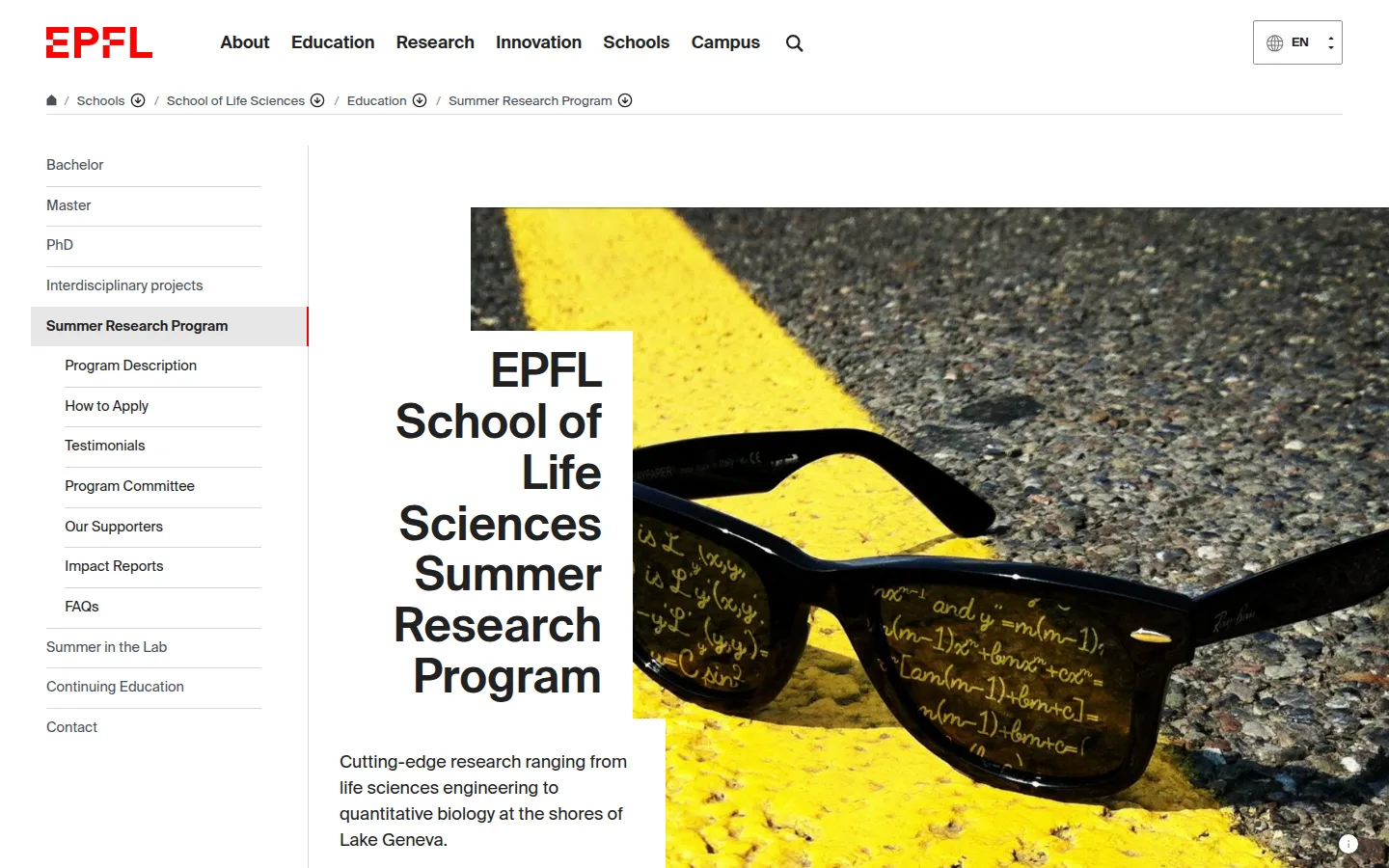
The EPFL School of Life Sciences Summer Research Program is an eight-week, funded research placement in Lausanne for students in biology, biophysics, chemistry, bioengineering, bioinformatics, quantitative biology, and related fields. The 2027 programme runs from 5 July to 27 August 2027, and the application deadline is 15 November 2026 at 23:59 CET. Participants receive CHF 3,600, with housing arranged and paid from the stipend, plus travel reimbursement of up to CHF 1,000 for overseas flights.
The short answer
2027 applications are open, but the window is short. EPFL's Summer Research Program closes on 15 November 2026 at 23:59 CET, and the programme runs from 5 July to 27 August 2027. EPFL expects 20–25 participants and says it received more than 1,300 applications for 25 places in 2026, so selection is competitive.
The offer is an eight-week lab placement with a CHF 3,600 stipend, housing paid from that stipend, and travel reimbursement of up to CHF 1,000 for overseas flights or CHF 500 for shorter distances. You must be enrolled in a life-sciences-related degree, have completed at least two years of undergraduate work up to the first year of a master's, and meet the GPA or class-rank threshold. PhD students are not eligible.
EPFL Life Sciences Summer Research Program at a glance
EPFL describes the schedule as fixed: students must be present for the entire programme, and the programme says it cannot accommodate a late arrival or an early departure. The dates do not match every university calendar, so check your term dates before applying.
| Item | What EPFL publishes |
|---|---|
| Host institution | École polytechnique fédérale de Lausanne (EPFL), School of Life Sciences |
| Location | Lausanne, Switzerland; some labs are at Campus Biotech in Geneva |
| Programme dates | 5 July–27 August 2027 |
| Length | Eight weeks, full time, on site |
| Cohort | 20–25 participants |
| Application deadline | 15 November 2026, 23:59 CET |
| Decision | All applicants receive an email before 20 December 2026 |
| Stipend | CHF 3,600 for the two-month period |
| Housing | Reserved and paid from the stipend; about CHF 1,700 remains for living costs |
| Travel | Up to CHF 1,000 for overseas flights; up to CHF 500 for shorter distances |
| Eligibility | Current life-sciences student; two years of undergraduate work up to first-year master's; GPA 3.75/4.0 or top 5% |
| Application | EPFL online form, completed in one sitting |
What the eight weeks involve
Participants join a research group in EPFL's School of Life Sciences and work on a current project. EPFL lists more than 30 participating labs for 2027, covering areas such as bioengineering, cancer research, cell and developmental biology, computational neuroscience, microbiology, neuroengineering, protein engineering, synthetic biology, and virology. The lab list includes groups in Lausanne and a smaller number at Campus Biotech in Geneva.
The working week is usually around 40 hours, but the exact schedule depends on the project. EPFL notes that some projects, such as cell culture work, may require weekend hours. Students are mentored by faculty and scientific staff, attend scientific seminars, and take part in Friday afternoon workshops on science-related and personal-development topics. The programme closes with a symposium and poster session or presentations from all participants.
The programme is not only bench work. EPFL organises social activities, including a day hike in the Swiss Alps with raclette, barbecues, and possible excursions to places such as CERN. The programme says workshops and activities are mandatory, not optional extras.
If you are assigned to a Geneva lab, you should expect to travel between Lausanne and Geneva. EPFL says the trip takes about one hour and 15 minutes each way. Housing remains in Lausanne, and the larger Geneva stipend is intended to cover the extra travel costs.
Who is eligible
EPFL's eligibility rules are specific. You must be currently enrolled in a university degree programme in biology, biophysics, chemistry, bioengineering, bioinformatics, quantitative biology, genetics, medical, or another life-sciences-related field. You must have completed at least two years of undergraduate work, up to the first year of a master's degree, before the programme starts.
The academic threshold is high. EPFL asks for a GPA equivalent to 3.75/4.0 or higher, or a position in the top 5% of your class. If your school uses a different grading scale, EPFL says you can enter another short format, explain the scale on your transcript, or use class rank as evidence. The programme is competitive, and EPFL says applicants just below the GPA threshold may still be evaluated but have a low chance of selection.
- You must be enrolled for the entire programme. PhD students are not eligible.
- If you have finished your bachelor's and are not yet in a master's programme, you can apply if you have confirmed a place in a life-sciences-related master's and will be enrolled by the programme start date.
- The programme focuses on human life sciences. EPFL says it does not select students whose background is animal science (veterinary) or plant science.
- Research experience is not required, but basic life-sciences understanding is essential and previous lab experience is a plus.
- EPFL does not require an English test. It may invite applicants to a Zoom call to check English during evaluation.
- You must be available on site for the full eight weeks, from 5 July to 27 August 2027.
Stipend, housing, and travel costs
EPFL pays each student CHF 3,600 for the two-month period. The programme describes this as a stipend that covers housing and living costs, not a salary. Housing is reserved and paid for out of the stipend before arrival, leaving approximately CHF 1,700 to live on. Students usually have single rooms and share kitchen and bathroom facilities with other participants. EPFL says it cannot make special housing arrangements.
Travel is reimbursed after the programme. EPFL reimburses up to CHF 1,000 for overseas flights and up to CHF 500 for shorter distances. Students working in Geneva labs receive a larger stipend to cover most of their travel to and from the programme, plus the extra cost of travelling to Geneva. The programme does not cover weekend tourism or other personal spending, so bring your own money for that.
If you need a visa, EPFL provides an invitation letter and instructions. The programme warns that a Swiss visa can take more than three months and says you should not start the visa process before receiving its instructions.
| Cost or support | What EPFL publishes |
|---|---|
| Stipend | CHF 3,600 for the two-month programme |
| Housing | Reserved and paid from the stipend before arrival |
| Living costs | About CHF 1,700 left after housing |
| Overseas travel | Reimbursed up to CHF 1,000 after the programme |
| Shorter-distance travel | Reimbursed up to CHF 500 after the programme |
| Geneva labs | Larger stipend to cover most travel and the extra commute |
| Visa | Invitation letter and instructions; allow more than three months |
| Personal spending | Not covered; bring your own money for weekends and tourism |
Documents and essay questions
The EPFL application must be completed in one sitting. There is no save-and-return option, so prepare your transcript, short essay answers, and referee details before you start. The application asks for your top three lab choices and a set of personal and scientific essays. EPFL says the essays replace the CV and motivation letter.
The personal essay questions ask for your top three accomplishments or awards (1,000 characters including spaces), internship programmes you have attended (800 characters), relevant professional experience (800 characters), the key strengths you would bring to the programme (800 characters), what motivates you to pursue science (800 characters), and your hobbies and interests (800 characters). You will also be asked how you used AI to prepare your application.
For each lab choice, EPFL asks three scientific questions: which specific aspects of the lab's research interest you (800 characters), which skills or techniques you want to acquire (800 characters), and whether there is a particular project you would like to pursue, with justifications and citations to relevant papers (800 characters). If you are interested in fewer than three labs, choose “none” in the menu and write “n/a” or a short explanation.
- Transcript: English, Spanish, French, German, Portuguese, and Italian transcripts are accepted. For other languages, include the original and an English translation; you may translate it yourself, and a faculty member can sign to verify it if possible.
- Official transcripts are preferred, but EPFL accepts unofficial transcripts or screenshots from your university portal if official copies are unavailable or too expensive.
- Master's applicants should upload both bachelor's and master's transcripts. First-semester master's students who do not yet have grades should upload a list of current courses.
- One letter of recommendation is required. The referee receives an upload link only after you submit the application, and the referee portal remains open until 15 November 2026 at 23:59 CET.
- EPFL does not ask for a CV, a motivation letter, or an English test score.
How to choose your labs
The lab choice is part of the application, not a separate step after admission. EPFL evaluates your application with input from your top three labs, and lab assignments are finalised when the cohort is selected. Read the lab pages before you write the scientific essays, and choose groups whose current projects match your coursework, techniques, and research interests.
Popular labs receive more applications, so a list made only of the most visible groups can reduce your chances. EPFL also asks you to explain what you want to learn from each lab, not just why the lab is prestigious. If you are genuinely interested in only one or two groups, use the “none” option rather than inventing a third choice.
Selection timeline
EPFL publishes a short timeline. The application deadline is 15 November 2026 at 23:59 CET. All applicants receive an email about their result before 20 December 2026; the how-to-apply page describes the wait as about six weeks after the deadline. The programme then runs from 5 July to 27 August 2027.
The programme may invite applicants to a Zoom call during evaluation to check English. It does not require a formal English certificate. Decisions are competitive, and EPFL says it received more than 1,300 applications for 25 places in 2026.
| Stage | Date |
|---|---|
| Application deadline | 15 November 2026, 23:59 CET |
| Results emailed | Before 20 December 2026 |
| Programme starts | 5 July 2027 |
| Programme ends | 27 August 2027 |
Application checklist
- Confirm that you will be enrolled in a life-sciences-related degree for the entire programme and that you meet the two-year undergraduate rule.
- Check your GPA against the 3.75/4.0 threshold or confirm that you are in the top 5% of your class.
- Shortlist three labs from the 2027 list and read their recent papers before drafting the scientific essays.
- Draft the six personal answers and the three lab-specific answers within the character limits.
- Ask one referee in advance and confirm they can upload a letter through EPFL's link after you submit.
- Prepare your transcript, including an English translation if needed, and a list of current courses if you are a first-semester master's student.
- Block enough time to complete the form in one sitting; there is no save-and-return option.
- Submit before 23:59 CET on 15 November 2026 and check that the referee upload link has reached your referee.
Common mistakes to avoid
- Starting the form before your transcript, essays, and referee details are ready. EPFL does not let you save and return.
- Assuming the referee letter is sent automatically before you submit. The link is triggered only after submission.
- Applying as a PhD student or as someone outside the two-year-to-first-year-master's window.
- Planning to arrive late or leave early. EPFL requires attendance for the entire eight weeks.
- Choosing only popular labs or naming a third lab you do not actually want to join.
- Treating the CHF 3,600 stipend as spending money. Housing is deducted first, leaving about CHF 1,700.
- Starting a visa application before EPFL sends its instructions.
- Missing the CET deadline or assuming the programme follows your local time zone.
How to apply
Applications are handled by École polytechnique fédérale de Lausanne (EPFL), not by Feynman Research Labs. Start from the official application page and check that the call is open before preparing documents.
The published deadline is 15 November 2026. Confirm the exact cutoff and time zone on the official page; do not rely on a third-party summary.
Sources and verification
This guide was checked against the official École polytechnique fédérale de Lausanne (EPFL) page on 11 November 2026. The provider can change eligibility, funding, or dates at any time. Confirm every fact before applying.
Frequently asked questions
- Is the EPFL Life Sciences Summer Research Program 2027 open?
- Yes. EPFL's 2027 call is open and closes on 15 November 2026 at 23:59 CET. The programme runs from 5 July to 27 August 2027.
- How much does the EPFL life-sciences summer programme pay?
- Each student receives CHF 3,600 for the two-month period. Housing is reserved and paid from the stipend, leaving about CHF 1,700 for living costs. EPFL also reimburses up to CHF 1,000 for overseas travel or CHF 500 for shorter distances.
- Who is eligible for the EPFL Life Sciences Summer Research Program?
- Applicants must be enrolled in a life-sciences-related degree, have completed at least two years of undergraduate work up to the first year of a master's by the programme start, and have a GPA equivalent to 3.75/4.0 or be in the top 5% of their class. PhD students are not eligible.
- Do I need a CV or motivation letter for the EPFL summer programme?
- No. EPFL says the personal and scientific essay questions replace the CV and motivation letter. You do need one letter of recommendation, transcripts, and answers to the essay questions.
- Can I apply if I have finished my bachelor's but have not started a master's?
- Yes, if you have confirmed a place in a life-sciences-related master's programme and will be enrolled as a student by the programme start date. You must be enrolled for the entire programme.
- Do I need an English proficiency test for the EPFL summer programme?
- No. EPFL does not require an English certificate, but it may invite applicants to a Zoom call to check English during evaluation.
- Can I choose fewer than three EPFL labs?
- Yes. EPFL asks for up to three lab choices. If you are interested in only one or two, choose “none” in the menu for the remaining choice and explain briefly rather than naming a lab you do not want.
- When will I hear back from the EPFL summer programme?
- EPFL says all applicants will receive an email about their result before 20 December 2026. The programme describes the wait as about six weeks after the 15 November 2026 deadline.
Official application link
Apply through EPFL's online form
The 2027 call closes on 15 November 2026 at 23:59 CET. EPFL controls eligibility, funding, and dates; confirm every detail on the official pages before applying.
Open official page

