
Academic guides · Guide
ICFO Summer Fellows Program: Stipend, Eligibility and 2027 Status
StatusClosed
ICFO's three-month summer fellowship pays €600 a month and prioritises students at Spanish universities. The 2026 call has closed and the 2027 call is not yet published.
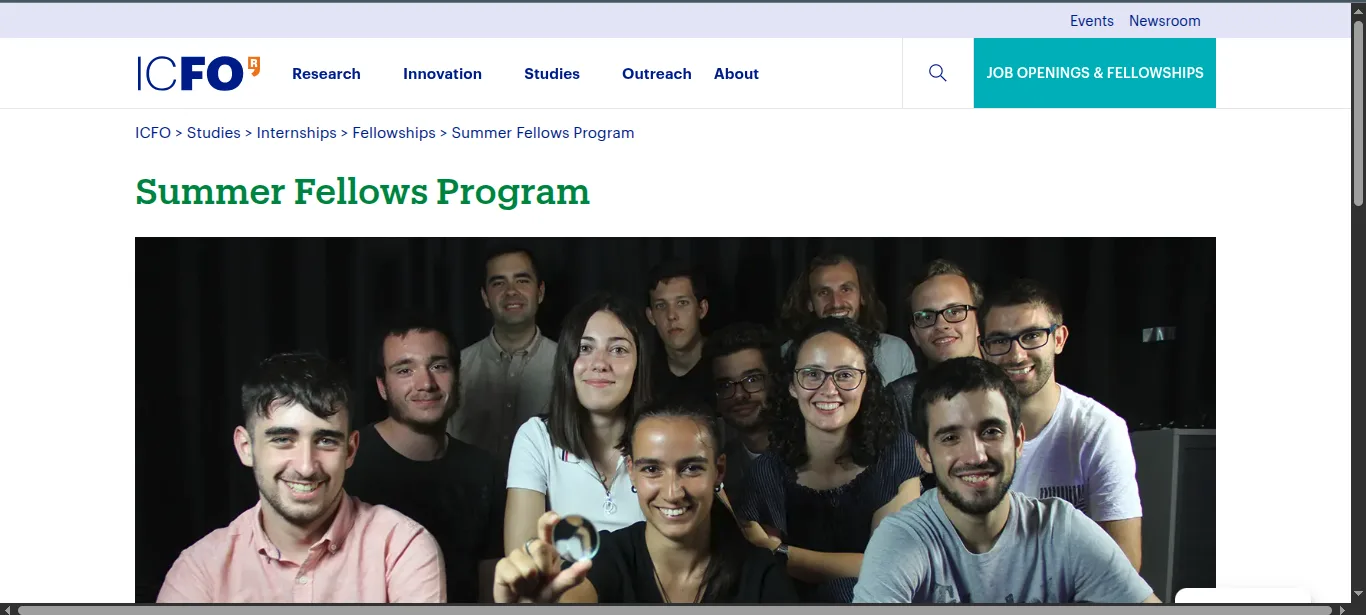
ICFO's Summer Fellows Program is a three-month, full-time summer research stay at the Institute of Photonic Sciences in Castelldefels, on the outskirts of Barcelona. The 2026 call offered a gross stipend of €600 per month, ran for approximately twelve weeks between June and September, and closed on 1 March 2026. As of 12 November 2026, ICFO's fellowships page says there are no calls available for under- and postgraduate students, and no 2027 call has been published.
The programme is aimed at outstanding students who are typically in the final two years of a Master's-equivalent or Engineering degree, in physics, engineering, chemistry, mathematics or biology. The 2026 call was mostly focused on students enrolled at Spanish universities, who were given priority. International applicants were not excluded, but ICFO strongly encouraged eligible international undergraduates to use its separate Student Research Fellowships route instead. That distinction is the most important thing to understand before planning an application.
The short answer
The Summer Fellows Program is not currently open. The 2026 edition has finished, and ICFO's official fellowships page lists no open under- or postgraduate calls. The programme's own page says it is launched each January, so a 2027 call is plausible, but ICFO has not confirmed that it will run, when it will open, what it will pay, or whether the Spanish-university priority will remain.
What is confirmed is the shape of the 2026 opportunity: three months of full-time research in an ICFO group, a dedicated training programme of lectures, lab tours and workshops, a €600 monthly gross stipend, and coverage of eligible travel expenses. The fellowship was non-renewable, and ICFO said decisions would be communicated by the end of April 2026.
Quick Facts
| Item | What ICFO published |
|---|---|
| Host | ICFO, the Institute of Photonic Sciences |
| Location | Castelldefels, Barcelona, Spain |
| Opportunity type | Full-time summer research fellowship |
| Duration | Three months, approximately twelve weeks, between June and September |
| Who it is for | Outstanding students, typically in the final two years of a Master's-equivalent or Engineering degree |
| Eligible fields | Physics, engineering, chemistry, mathematics and biology |
| Funding | €600 per month gross in the 2026 call, plus eligible travel expenses |
| Renewal | Non-renewable |
| Application status | Closed for 2026; no under- or postgraduate calls open as of 12 November 2026 |
| 2026 deadline | 1 March 2026 |
| Decisions | By the end of April 2026 for the 2026 call |
| Official portal | ICFOjobs, the institute's online application system |
What the Summer Fellows Program is
ICFO describes its Summer Fellows as outstanding and highly motivated students who join its research groups for a three-month stay during the summer period. The programme combines a research project with a focused training and skills-development programme. Fellows spend approximately twelve weeks in full-time research under the supervision and mentorship of an ICFO Group Leader.
This is not a taught summer school. The research project is the centre of the placement. ICFO says projects may be undertaken with any research group, and it publishes a long, non-exhaustive list of research lines so that applicants can identify where their interests fit. Around the project, the cohort takes part in lectures, lab tours and workshops designed to strengthen their understanding of the photonics research landscape and to build transferable skills. Fellows are also encouraged to attend the institute's seminar programme, including near-daily research seminars and the ICFO Colloquium series.
The programme has a cohort structure. ICFO presents it as a way to give students early exposure to frontier science and the experience of working in a research group, with social and professional activities as part of the experience.
ICFO is a photonics research institute rather than a university department. Its work spans fundamental and applied optics, and the summer programme is one of several routes through which students can spend time there. The institute also runs PhD fellowships, postdoctoral training and other internship schemes, so applicants should read the specific call rather than assuming that one programme's terms apply to another.
Where you would work and what you would research
The 2026 call listed research lines rather than fixed projects. The list included atto-science, ultrafast optics and nonlinear optics; photovoltaics, thermal photonics and solar fuels; optical sensing and optoelectronics; nanophotonics and nanomechanics; ultracold quantum gases; quantum and low-dimensional materials; quantum communications, sensing and simulation; quantum optics and quantum information; nanophotonics, condensed matter physics and light-matter interactions; medical optics; and biophysics, biophotonics and super-resolution imaging.
That list is broad, and it is meant to be. ICFO says projects may be undertaken with any research group and that the research lines are not limited to those examples. Applicants are expected to browse the group profiles on the ICFO website and identify the groups that best match their interests. The motivation letter must state the research group or groups of interest, so this is not a step that can be left until after submission.
The institute's research is organised into areas that include advanced and quantum materials, energy and environment, quantum science and technologies, bio-nano and medical photonics, light-matter interactions, and ultrafast science. Those labels are useful for orientation, but the group pages are more specific. A credible application will name a group and explain why its recent work connects to the applicant's preparation, rather than listing several unrelated groups in the hope that one will respond.
ICFO's call does not state whether housing is provided, so accommodation and living costs should be treated as the fellow's responsibility unless a future call says otherwise.
The training programme
The training component is one of the features that distinguishes the Summer Fellows Program from a straightforward internship. ICFO says the programme includes lectures, lab tours and workshops aimed at strengthening fellows' understanding of the photonics research landscape, expanding transferable skills, and fostering networking and community building through professional and social activities.
Fellows are also encouraged to attend the institute's vibrant seminar programme, including near-daily research seminars and the ICFO Colloquium series. That exposure is part of the value of being at a research institute rather than a single laboratory: the colloquium brings in speakers from across photonics and adjacent fields, and the seminar programme covers the institute's diverse research topics and applications.
The call does not publish a syllabus, a list of workshops, or a credit equivalence. Applicants should not assume that the programme carries ECTS credits or substitutes for a university course; its content is likely to change from year to year.
Who is eligible
ICFO's 2026 call described the programme as attracting outstanding students, ideally within the last two years of their Master's-equivalent or Engineering degree studies. Eligible areas included physics, engineering, chemistry, mathematics and biology. That is a broad disciplinary range, but it is not unrestricted: the call is aimed at students with a background that can support a photonics research project.
The most consequential eligibility rule in the 2026 call was institutional, not academic. ICFO said the summer programme was mostly focused on students enrolled in Spanish universities, who would be given priority. It added that outstanding international applicants might be considered, but that eligible international undergraduate students were strongly encouraged to apply to the Student Research Fellowships programme instead. In practice, an applicant from outside Spain should treat the Summer Fellows Program as a long shot and the Student Research Fellowships as the more realistic route.
The call did not publish a minimum GPA, a required year of study, a nationality rule, or an English-test requirement. It did require the application materials to be in English, and it described the selection as based on merit and potential using the submitted application material.
One point needs care: the programme page describes the target group as students typically in the final two years of a Master's-equivalent or Engineering degree, while the 2026 call also refers to "undergraduate students" in its description of the research experience. The call's eligibility section is the more specific document. Applicants should read the eligibility section of the current call rather than relying on the general programme page.
Funding and costs
The 2026 call offered a stipend of €600 per month gross for full-time dedication. The fellowship lasted three months, so the gross stipend for the full period would be €1,800, before any tax or social-security deductions. ICFO also said eligible travel expenses would be covered. The fellowship was non-renewable, and the standard duration was three months, although specific conditions could be negotiated during the selection process.
ICFO did not state on the 2026 call whether accommodation, meals, health insurance, visa fees or local transport were covered. It also did not publish a housing allowance or a relocation grant. The stipend should therefore be treated as a contribution to living costs, not as a full funding package. Barcelona-area accommodation is a significant cost, and applicants should budget for it unless a future call states otherwise.
The call said the fellowship was for full-time dedication. The programme is structured as a full-time research stay, and the training activities are part of the commitment.
How to apply
The 2026 application had four required documents, all in English:
- A presentation or motivation letter stating the research group or groups of interest and answering the question of why the summer programme would benefit the applicant's career.
- A curriculum vitae including contact details.
- Scanned academic transcripts for the undergraduate degree and for any postgraduate study.
- The name and contact details of one potential referee whom ICFO may contact if necessary.
Applications were submitted through ICFOjobs, the institute's online application interface. The call warned that it was the candidate's responsibility to ensure all required material was complete before submitting.
The 2026 deadline was 1 March 2026. ICFO did not publish a time of day in the call. Applicants should not assume that a future deadline will fall on the same date, and they should confirm the cutoff in ICFOjobs if a new call opens.
The application is not the whole process. ICFO describes a review sequence in which applications are first checked for eligibility, then ranked by a Selection Committee, then passed to a matching stage with one or more Group Leaders. The matching stage includes a discussion of research interests, suitability for a potential project, duration of the stay and other conditions. ICFO says an interview, either in person or online, is a fundamental part of the procedure. If the candidate and a Group Leader agree to a match, ICFO issues an official fellowship offer.
How selection works
The selection process has three distinct filters. The first is eligibility: ICFO checks that the application meets the requirements and conditions of the call. The second is comparative ranking by the Selection Committee, based on the submitted material. The third is matching, where the top-ranked candidates discuss a potential project with Group Leaders and either reach an agreement or do not.
That structure explains why the motivation letter matters. A letter that names specific groups, explains why their research connects to the applicant's coursework or prior projects, and gives a concrete reason why the programme would advance the applicant's career gives both the committee and the Group Leader something to work with.
The interview is described as fundamental, not optional. Applicants should be prepared to discuss their research interests, their preparation and what they could contribute to a group. ICFO says the matching stage also covers the duration of the stay and other conditions, so it is a two-way negotiation rather than a pure selection interview.
For the Summer Fellows call, applicants provided one referee's contact details rather than a letter. Choose a referee who knows your research potential, ask permission before submitting the name, and brief them on the call so they are not surprised by contact.
Timeline and current status
The 2026 cycle is closed. Applications were due on 1 March 2026, and ICFO said all applicants would be notified of the decision in their case by the end of April 2026. The fellowships then ran for three months between June and September 2026.
As of 12 November 2026, the fellowships landing page says "No calls available for Under- and Postgraduate Students." The Summer Fellows programme page still describes the programme and says it is launched each January, with more information on the ICFO jobs page. That is the strongest signal about timing, but it is not an announcement of a 2027 call.
The 2027 cycle is therefore unconfirmed. ICFO has not published a 2027 start date, application window, deadline, stipend, eligibility rule or decision date. Applicants should monitor the fellowships page and the ICFOjobs openings rather than assuming that the 2026 dates will repeat. If a call opens in January 2027, the deadline could fall in March again, but that would be a pattern, not a promise.
There is a second route to watch. ICFO's Student Research Fellowships are open to undergraduate and master's students worldwide, and ICFO says calls are launched twice a year in February and October. That programme has a different eligibility focus from the Summer Fellows Program, and it may be the better route for international applicants. The Student Research Fellowships page should be checked separately.
What makes a credible application
The strongest applications will do three things that ICFO's process rewards.
First, they will name a specific group or a small, coherent set of groups. ICFO asks for the research group or groups of interest in the motivation letter. A list of ten groups suggests that the applicant has not done the work. Two or three groups with a clear intellectual connection is more credible, and one group with a specific reason is stronger still.
Second, they will connect the applicant's preparation to the group's work. ICFO's research lines range from attosecond science to medical optics, and the institute does not expect every applicant to have a photonics background. It does expect applicants to explain why their physics, engineering, chemistry, mathematics or biology training prepares them for a particular project. Coursework, final-year projects, programming, laboratory experience and independent reading can all be relevant.
Third, they will treat the referee as part of the application. Choose someone who knows the applicant's research potential and can speak to specific work, ask permission before submitting the name, and brief the referee on the call.
The Spanish-university priority is not a formality. International applicants can still be considered, but the 2026 call explicitly directed them towards the Student Research Fellowships. A credible international application should either make a strong case for why the Summer Fellows Program is the right route or switch to the route that ICFO recommends.
What is confirmed and what is not yet announced
Confirmed for the 2026 cycle: the three-month duration between June and September; approximately twelve weeks of full-time research; supervision by an ICFO Group Leader; the training programme of lectures, lab tours and workshops; the €600 monthly gross stipend; coverage of eligible travel expenses; the non-renewable term; the four application documents; the 1 March 2026 deadline; the eligibility check, committee ranking and matching interview; and decisions by the end of April 2026.
Confirmed about the programme's design: ICFO describes the Summer Fellows as students typically in the final two years of a Master's-equivalent or Engineering degree; the programme is launched each January; projects may be undertaken with any research group; and the research lines cover the broad areas listed above.
Not announced: whether a 2027 call will run; its opening date, deadline, start and end dates; its stipend and travel terms; whether housing or insurance will be provided; whether the Spanish-university priority will remain; the number of fellows; and the decision date. ICFO's pages can change, so check the current call before relying on any 2026 detail.
Sources
- ICFO, "Summer Fellows Program," accessed 12 November 2026
- ICFO, "Fellowships," accessed 12 November 2026
- ICFOjobs, "ICFO Summer Fellowships 2026," accessed 12 November 2026
- ICFO, "Student Research Fellowships," accessed 12 November 2026
- ICFO, "Research Groups," accessed 12 November 2026
- ICFO, "ICFOjobs," accessed 12 November 2026
Frequently asked questions
- Is the ICFO Summer Fellows Program open for 2027?
- No. As of 12 November 2026, ICFO's fellowships page says there are no calls available for under- and postgraduate students. The 2026 Summer Fellows call closed on 1 March 2026, and ICFO has not published a 2027 call. ICFO says the programme is launched each January, but that is a pattern rather than a confirmed 2027 date.
- How much does the ICFO Summer Fellows Program pay?
- The 2026 call offered a stipend of €600 per month gross for full-time dedication over three months, and said eligible travel expenses are covered. The fellowship is non-renewable. ICFO has not confirmed the stipend or travel terms for a future call.
- Who is eligible for the ICFO Summer Fellows Program?
- ICFO says the programme attracts outstanding students, typically in the final two years of a Master's-equivalent or Engineering degree, in physics, engineering, chemistry, mathematics or biology. The 2026 call was mostly focused on students enrolled at Spanish universities, who were given priority.
- Can international students apply to the ICFO Summer Fellows Program?
- Outstanding international applicants may be considered, but the 2026 call said it was mostly focused on students enrolled at Spanish universities and that those students would be given priority. ICFO strongly encouraged eligible international undergraduate students to apply to its Student Research Fellowships instead.
- What documents does the ICFO Summer Fellows application require?
- The 2026 call asked for a presentation or motivation letter naming the research group or groups of interest and explaining why the programme would benefit the applicant's career, a CV in English, scanned academic transcripts for the undergraduate degree and any postgraduate study, and the name and contact details of one potential referee.
- Is the ICFO Summer Fellows Program remote?
- No. The fellowship is a full-time research stay of approximately twelve weeks at ICFO in Castelldefels, on the outskirts of Barcelona, between June and September. Fellows work under the supervision of an ICFO Group Leader.
- What is the difference between the Summer Fellows Program and ICFO's Student Research Fellowships?
- The Summer Fellows Program is a three-month summer cohort with a dedicated training programme, launched each January and focused mainly on students at Spanish universities in the 2026 call. Student Research Fellowships are open to undergraduate and master's students worldwide, with calls launched twice a year in February and October.
- When are ICFO Summer Fellows decisions announced?
- For the 2026 call, ICFO said all applicants would be notified of the decision in their case by the end of April 2026. ICFO has not published a decision date for a future cycle.
Official application link
Check ICFO's official job and fellowship openings
ICFO's fellowships page listed no open under- or postgraduate calls on 12 November 2026. The 2026 Summer Fellows call closed on 1 March 2026, and no 2027 call has been published.
Open official page

