
Academic guides · Guide
ICTP Postdoctoral Fellowships: 2027 Calls, Pay and Eligibility
StatusOpen
ICTP advertises postdoctoral fellowships section by section, not through one central call. The 2027 mathematics call closes on 13 December 2026 and pays €2,100–2,300 a month.
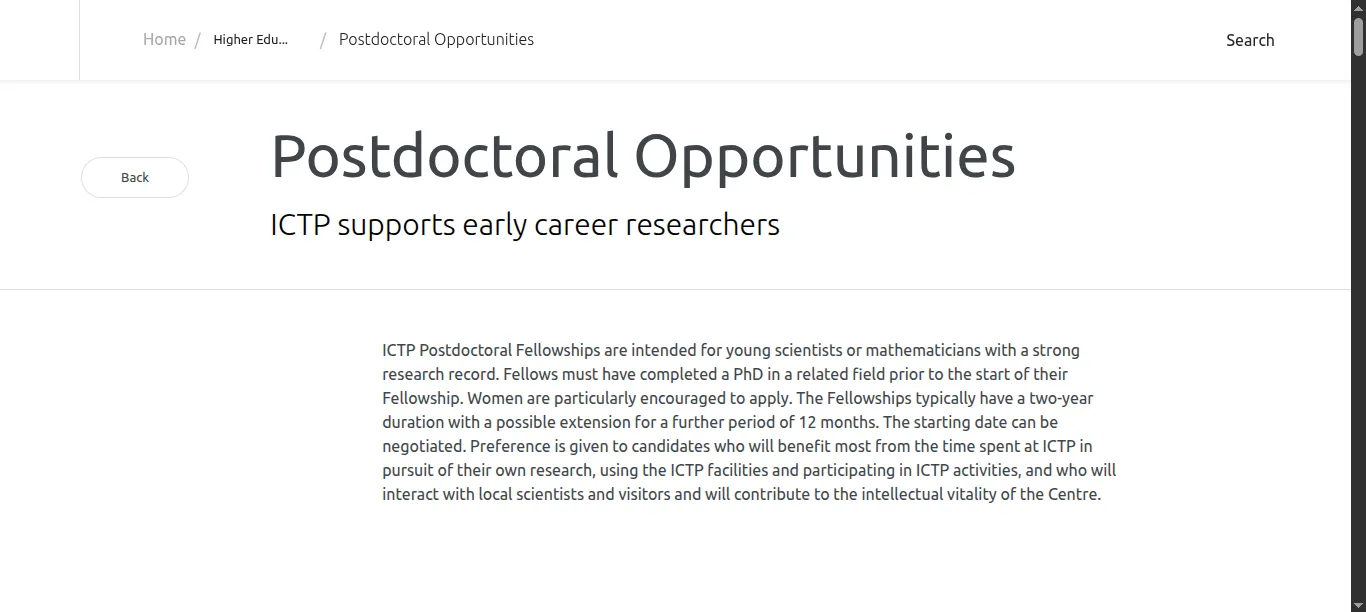
ICTP's postdoctoral fellowships are a set of section-specific opportunities at the Abdus Salam International Centre for Theoretical Physics in Trieste, Italy, rather than a single central fellowship with one deadline. As of 12 November 2026, two 2027 calls are open: Mathematics Postdoctoral Positions 2027, with a deadline of 13 December 2026 and a tax-free monthly stipend of EUR 2,100 to EUR 2,300, and the CMSP Postdoctoral Position 2027, with a deadline of 28 February 2027. Many other opportunities on ICTP's Postdoctoral Opportunities page say "Call: To be announced."
That structure is the first thing to understand. There is no single ICTP postdoctoral application that covers every research section. Applicants need to identify the section that matches their field, read that call, and apply through its own online link.
The short answer
ICTP is a UNESCO Category 1 institute governed by the IAEA, Italy and UNESCO. Its postdoctoral fellowships are intended for young scientists or mathematicians with a strong research record. Fellows must have completed a PhD in a related field before the fellowship starts, women are particularly encouraged to apply, and the fellowships typically last two years with a possible 12-month extension. The starting date can be negotiated.
The two confirmed 2027 opportunities are in mathematics and condensed matter and statistical physics. The mathematics call is the more financially detailed: it publishes a tax-free monthly stipend, a yearly travel grant, a pension contribution, family allowances and health insurance. The CMSP call says ICTP offers "internationally competitive remuneration" and a number of benefits, but it does not publish an amount.
Quick Facts
| Item | What ICTP publishes |
|---|---|
| Host | Abdus Salam International Centre for Theoretical Physics (ICTP) |
| Location | Trieste, Italy |
| Opportunity type | Postdoctoral research fellowships, advertised by research section |
| Duration | Typically two years, with a possible 12-month extension |
| Eligibility | PhD in a related field completed before the start; strong research record |
| Mathematics 2027 pay | EUR 2,100–2,300 tax-free per month, depending on seniority |
| Mathematics 2027 benefits | EUR 2,000 per year travel grant, pension contribution, family allowances, Henner health insurance |
| CMSP 2027 pay | "Internationally competitive remuneration"; amount not stated |
| Open 2027 calls | Mathematics (deadline 13 December 2026); CMSP (deadline 28 February 2027) |
| Other calls | Many listed as "Call: To be announced" |
| Application system | ICTP online e-applications portal, with a separate link for each call |
What ICTP is and how its postdoctoral funding works
ICTP is an international research centre in Trieste, in north-eastern Italy. It is governed by the International Atomic Energy Agency, the Italian government and UNESCO, and it is a UNESCO Category 1 Institute. Its research is organised into six sections: High Energy, Cosmology and Astroparticle Physics; Condensed Matter and Statistical Physics; Mathematics; Earth System Physics; Quantitative Life Sciences; and Science, Technology and Innovation.
The postdoctoral programme is part of ICTP's higher education and career development work. The centre describes its fellowships as support for early-career researchers, and the general framework is consistent across sections: a PhD is required before the start, the research record must be strong, and the fellowship is intended to let the fellow pursue their own research while participating in ICTP's activities. The centre also says preference is given to candidates who will benefit most from using ICTP's facilities and participating in its activities, who will interact with local scientists and visitors, and who will contribute to the intellectual vitality of the centre.
The section structure matters because funding, duration and deadlines are set by the individual call. A mathematics fellowship and a CMSP fellowship are both ICTP postdocs, but they are not interchangeable. The mathematics call publishes a salary range and a specific benefits package; the CMSP call leaves the remuneration amount unstated. Applicants should read the call for their section rather than relying on a general ICTP description.
The two open 2027 calls
| Feature | Mathematics Postdoctoral Positions 2027 | CMSP Postdoctoral Position 2027 |
|---|---|---|
| Section | Mathematics | Condensed Matter and Statistical Physics |
| Start | 2027; starting date negotiable | Fall 2027 |
| Duration | 24 months, possible 12-month extension | Two years, possible one-year renewal |
| PhD required | PhD in mathematics | PhD in physics or related disciplines |
| Nationality | No restriction stated; preference for candidates from and working in developing countries | Any nationality |
| Deadline | 13 December 2026 | 28 February 2027 |
| Pay | EUR 2,100–2,300 tax-free per month, depending on seniority | "Internationally competitive remuneration"; amount not stated |
| Other benefits | EUR 2,000 per year travel grant, pension contribution, family allowances, Henner health insurance | "A number of benefits"; details not stated |
| Application | ICTP online application, two reference letters required | ICTP online application |
The two calls also differ in emphasis. The mathematics call gives explicit preference to candidates who are from, and working in, developing countries. The CMSP call is open to any nationality and gives priority to applicants in the section's areas of expertise and to candidates who obtained their PhD after 2022. Both calls encourage women to apply, and the CMSP wording is particularly direct: "Female candidates are strongly encouraged to apply."
Mathematics 2027 in detail
The mathematics call is for postdoctoral fellowships starting in 2027. The appointment is for 24 months, with a possible extension for a further 12 months, and the starting date can be negotiated. ICTP says the fellows pursue their own research and participate in mathematics activities across ICTP, SISSA and the University of Trieste. The duties also include tutorials to Postgraduate Diploma students, organisation of seminars and other Mathematics section academic activities.
The pay and benefits are unusually specific for a postdoctoral call. ICTP lists a tax-free monthly stipend of EUR 2,100 to EUR 2,300 depending on seniority, a travel grant of EUR 2,000 per year, a pension contribution, additional allowances for family members, and health insurance with Henner Insurance Company. Those figures are for the 2027 call and should not be assumed for other sections or future cycles.
Eligibility is equally specific. The fellowship is intended for young mathematicians with a strong research record, and fellows must have completed a PhD in mathematics before the start of the fellowship. Women are particularly encouraged to apply. The call does not state an age limit or a nationality restriction, but it gives preference to candidates who will benefit most from ICTP, who will contribute to its intellectual life, and who are from and working in developing countries.
The application requires two letters of recommendation from established researchers. ICTP says incomplete applications will not be considered. That makes the reference letters part of the application, not an afterthought: applicants should choose referees who know their research and should give them enough time to submit before 13 December 2026.
CMSP 2027 in detail
The CMSP call is for postdoctoral positions starting in fall 2027. The section has about 50 academic members, including faculty, visitors, postdocs and graduate students, and it runs an intense programme of workshops and conferences. It collaborates closely with SISSA, Elettra and the University of Trieste. Fellows are also encouraged and supported to participate in activities in developing countries, in line with ICTP's mission.
The appointment is for two years, with the possibility of renewal for a further year. Candidates must have completed a PhD in physics or a related discipline before the start. ICTP says preference will be given to applicants in the section's areas of expertise and that candidates who obtained their PhD after 2022 will be given priority. The call is open to outstanding young scientists of any nationality, and female candidates are strongly encouraged to apply.
The remuneration is described only as "internationally competitive," with "a number of benefits." The call does not publish a monthly amount, a travel allowance, a pension contribution or an insurance provider. Applicants who need a precise budget should ask the CMSP secretariat at cm@ictp.it before applying rather than assuming that the mathematics package applies.
Other ICTP postdoctoral routes
The Postdoctoral Opportunities page lists many other calls, most of which were marked "Call: To be announced" on 12 November 2026. They include the "Ludwig Boltzmann" Senior Postdoctoral Fellowship in condensed matter and statistical physics, which is a three-year appointment with a possible one-year extension and requires at least one previous postdoctoral experience. They also include Earth System Physics fellowships, Quantitative Life Sciences fellowships, Science, Technology and Innovation fellowships, joint ICTP-Elettra positions, medical physics positions and project-specific posts attached to European Research Council grants.
A page entry is not necessarily an open call. Many entries describe the opportunity and then say "Call: To be announced," meaning ICTP has not published the application window or deadline. Check the status line on each opportunity rather than assuming a call will open.
The "Ludwig Boltzmann" senior fellowship is worth noting because it is a different career stage from the standard postdoc. It requires at least one previous postdoctoral experience and very active, independent research. The standard postdoc calls are aimed at researchers who have recently completed a PhD. Applicants should choose the route that matches their experience rather than applying to every listing.
Eligibility and what a strong research record means
The common eligibility rule is a PhD completed before the fellowship starts. The mathematics call specifies a PhD in mathematics; the CMSP call specifies physics or a related discipline. ICTP does not publish a minimum number of publications, a required journal list, or a fixed citation threshold. "Strong research record" is therefore judged by the section, in the context of the field.
The other common expectations are research independence and fit with the section. ICTP says fellows pursue their own research, so the application needs to show a research programme that can be carried out in Trieste, not just a willingness to join someone else's project. The mathematics call adds a teaching and academic-service component: tutorials to Postgraduate Diploma students, seminar organisation and other section activities. Applicants should be prepared to contribute to those duties.
The development mission is part of ICTP's identity. The mathematics call gives explicit preference to candidates from and working in developing countries. The CMSP call encourages fellows to participate in activities in developing countries. That does not mean other applicants are excluded, but it does mean that a credible application should understand the institution's mission rather than treating ICTP as a generic European postdoc.
Funding and benefits
The mathematics package is the benchmark for what ICTP publishes. The tax-free monthly stipend of EUR 2,100 to EUR 2,300 is the core support, with seniority determining where a fellow falls in the range. The EUR 2,000 annual travel grant supports conference travel and collaboration. The pension contribution, family allowances and Henner health insurance are additional benefits. The call does not state whether accommodation is provided, whether relocation costs are reimbursed, or whether the travel grant can be used for any destination.
The CMSP package is not published in comparable detail. ICTP says the remuneration is internationally competitive and that there are a number of benefits, but it does not give amounts. Applicants should treat the mathematics figures as mathematics-specific and ask the CMSP secretariat for the current terms.
The duration also affects the financial picture. A two-year appointment with a possible extension is a relatively long postdoc by European standards, and it gives fellows time to develop a research programme. The mathematics call's 24-month term plus a possible 12-month extension, and the CMSP call's two-year term plus a possible one-year renewal, are both stated on the individual calls.
How to apply
The application route is the ICTP online e-applications system. Each call has its own link. The mathematics call uses the mathematics application portal; the CMSP call uses the CMSP application portal. Applicants should not send a generic application to a central ICTP address and expect it to be routed to the right section.
The mathematics call requires two letters of recommendation from established researchers, submitted through the application process. ICTP says incomplete applications will not be considered. The CMSP call does not publish a reference-letter requirement on its page, so applicants should check the portal instructions and the section's research areas before submitting.
A credible application will include a research statement that explains what the applicant wants to do at ICTP, why Trieste is the right place for it, and how it connects to the section's expertise. It will also include a CV with publications and talks, and referees who can speak to the applicant's research independence. For the mathematics call, the statement should acknowledge the teaching and seminar duties; for the CMSP call, it should connect to the section's research areas and, where relevant, to the collaborations with SISSA, Elettra and the University of Trieste.
Selection and what makes a credible application
ICTP's selection criteria are section-specific, but the published language points to three tests. The first is research quality: a strong record and the ability to pursue independent work. The second is fit: the applicant's research should connect to the section's areas and to the facilities and collaborations available in Trieste. The third is contribution: ICTP wants fellows who will interact with local scientists and visitors and add to the intellectual life of the centre.
The development mission is a fourth consideration where the call states it. The mathematics call gives preference to candidates from and working in developing countries. The CMSP call frames the fellowship as part of a global mission to promote science in the developing world and encourages fellows to participate in activities in developing countries. Applicants can address that mission directly if it is genuine to their background or plans; a token sentence is unlikely to help.
The strongest applications will be specific about the research programme. A proposal that could have been written for any postdoc in the field is weaker than one that names the ICTP group, explains why the group's work matters for the project, and shows what the applicant would do differently or additionally. The mathematics call's teaching duties and the CMSP call's workshop programme are also opportunities to show that the applicant will contribute to the section, not just consume its resources.
Timeline and current status
As of 12 November 2026, the mathematics 2027 call is open with a deadline of 13 December 2026. The CMSP 2027 call is open with a deadline of 28 February 2027. The mathematics appointment starts in 2027, with a negotiable starting date. The CMSP appointment starts in fall 2027.
Many other ICTP postdoctoral opportunities are listed but marked "Call: To be announced." That includes the Ludwig Boltzmann senior fellowship, several Earth System Physics and Quantitative Life Sciences posts, the STI fellowship and various project-specific positions. There is no central ICTP-wide deadline, and there is no guarantee that a listed opportunity will open on a predictable schedule.
Applicants should check the individual opportunity page for the status line and the application link. The overview page is a directory, not a call. A listing that says "Call: To be announced" is not an invitation to submit an application.
What is confirmed and what is not yet announced
Confirmed for the mathematics 2027 call: the 13 December 2026 deadline; the 24-month term with a possible 12-month extension; the negotiable start; the PhD in mathematics requirement; the EUR 2,100–2,300 tax-free monthly stipend; the EUR 2,000 annual travel grant; the pension contribution, family allowances and Henner health insurance; the two reference letters; and the online application link.
Confirmed for the CMSP 2027 call: the 28 February 2027 deadline; the fall 2027 start; the two-year term with a possible one-year renewal; the PhD in physics or related discipline requirement; the any-nationality rule; the priority for PhDs obtained after 2022 and for the section's areas of expertise; and the online application link.
Not announced: the exact CMSP salary and benefits; whether either call provides housing, relocation support or dependent-specific additional payments beyond those listed; the 2027 timelines for other sections; and whether the listed "To be announced" calls will open at all. ICTP's pages can change, so check the current call before relying on any figure or date.
Sources
- ICTP, "Postdoctoral Opportunities," accessed 12 November 2026
- ICTP, "Mathematics Postdoctoral Positions – 2027," accessed 12 November 2026
- ICTP, "CMSP Postdoctoral Position 2027," accessed 12 November 2026
- ICTP, "Mathematics Postdoctoral Positions 2027 application portal," accessed 12 November 2026
- ICTP, "CMSP Postdoctoral Position 2027 application portal," accessed 12 November 2026
- ICTP, "Research Fields," accessed 12 November 2026
Frequently asked questions
- Is there one central ICTP postdoctoral fellowship call?
- No. ICTP advertises postdoctoral opportunities section by section on its Postdoctoral Opportunities page. Each call has its own research area, duration, eligibility rules, deadline and application link. Some listed opportunities say 'Call: To be announced.'
- What is the deadline for the ICTP Mathematics Postdoctoral Positions 2027?
- The deadline is 13 December 2026. ICTP says incomplete applications will not be considered, and candidates must arrange for two letters of recommendation from established researchers.
- How much does the ICTP mathematics postdoctoral fellowship pay?
- ICTP lists a tax-free monthly stipend of EUR 2,100 to EUR 2,300 depending on seniority, a travel grant of EUR 2,000 per year, a pension contribution, additional allowances for family members, and health insurance with Henner Insurance Company.
- What is the deadline for the ICTP CMSP Postdoctoral Position 2027?
- The CMSP call has a deadline of 28 February 2027. The appointment starts in fall 2027, lasts two years, and may be renewed for a further year.
- Do I need a PhD to apply for an ICTP postdoctoral fellowship?
- Yes. ICTP says fellows must have completed a PhD in a related field before the fellowship starts. The mathematics call requires a PhD in mathematics; the CMSP call requires a PhD in physics or a related discipline.
- How long do ICTP postdoctoral fellowships last?
- ICTP says its postdoctoral fellowships typically have a two-year duration with a possible extension of a further 12 months. The mathematics 2027 call is 24 months with a possible 12-month extension; the CMSP 2027 call is two years with a possible one-year renewal.
- Can researchers of any nationality apply?
- The CMSP 2027 call is open to outstanding young scientists of any nationality. The mathematics call does not state a nationality restriction, but it gives preference to candidates from, and working in, developing countries. Women are particularly encouraged to apply to both calls.
- Are other ICTP postdoctoral calls open now?
- As of 12 November 2026, the mathematics and CMSP 2027 calls are open. Many other opportunities listed on ICTP's Postdoctoral Opportunities page say 'Call: To be announced,' so there is no single ICTP-wide deadline.
Official application link
Check ICTP's official postdoctoral opportunities
ICTP lists postdoctoral calls by research section. The 2027 mathematics call closes on 13 December 2026 and the CMSP call on 28 February 2027; other calls are marked 'To be announced.'
Open official page

