
Academic guides · Guide
ISTernship Summer Fellowship: 2027 Status, Stipend and Eligibility
StatusClosed
ISTA has paused its ISTernship summer fellowship for the 2026 and 2027 cycles. A guide to the programme's research areas, €1,150 monthly stipend and alternatives.
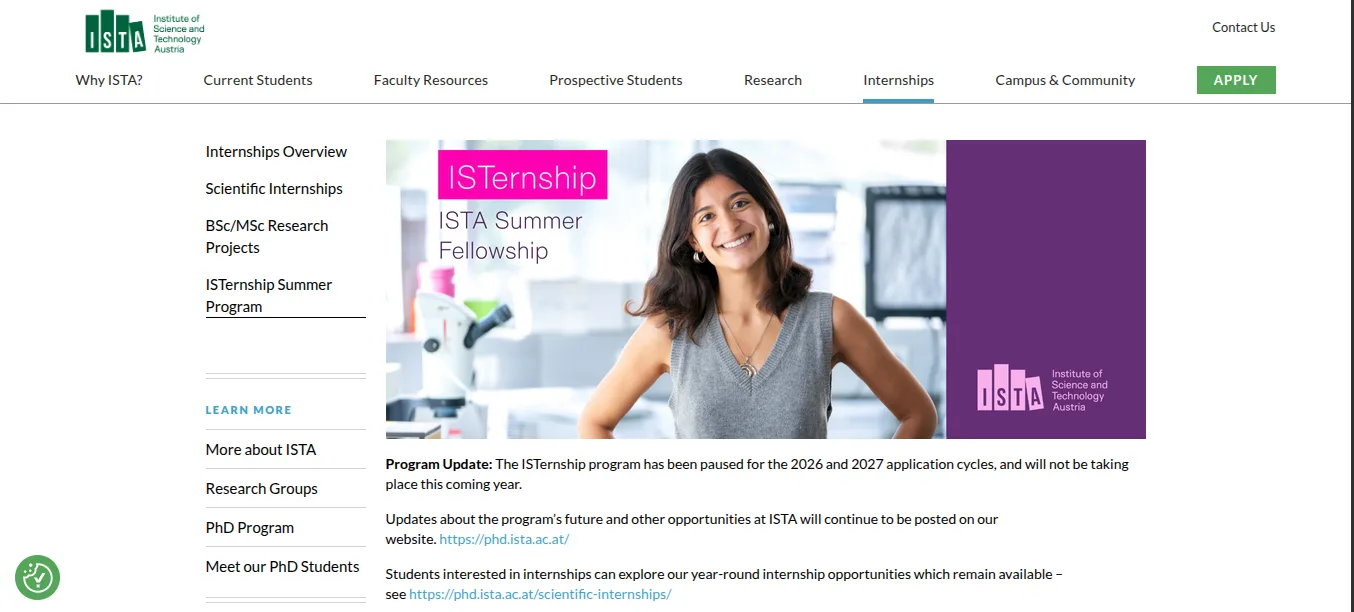
The ISTernship Summer Fellowship is a two- to three-month research programme at the Institute of Science and Technology Austria (ISTA) in Klosterneuburg, near Vienna. ISTA has paused the programme for the 2026 and 2027 application cycles, so there is no ISTernship application to submit in 2026 or 2027. The most recent published terms, from the 2025 cycle, included a monthly fellowship payment of EUR 1,150, a travel lump sum based on distance, and a placement in an ISTA research group between 15 May and 15 September.
The pause is the most important fact for anyone planning a summer at ISTA. The programme's page still describes the fellowship in detail, but it is describing a scheme that is not currently recruiting. ISTA does point students to year-round scientific internships that remain available, and to its PhD programme, which bachelor's and master's students can apply to.
The short answer
ISTernship is paused, not merely closed for the season. ISTA's current banner says the programme has been paused for the 2026 and 2027 application cycles and "will not be taking place this coming year." A lower notice on the same page, which appears to predate the banner, says information about the 2027 cycle would be made available late in 2026. The banner is the more specific statement, and the practical position as of 12 November 2026 is that no ISTernship application is open.
The programme itself is a genuine research fellowship rather than a summer school. ISTerns join an ISTA research group, agree a project with the group, and spend two to three months working on it. The cohort takes part in a tailored programme of events, including a poster session, and ISTA provides administrative support with travel and visas.
Quick Facts
| Item | What ISTA published |
|---|---|
| Host | Institute of Science and Technology Austria (ISTA) |
| Location | Klosterneuburg, near Vienna, Austria |
| Opportunity type | Summer research fellowship for bachelor's and master's students and recent graduates |
| Duration | Two to three months, between 15 May and 15 September |
| Eligibility | Enrolled bachelor's or master's students in good standing, or recent graduates within one year; at least two years of bachelor's study completed |
| Research areas | Biology, computer science, data science and scientific computing, mathematics, physics, neuroscience, chemistry and materials, interdisciplinary areas |
| 2025 stipend | EUR 1,150 per month |
| Travel | Lump sum calculated by distance travelled |
| Health insurance | Not included; paid by the ISTern if needed |
| Housing | Campus guest house or OeAD student residences, subject to availability and cost |
| 2025 application deadline | 5 February 2025, 15:00 CET |
| Current status | Paused for the 2026 and 2027 application cycles |
| Alternative routes | Year-round scientific internships; ISTA PhD programme |
What the ISTernship is
ISTA has run the ISTernship since 2013. Each summer, selected ISTerns from across the world join ISTA for two to three months to work on research projects agreed with ISTA research groups. The programme is aimed at students and recent graduates who want to develop their scientific research skills in an interdisciplinary research institute.
The research project is the core of the fellowship. ISTerns decide the project together with the host research group, and the exact dates and length are settled with the group after an offer is made. The programme is not a fixed curriculum: the group, the project and the fellow's interests shape the work.
Around the project, ISTA runs a tailored programme of events. The page mentions presentations giving short overviews of the research conducted in ISTA groups, invitations to annual ISTA events over the summer, and an annual poster session in August where ISTerns present their work to the broader ISTA community. The poster session is a concrete output: it gives fellows experience in presenting research to a multidisciplinary audience.
ISTA provides financial and administrative support. That includes a monthly fellowship payment, a travel lump sum, help with travel and visa arrangements, and access to accommodation on campus or in OeAD student residences in Vienna, subject to availability. The programme is conducted in English, and ISTA requires 100% in-person, uninterrupted presence for participation.
Why the programme is paused
ISTA's page does not give a reason for the pause. It states the decision and points readers to the ISTA PhD website for updates about the programme's future and other opportunities. The page also directs students to year-round scientific internships, which remain available, and to the PhD programme.
The pause covers both the 2026 and 2027 application cycles. That means there is no point preparing an ISTernship application for either year on the assumption that a call will open late. The older notice about 2027 information being available late in 2026 is inconsistent with the banner, and applicants should treat the banner as the current status until ISTA publishes a new call.
The pause is not the same as cancellation forever. ISTA says updates about the programme's future will continue to be posted. But a future cycle would be a new announcement, with its own dates, eligibility rules and funding. Nothing on the current page confirms that the programme will resume, or what it would look like if it did.
Research areas and what you would work on
The ISTernship covered all of ISTA's basic research areas. The page lists biology, computer science, data science and scientific computing, mathematics, physics, neuroscience, chemistry and materials, and interdisciplinary areas. That breadth is unusual for a summer programme, and it reflects ISTA's structure as an interdisciplinary institute rather than a single-department department.
Applicants did not apply to a fixed catalogue of projects. They named one or two participating ISTA research groups in the application, and selected ISTerns then decided the project with the host group. That meant the quality of the match depended heavily on the applicant's understanding of the group's work. ISTA explicitly said applicants should not contact professors to apply for the fellowship, so the application itself was the route to a group.
The research areas are broad enough that a physicist, a computer scientist and a biologist could all find a home, but the application still needed to be specific. A statement that named two groups without explaining why they fit, or that described an interest in "science" generally, gave the reviewers little to work with.
Who was eligible
The eligibility rules below are the 2025 rules, which are the most recent published version. They would not automatically apply to a future cycle.
Applicants had to be enrolled in a bachelor's or master's degree and be in good standing at a degree-granting institution. Current students and recent graduates with bachelor's or master's degrees, or equivalent, from all disciplines of the natural sciences, mathematics, computer sciences, physics, chemistry and related interdisciplinary areas were eligible. Applicants needed to have completed at least the second year or fourth semester of their bachelor's studies before the programme start date.
Recent graduates could apply if they had graduated within a year of the programme start date. Students who had been accepted to or enrolled in a PhD programme before the start were not eligible. ISTernship applicants could also apply to ISTA's PhD programme, but if they were invited to a PhD interview, they became ineligible for the ISTernship.
One further restriction applied to applicants enrolled at universities in Russia. ISTA said all short-term mobility programmes between ISTA and Russia had been suspended, so applicants currently enrolled in Russian universities were ineligible.
Funding and costs
The 2025 fellowship payment was EUR 1,150 per month. ISTA described it as compensation to assist with the cost of living in Austria. The payment was monthly, and the total depended on the length of the fellowship, which was two to three months.
ISTA also provided a travel lump sum based on the distance travelled to and from ISTA. The page warns that the lump sum may not cover the entire fare if flights are booked late or with additional luggage; the participant covers the rest. Travel and visa arrangements were supported administratively, but the page does not say that ISTA pays visa fees.
Health insurance was not included. ISTerns without a European Health Insurance Card had to pay for health insurance if necessary, and ISTA notes that participants may need private travel insurance to cover their first two weeks in Austria for the visa application. Housing was available on campus in the ISTA guest house or in OeAD student residences in Vienna, depending on availability, and the cost was not stated as covered. ISTerns who arranged their own housing were responsible for the accommodation proof required for a visa.
The overall picture is a stipend that contributes to living costs, plus a travel contribution, but not a fully comprehensive package. Applicants would have needed to budget for health insurance, any housing cost and daily living in the Vienna area.
How to apply
The 2025 application was submitted through ISTA's online system. The required documents were:
- A CV or resume. ISTA provided an optional template but said all applications would be reviewed equally regardless of whether the template was used.
- A statement of purpose. ISTA described this as a fundamental component and suggested addressing motivation, the choice of research group or groups, the skills the applicant wanted to develop, and the impact the fellowship would have on their scientific journey.
- Contact information for one or two referees. Applications with at least one completed reference were reviewed.
- One or two names of participating ISTA research groups.
- University transcripts and diplomas for all degree programmes and years attended, with an original-language version and English translation recommended. Unofficial translations made by the applicant were accepted.
No English language test was required. ISTA said English skills would be evaluated through the application components. Applicants were told not to contact professors to apply.
The 2025 deadline was 5 February 2025 at 15:00 CET. That date is historical. A future cycle would publish its own deadline, and the pause means there is no current deadline to plan around.
What the selection looked for
ISTA's published advice points to three things. The first is a specific, well-motivated choice of research group. Applicants named one or two groups, and the statement of purpose was meant to explain why those groups, not just why ISTA. The second is a clear account of what the applicant wanted to learn and how the fellowship would affect their scientific trajectory. The third is evidence of preparation: the CV, transcripts and references.
The statement of purpose was the main opportunity to stand out. ISTA said it had no specific format rules, but suggested questions: What is your motivation? Why have you chosen these groups? What skills do you want to develop or learn? What impact will the fellowship have on your science journey? Those questions are a useful structure for any research application, not just this one.
The references mattered, but ISTA's page does not publish a ranking formula or a minimum GPA. The eligibility rules were threshold conditions, not a complete description of the selection. A credible application would have shown that the applicant could work independently in a group and contribute to a project, not just attend events.
What to do while the programme is paused
ISTA's own page offers two alternatives. The first is its year-round scientific internships, which ISTA says remain available. Those are a different programme with their own eligibility and application process, and they are not a substitute for the summer cohort experience. The second is the PhD programme, which ISTA says bachelor's and master's students are eligible to apply to.
The year-round internships are worth investigating if the goal is research experience at ISTA rather than specifically the ISTernship cohort. The PhD route is a larger commitment and has its own admissions process. Neither should be treated as a back door into the paused programme.
A third option is to monitor the ISTA PhD website for a future ISTernship announcement. The page says updates about the programme's future will be posted there. Applicants can prepare the documents that a future call would likely require, but they should not assume that the 2025 rules, stipend or dates will return unchanged.
Timeline and current status
The 2025 cycle closed on 5 February 2025. The programme was then paused for 2026 and 2027. As of 12 November 2026, the ISTernship page carries the pause banner and no application link.
The page's older text still says information about the 2027 application cycle would be made available late in 2026. That notice is inconsistent with the banner, which says the programme will not take place in 2026 or 2027. The banner is the more specific and more recent statement. Applicants should not plan for a 2027 call unless ISTA publishes a new announcement.
No 2026 or 2027 start date, deadline, stipend or eligibility rule has been published. The 2025 details are useful for understanding the programme's shape, not for planning a future application.
What is confirmed and what is not yet announced
Confirmed: the ISTernship existed since 2013; it was a two- to three-month summer fellowship between 15 May and 15 September; it covered biology, computer science, data science and scientific computing, mathematics, physics, neuroscience, chemistry and materials, and interdisciplinary areas; the 2025 stipend was EUR 1,150 per month; travel support was a distance-based lump sum; health insurance was not included; housing was subject to availability and cost; no English test was required; and the 2025 deadline was 5 February 2025 at 15:00 CET.
Confirmed about the current status: ISTA has paused the programme for the 2026 and 2027 application cycles and says it will not take place this coming year. Year-round scientific internships remain available, and the PhD programme is open to bachelor's and master's students.
Not announced: whether the ISTernship will resume after 2027; any future dates, deadline, stipend, travel terms, housing arrangements or eligibility rules; and the reason for the pause. ISTA's pages can change, so check the current banner before relying on any historical detail.
Sources
Frequently asked questions
- Is the ISTernship summer fellowship running in 2027?
- No. ISTA's current programme banner says the ISTernship has been paused for the 2026 and 2027 application cycles and will not be taking place this coming year. There is no open ISTernship application as of 12 November 2026.
- How much did the ISTernship pay?
- In 2025, ISTerns received a monthly fellowship payment of EUR 1,150 to cover basic living expenses, plus a travel lump sum calculated by distance. Health insurance was not included, and housing was subject to availability and cost.
- Who was eligible for the ISTernship?
- Applicants had to be enrolled in a bachelor's or master's degree and in good standing, or be recent graduates within one year of the programme start. They needed at least two years or four semesters of bachelor's study completed before the start. Students already accepted to or enrolled in a PhD programme were ineligible.
- What research areas did the ISTernship cover?
- ISTernship opportunities were available across ISTA's basic research areas: biology, computer science, data science and scientific computing, mathematics, physics, neuroscience, chemistry and materials, and interdisciplinary areas.
- How long did the ISTernship last?
- The fellowship lasted two to three months between 15 May and 15 September. The exact dates and length were decided with the host research group after an offer was made.
- Did the ISTernship require an English language test?
- No. ISTA did not require any English language test. It said applicants' English skills would be evaluated through the application components, including the CV and statement of purpose.
- Can I apply to ISTA's PhD programme instead?
- Yes. ISTA says bachelor's and master's students are eligible to apply to its PhD programme. When the ISTernship was running, applicants could apply to both, but anyone invited to a PhD interview became ineligible for the ISTernship.
- What should I do while the ISTernship is paused?
- ISTA points students to its year-round scientific internships, which remain available, and to its PhD programme. The ISTernship page says updates about the programme's future will be posted on the ISTA PhD website.
Official application link
Check ISTA's official ISTernship page
ISTA has paused the ISTernship for the 2026 and 2027 application cycles. The page says updates about the programme's future will be posted on the ISTA PhD website.
Open official page

