
Academic guides · Guide
KAUST Internships: VSRP Stipend, Eligibility and How to Apply
StatusOpen
KAUST's Visiting Student Research Program offers 2–6 month STEM internships with a $1,000 monthly stipend, housing and flights. Applications are rolling.
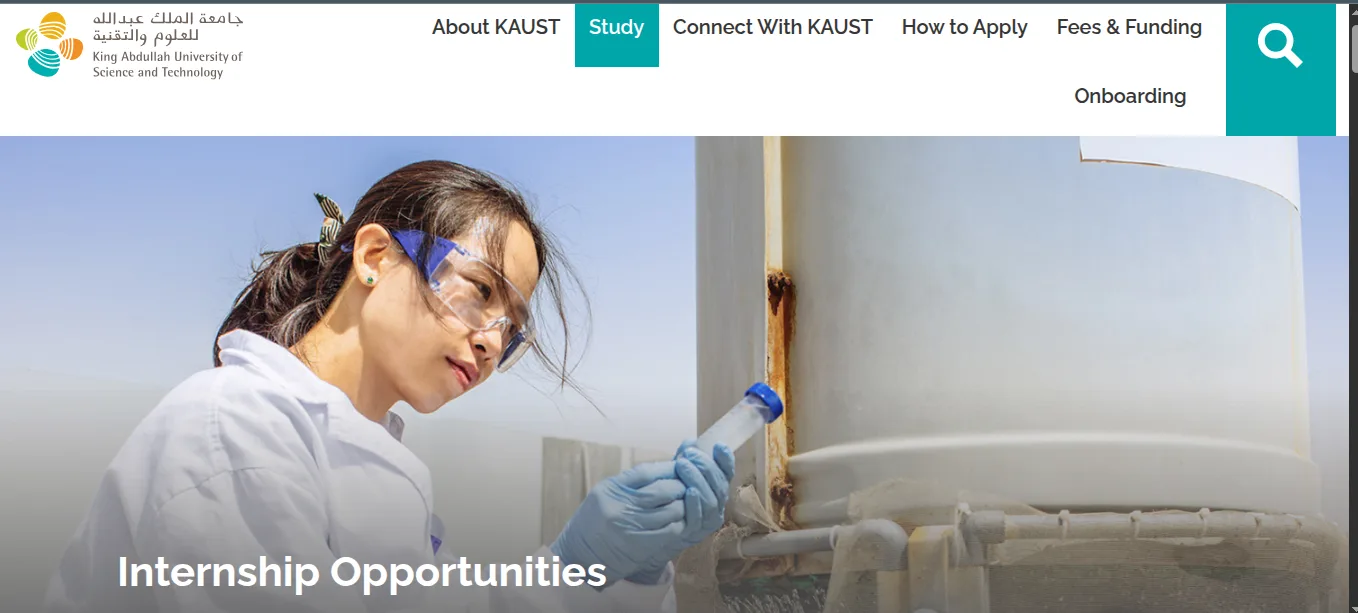
KAUST's main internship route is the Visiting Student Research Program (VSRP), a fully funded research placement for third- and fourth-year bachelor's students and master's students in science, technology, engineering and mathematics. Internships last two to six months, can start at any point in the year, and include a USD $1,000 monthly stipend, a private bedroom and bathroom, airfare to KAUST and back, and access to core laboratories. Applications are rolling, and KAUST lists more than 100 active faculty-led projects across its 17 STEM degree programmes.
KAUST is best understood as a hub of internship routes rather than a single programme. VSRP is the central, year-round route. The university's Computer, Electrical and Mathematical Sciences and Engineering (CEMSE) division also runs a separate Saudi Summer Internship, which in 2026 ran from 15 June to 6 August. The two have different audiences, eligibility rules and application processes, and neither should be confused with the other.
The short answer
VSRP is open now, in the sense that applications are accepted year-round and projects are listed continuously. There is no single annual deadline. Applicants choose a specific project, apply through its page, and are assessed by KAUST admissions. The programme is fully funded, with a $1,000 monthly stipend and housing and flights provided.
The main thresholds are a 3.5/4.0 GPA, English proficiency, and current enrolment in the third or fourth year of a bachelor's degree or in a master's programme. Recent graduates can apply if they completed their degree within one year of the start date. Current PhD candidates, KAUST students and KAUST alumni are not eligible.
Quick Facts
| Item | What KAUST publishes |
|---|---|
| Host | King Abdullah University of Science and Technology (KAUST) |
| Location | Thuwal, Saudi Arabia |
| Main route | Visiting Student Research Program (VSRP) |
| Opportunity type | Faculty-led research internship |
| Duration | 2–6 months |
| Start dates | Flexible; any point throughout the year |
| Who it is for | Third- and fourth-year bachelor's students and master's students in STEM |
| GPA | Minimum 3.5 on a 4-point scale, or equivalent |
| Funding | USD $1,000 monthly stipend, private bedroom and bathroom, airfare, social and cultural activities, core lab access |
| Application fee | None |
| Application status | Rolling, year-round |
| Deadline | No single deadline; apply to a specific project |
| Official portal | KAUST admissions internship project search |
KAUST as a hub of internship routes
KAUST is a graduate research university in Thuwal, Saudi Arabia. Its academic programme is organised around 17 STEM degree programmes, and its research facilities include core laboratories and major research centres. The internship page presents VSRP as preparation for graduate study and as hands-on exposure to research or co-op experience.
The hub framing matters because a search for "KAUST internship" can surface several different schemes. VSRP is the university-wide visiting student programme. The CEMSE Saudi Summer Internship is a divisional programme with a Saudi-focused eligibility rule and a fixed summer cohort. Individual research groups or centres may advertise other opportunities, but those are not necessarily part of VSRP and may have their own terms.
Applicants should start with the VSRP project search if they want the broadest choice of projects and a year-round start. They should look at the CEMSE programme separately if they are Saudi recent graduates or students in applied mathematics, computer science, electrical and computer engineering, or statistics and want a fixed summer cohort.
What the VSRP is
VSRP places interns in KAUST faculty research groups for two to six months. KAUST says interns collaborate with faculty in state-of-the-art facilities, contribute to real-world research, and join a community that includes more than 100 nationalities. Many interns use the programme as preparation for a master's or PhD, and KAUST says participants have presented their findings at conferences or published papers.
The project is the centre of the internship. Each project page describes the nature of the project, the recommended student background and the desired research outcomes. Applicants apply to a specific project through its "Apply" button. That is different from a general admissions application: the project choice determines the research area, the supervisor and much of the day-to-day work.
The duration is flexible within the two-to-six-month range. KAUST says interns can choose their start and end dates at any point throughout the year. That flexibility is useful for students in different academic calendars, but it also means there is no fixed cohort start or single summer intake.
Research areas and projects
VSRP projects span KAUST's 17 STEM degree programmes. The university's research is organised into three broad divisions: Biological and Environmental Science and Engineering; Computer, Electrical and Mathematical Science and Engineering; and Physical Science and Engineering. The project search lists more than 100 active projects, each with its own background requirements and outcomes.
The project catalogue is the best source of specifics. KAUST says the projects are related to its degree programmes but that the curriculum emphasises interdisciplinary studies, so interns can explore interests and collaborate with experts from other disciplines. A project may sit in one division while drawing on facilities or expertise from another.
Applicants should read the project description carefully. The "recommended student background" is not a decorative field: it tells you what preparation the faculty member expects. A project in applied mathematics may expect programming and numerical methods; a project in bioscience may expect laboratory experience; a project in electrical engineering may expect signal processing or hardware skills. Applying to a project whose background you do not meet is unlikely to produce a strong application, even if your GPA is high.
Who is eligible
The VSRP eligibility rules are published on the internship page. Applicants must be undergraduate students in the third year or above, or master's students. They need a minimum GPA of 3.5 on a 4-point scale, or equivalent. They must provide evidence of English proficiency, unless they earned a degree through in-person study at an accredited institution in the United States, Canada, the United Kingdom, Ireland, Australia or New Zealand.
The English requirements are specific. KAUST lists an IELTS score of 6.5 overall with at least 6 in all individual sections; a TOEFL score of 4.5 overall with at least 4 in all individual sections; a PTE Academic score of 64 overall with at least 61 in all sections; a Cambridge C1 Advanced or C2 Proficiency score of 176 overall with at least 169 in all sections; and a Duolingo English Test score of 110 overall with at least 100 in all sections. KAUST's page does not state which TOEFL scale the 4.5 refers to, so applicants should confirm the expected test format with the admissions office.
Current PhD candidates, KAUST students and KAUST alumni are not eligible. Graduates can apply if they will have completed their degree within one year of the internship start date. KAUST also says applicants can submit only one application at a time.
Funding and what is covered
KAUST describes VSRP as a fully funded programme. The published benefits are a USD $1,000 monthly stipend, a private bedroom and bathroom, airfare to KAUST and back, social and cultural activities, and access to core laboratories and major research and community facilities. The page also says KAUST covers tuition fees, housing, return flights, and provides a monthly stipend for living expenses.
The housing benefit is in-kind, not a cash allowance. Interns are provided with a private bedroom and bathroom, which KAUST describes as part of the programme. The page does not state whether meals, local transport, health insurance or visa costs are covered. Applicants should budget for those items unless KAUST confirms otherwise.
There is no application fee. That is worth noting because some international internship schemes charge one. The $1,000 monthly stipend is the cash component; the value of housing and flights is additional. The page does not publish a breakdown of the stipend or a cost-of-living estimate for Thuwal.
How to apply
The application process has five steps.
- Choose a project. Use the KAUST internship project search to find an active project. Read the project description, the recommended background and the desired outcomes. You can submit only one application at a time.
- Prepare the documents. KAUST asks for official transcripts in English for all degrees, a letter of recommendation from a faculty member at your current institution, a valid passport with at least six months of validity, a statement of purpose, and a CV.
- Apply through the project page. The application is submitted through the project's "Apply" button, not through a general VSRP form. You will be asked to nominate a recommender.
- Let your recommender know. KAUST says it will contact your nominated recommender as part of the admissions process. The recommender should be aware of the application and expect the contact. You can update recommender information, send reminders and track the letter's status in the admissions portal.
- Provide an English score if needed. KAUST says you may submit an application without an English test score, but if your application is successful you must provide results that meet the minimum requirements. If you do not meet the requirements, KAUST says it will provide a Duolingo test token.
The recommendation letter is one letter, not two or three. It must come from a faculty member at the applicant's current institution. KAUST does not require the letter to be uploaded by the applicant; the admissions team contacts the referee.
The Saudi Summer Internship
The CEMSE Saudi Summer Internship is a separate programme. It introduces Saudi university students and recent graduates to research in applied mathematics and computational sciences, computer science, electrical and computer engineering, and statistics. Participants work on research projects mentored by KAUST scholars and present their work at an end-of-programme e-poster session.
The 2026 edition ran from 15 June to 6 August 2026 on the KAUST campus. It was open to recent Saudi graduates, senior undergraduates and current master's students in the four named areas, with a cumulative GPA of 3.5/4.0 or higher, strong English proficiency and a demonstrated motivation to work on research projects. The benefits included a stipend to cover living expenses at KAUST, logistics support to relocate to campus, free accommodation on campus, access to research facilities, and a certificate of completion.
The application required a CV, official transcripts in English and a copy of the national ID, followed by a KAUST admissions review. The page does not publish an application deadline or a 2027 edition. The 2026 dates are historical, and applicants should not assume that the programme will run on the same dates in 2027.
Timeline and current status
VSRP is rolling. Applications are accepted all year round, and start and end dates can be chosen at any point in the year. There is no single deadline and no fixed cohort. KAUST says it releases results as soon as a final admissions decision is made, and it does not have a decision release schedule.
The Saudi Summer Internship is not rolling. Its 2026 edition ran from 15 June to 6 August 2026 and is now past. No 2027 dates or application window have been published on the CEMSE page reviewed for this guide.
For VSRP, the practical timeline depends on the project and the applicant's preferred start date. Applicants who need a visa should allow time for the admissions decision and the Saudi visa process. The page does not publish a recommended lead time, so it is worth asking the internship office or the project supervisor once an offer is made.
Selection and what makes a credible application
KAUST's published selection criteria are the eligibility thresholds and the project requirements. The project page describes the recommended student background and the desired research outcomes, and the faculty member and admissions team assess the application against those. There is no published minimum publication count or fixed list of preferred courses.
A credible application will do three things. First, it will target a project whose background genuinely matches the applicant's coursework, skills and prior research. Second, the statement of purpose will explain why that project, why KAUST, and what the applicant wants to learn or contribute. Third, the recommendation letter will come from a faculty member who can speak to the applicant's research potential and work habits.
The GPA threshold is high, and the English requirement is non-negotiable for successful applicants. But the project fit is what distinguishes a strong application from an eligible one. A generic statement that could be sent to any of the 100+ projects is weaker than one that engages with the specific project's research question and methods.
What is confirmed and what is not yet announced
Confirmed for VSRP: the two-to-six-month duration; the year-round start and end dates; the rolling application; the 3.5/4.0 GPA threshold; the English test requirements and waivers; the exclusion of current PhD candidates, KAUST students and KAUST alumni; the one-application-at-a-time rule; the $1,000 monthly stipend; the private bedroom and bathroom; the airfare; the core lab access; the document list; the one faculty recommendation letter; and the no-application-fee rule.
Confirmed for the Saudi Summer Internship: the 2026 dates of 15 June to 6 August 2026; the Saudi recent graduate, senior undergraduate and master's audience; the four named fields; the 3.5/4.0 GPA; the stipend, accommodation, relocation support and certificate; and the CV, transcript and national ID requirements.
Not announced: the 2027 Saudi Summer Internship dates or whether it will run; whether other KAUST divisions run separate internship calls; the exact cash value of housing and flights; whether meals, health insurance, local transport or visa fees are covered; and the processing time for admissions decisions. KAUST's pages can change, so check the project page and the internship page before applying.
Sources
Frequently asked questions
- What is the main KAUST internship programme?
- The main route is the Visiting Student Research Program (VSRP), which offers 2–6 month research internships with KAUST faculty for third- and fourth-year bachelor's students and master's students in STEM. KAUST also runs separate programmes such as the CEMSE Saudi Summer Internship.
- How much does the KAUST VSRP pay?
- KAUST lists a USD $1,000 monthly stipend, a private bedroom and bathroom, airfare to KAUST and back, social and cultural activities, and access to core laboratories and major research facilities. The programme is described as fully funded, and KAUST says there is no application fee.
- What GPA do I need for the KAUST VSRP?
- KAUST requires a minimum GPA of 3.5 on a 4-point scale, or equivalent. Applicants must also provide evidence of English proficiency, unless they earned a degree through in-person study in the United States, Canada, the United Kingdom, Ireland, Australia or New Zealand.
- Can I apply if I have already graduated?
- Yes, if you will have completed your degree within one year of the internship start date. Current PhD candidates, KAUST students and KAUST alumni are not eligible.
- How long is a KAUST VSRP internship?
- Internships last between two and six months. KAUST says start and end dates are flexible and can be chosen at any point throughout the year, and applications are accepted all year round.
- How many projects can I apply to?
- You can submit only one application at a time to KAUST. The application is made to a specific project through the project page, and KAUST lists over 100 active faculty-led projects.
- What documents does the VSRP application require?
- KAUST asks for official transcripts in English for all degrees, a letter of recommendation from a faculty member at your current institution, a valid passport with at least six months of validity, a statement of purpose, and a CV. The recommendation letter is submitted after KAUST contacts your nominated referee.
- Is the Saudi Summer Internship the same as the VSRP?
- No. The Saudi Summer Internship is a separate CEMSE programme for Saudi recent graduates, senior undergraduates and current master's students in applied mathematics, computer science, electrical and computer engineering, or statistics. Its 2026 edition ran from 15 June to 6 August 2026.
Official application link
Search KAUST's official internship projects
VSRP applications are rolling and projects are listed year-round. The separate CEMSE Saudi Summer Internship ran from 15 June to 6 August 2026; no 2027 dates have been published.
Open official page

