
Academic guides · Guide
Leeds Summer Research Programme 2027: Dates, Fees and Eligibility
StatusClosed
Leeds' six-week research programme runs 3 July–14 August 2027 and costs £4,995. Applications open in December 2026 and close on 1 March 2027.
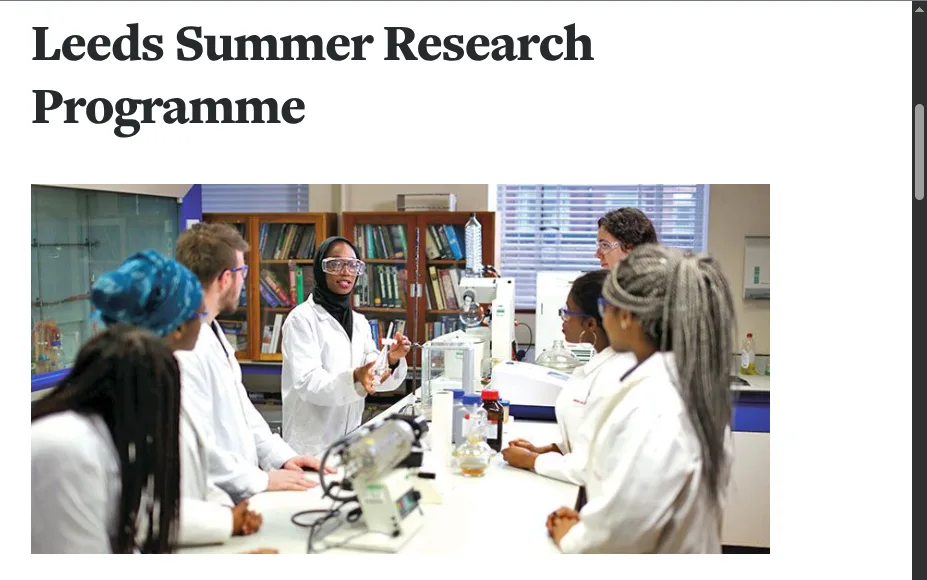
The Leeds Summer Research Programme (LSRP) is a six-week, full-time research placement at the University of Leeds for international undergraduate students. The 2027 edition runs from 3 July to 14 August 2027, applications open in December 2026, and the LSRP deadline is 1 March 2027. The programme fee is £4,995, and participants earn 24 Leeds credits, equivalent to 12 ECTS or 6 US credits.
LSRP is part of Leeds International Summer School (LISS), but it is not a taught summer school. Students work with a dedicated supervisor and other academic staff on a defined research project for 35 hours a week, complete approximately 30 hours of pre-arrival preparation, and present their work at a research showcase. The research projects are published when applications open, and the available topics change from year to year.
The short answer
LSRP 2027 is confirmed and will open for applications in December 2026. The deadline is 1 March 2027, earlier than the general LISS deadlines of 1 April and 1 May 2027. Applications are reviewed after the LSRP deadline, shortlisted applicants are interviewed online with their proposed supervisor before 1 April, and unsuccessful applicants can apply to taught LISS modules instead.
The main conditions are standard LISS eligibility plus the prerequisites for the specific project. Applicants must be enrolled at a university or be recent graduates, in good academic standing, and meet the English language requirement unless they are taught in English. The fee is £4,995, and LSRP participants are not eligible for the LISS merit or social-media scholarships.
Quick Facts
| Item | What Leeds publishes |
|---|---|
| Host | University of Leeds |
| Location | Leeds, West Yorkshire, United Kingdom |
| Opportunity type | Full-time summer research programme |
| Duration | Six weeks, 3 July–14 August 2027 |
| Workload | 35 hours of research per week plus approximately 30 hours of pre-arrival preparation |
| Credit | 24 Leeds credits, equivalent to 12 ECTS or 6 US credits |
| Who it is for | International undergraduate students |
| Eligibility | Standard LISS entry requirements plus project-specific prerequisites |
| Fee | £4,995 |
| Application opens | December 2026 |
| LSRP deadline | 1 March 2027 |
| Interviews | Online, before 1 April 2027 |
| Official portal | Leeds International Summer School application |
What the Leeds Summer Research Programme is
LSRP provides high-achieving international undergraduate students with research experience at the University of Leeds. Leeds describes it as combining supervised, hands-on research projects with the social and cultural programme of the Leeds International Summer School. Students work closely with Leeds academics on defined research projects, contribute to research activity, and gain academic and professional experience in a research environment.
The programme is six weeks long and full-time. Participants work with a dedicated supervisor and other academic staff for 35 hours of research activity per week. Leeds also expects approximately 30 hours of pre-arrival preparation and tasks, which means the commitment begins before arrival in Leeds. The programme culminates in a research showcase where participants present their work.
The credit value is one of the programme's distinctive features. LSRP is worth 24 Leeds credits, equivalent to 12 ECTS or 6 US credits. Because of the full-time commitment, participants cannot enrol on taught LISS modules at the same time. That rule matters for anyone who wants to combine research with a taught course: the two routes are alternatives, not complements.
LSRP is aimed at international undergraduates, and the research projects are defined by Leeds academics rather than proposed by students. That makes it closer to a structured research internship than to a self-designed independent study. Applicants choose from the projects published when applications open, and the supervisor and project team set the research question and scope.
Research areas and projects
LSRP projects are available across many, if not all, of Leeds' faculties. The programme page lists five faculty areas: Arts, Humanities and Cultures; Engineering and Physical Sciences; Environment and Social Sciences; Health and Life Sciences; and Leeds University Business School. That breadth means the programme is not limited to STEM students, although the project prerequisites will vary by discipline.
The specific projects are published when applications open in December 2026. Leeds says full details of the programme objectives, learning outcomes, contact hours and assessment will be published at the same time. Until then, applicants can use the faculty list to gauge whether their interests are likely to be covered, but they cannot confirm a specific project.
The project prerequisites are the part to watch. Leeds says applicants must meet the standard LISS entry requirements and any specific prerequisites for their chosen project. A project in engineering may require prior coursework in a particular subject; a project in the business school may require quantitative or qualitative research experience; a project in the health and life sciences may require laboratory skills. The project description should state what is expected.
Who is eligible
The eligibility rules have two layers. The first is the standard LISS requirement: applicants must be enrolled at a university or be recent graduates, and they must be in good academic standing at their home university. The minimum grade average is 50 on the UK system, a GPA of 2.5 on the US system, a GPA of 5.0 on the Australian system, or an equivalent.
The second layer is the project-specific prerequisite. Leeds says applicants must meet any specific prerequisites for their chosen project. Those prerequisites are not published until the projects are published, so applicants should check the project description carefully when applications open.
The English language requirement is part of the standard LISS eligibility. Leeds accepts IELTS 5.5 overall with no component below 5.0; TOEFL iBT 4 overall with no component below 3.5 for tests taken after 21 January 2026; TOEFL iBT 72 overall with minimum sub-scores for tests taken before that date; TOEIC with listening 400, reading 385, speaking 160 and writing 150; Password Skills 5.5 with no component below 5.0; LanguageCert International ESOL B2 Communicator with 33 in each skill; and Duolingo 95 overall with no component below 95.
If the applicant is taught in English at their home university, Leeds does not require a language certificate. Instead, it asks for evidence that the degree is taught in English, such as a link to the university's language-of-instruction page or a letter from the home university. Leeds does not accept CET-4 or CET-6.
Fees and what is included
The six-week LSRP fee is £4,995. Leeds describes LISS as an all-inclusive programme, and the fee includes tuition, accommodation, breakfast and lunch Monday to Friday, module field trips, weekend excursions, social activities, and premium membership at The Edge sports centre.
The fee does not include flights, travel insurance or visas. Applicants should budget for those separately, along with any meals not covered on weekdays and any personal spending. Leeds also offers a free transport service from Manchester Airport and Leeds Bradford Airport during the LISS arrival period, with booking details sent to offer holders in May.
LSRP participants are not eligible for the Merit Scholarship or the LISS Champion social-media scholarship. The early application discount, worth £150 for the four-week programme or £75 for the two-week programme, does not apply to the LSRP. That means the £4,995 fee is the published cost, without the discounts available on other LISS routes.
The payment schedule is a £300 deposit to accept an offer, followed by the remaining balance by 8 May 2027. Leeds says the deposit and remaining balance are non-refundable 14 days after payment, and payments are usually non-refundable after 14 days. Applicants should read the refund policy before paying.
How to apply
The application is made through the Leeds International Summer School online application. Leeds advises reading the instructions on the first page carefully because the form cannot be saved and completed later. Applicants should have their personal details, academic details and supporting documents ready before starting.
The supporting documents are:
- A supporting statement of 500 to 1,000 words outlining the reasons for applying. For LSRP, this should address the research project and the applicant's preparation for it, not just a general interest in Leeds.
- An official academic transcript from the home university, in English.
- English language evidence if required, or proof that the applicant is taught in English at the home university.
- An optional merit scholarship application, although LSRP participants are not eligible for the merit scholarship, so this does not apply to them.
The LSRP deadline is 1 March 2027. Leeds reviews all LSRP applications after the deadline, rather than on a rolling basis. Shortlisted applicants are invited to a brief online interview with their proposed supervisor before 1 April. The interview is part of the selection process, not a formality.
Applicants who are not selected for LSRP can apply for a place on one of the taught LISS modules instead. That is a useful fallback, but it is a different programme with different fees, dates and learning outcomes. The LSRP and the taught modules cannot be combined.
Selection and interviews
Leeds does not publish a detailed scoring rubric for LSRP. The published process is a review of the application after the deadline, followed by an online interview with the proposed supervisor for shortlisted applicants. The supervisor is the person best placed to judge whether the applicant has the background and motivation for the project.
The supporting statement is the main written evidence. A credible statement will explain why the specific project interests the applicant, what relevant coursework, research experience or skills they bring, and how the project connects to their academic or career plans. A generic statement about wanting to study in the UK is unlikely to be enough.
The interview is described as brief. Applicants should expect to discuss their background, their understanding of the project, and their reasons for applying. They should also be ready to ask questions about the project's scope, methods and expected outputs. The interview is with the proposed supervisor, so it is also a chance to confirm that the project is a good fit.
Timeline and current status
The 2027 programme dates are confirmed: 3 July to 14 August 2027. Applications open in December 2026. The LSRP deadline is 1 March 2027, with shortlisted interviews before 1 April. The programme then runs for six weeks in July and August.
The general LISS deadlines are later: 1 April 2027 for the early application deadline and 1 May 2027 for the final deadline. LSRP applicants should not use those dates. The LSRP deadline is 1 March 2027, and Leeds reviews LSRP applications separately.
The research projects for 2027 have not been published yet. Leeds says they will be published when applications open, along with full details of the programme objectives, learning outcomes, contact hours and assessment. Applicants should check the programme page in December 2026 for the project list and prerequisites.
What makes a credible application
The strongest LSRP application will be specific about the project. Leeds publishes projects when applications open, and the supporting statement should engage with the project's research question, methods and expected contribution. Applicants should explain why they are prepared for that project, not just why they want to spend six weeks in Leeds.
The academic transcript matters because the programme is aimed at high-achieving students and because the project may have prerequisites. A strong grade average in relevant subjects is more persuasive than a general record of good grades. If the applicant has research experience, a final-year project, a laboratory placement or a relevant internship, the statement should describe it concretely.
The English requirement is a threshold, not a differentiator. Applicants who need a test should take it early enough to have the result before the 1 March deadline. Applicants who are taught in English should prepare the evidence in advance, because Leeds asks for a link to the exact webpage confirming the language of instruction or a letter from the home university.
The interview is the final filter. A shortlisted applicant should be ready to discuss the project in detail and to explain how their background fits. The interview is also a chance to check whether the supervisor's expectations match the applicant's interests. A thoughtful question about the project is more useful than a generic question about Leeds.
What is confirmed and what is not yet announced
Confirmed for 2027: the 3 July–14 August dates; the December 2026 application opening; the 1 March 2027 LSRP deadline; the online interviews before 1 April; the six-week duration; the 35-hour research week plus approximately 30 hours of pre-arrival preparation; the research showcase; the 24 Leeds credits (12 ECTS or 6 US credits); the £4,995 fee and its inclusions; the £300 deposit and 8 May 2027 balance deadline; the exclusion from merit and LISS Champion scholarships; and the standard LISS eligibility and English requirements.
Not yet announced: the 2027 research project list and each project's specific prerequisites; the full programme objectives, learning outcomes, contact hours and assessment; whether the fee will change; and the number of places. Leeds says these details will be published when applications open.
Worth confirming: whether the applicant's degree is taught in English for the purposes of the language requirement; whether the applicant's grade average meets the UK 50 / US 2.5 / Australian 5.0 threshold; and whether the specific project requires prior coursework or skills. Leeds's pages can change, so check the programme page and the applying page before submitting.
Sources
- University of Leeds, "Leeds Summer Research Programme," accessed 12 November 2026
- University of Leeds, "Applying," accessed 12 November 2026
- University of Leeds, "Fees and scholarships," accessed 12 November 2026
- University of Leeds, "Leeds International Summer School," accessed 12 November 2026
- University of Leeds, "Academic modules," accessed 12 November 2026
Frequently asked questions
- When is the Leeds Summer Research Programme 2027?
- The six-week programme runs from 3 July to 14 August 2027 at the University of Leeds. Applications open in December 2026, and the LSRP deadline is 1 March 2027.
- How much does the Leeds Summer Research Programme cost?
- The six-week programme fee is £4,995. It includes tuition, accommodation, breakfast and lunch Monday to Friday, field trips, weekend excursions, social activities and The Edge sports centre membership. Flights, travel insurance and visas are not included.
- Who is eligible for the Leeds Summer Research Programme?
- Applicants must meet the standard Leeds International Summer School entry requirements and any specific prerequisites for their chosen project. That means being enrolled at a university or being a recent graduate, in good academic standing, with a minimum grade average of 50 in the UK system, a GPA of 2.5 in the US system, a GPA of 5.0 in the Australian system, or equivalent.
- What English language score do I need for LSRP?
- Leeds accepts IELTS 5.5 with no component below 5.0, TOEFL iBT 4 with no component below 3.5 for tests taken after 21 January 2026, TOEIC, Password Skills 5.5, LanguageCert B2, or Duolingo 95. If you are taught in English at your home university, you can provide evidence of English-medium instruction instead. Leeds does not accept CET-4 or CET-6.
- Is the Leeds Summer Research Programme credit-bearing?
- Yes. The programme is worth 24 Leeds credits, equivalent to 12 ECTS or 6 US credits. Because it is a full-time commitment, participants cannot enrol on taught LISS modules at the same time.
- Do I need a research proposal?
- Leeds asks for a supporting statement of 500 to 1,000 words outlining your reasons for applying, an official academic transcript in English, and English language evidence if required. Research projects are published when applications open, and applicants should address the project they are applying for.
- What happens after the LSRP deadline?
- Leeds reviews all LSRP applications after the 1 March 2027 deadline. Shortlisted applicants are invited to a brief online interview with their proposed supervisor before 1 April. Applicants who are not selected can apply for a place on one of the taught LISS modules instead.
- Can I get a scholarship for the Leeds Summer Research Programme?
- No. Leeds says LSRP participants are not eligible for the Merit Scholarship or the LISS Champion scholarship, and the early application discount does not apply to the LSRP.
Official application link
Check the official Leeds Summer Research Programme page
Applications open in December 2026 and the LSRP deadline is 1 March 2027. Research projects and full programme details will be published when applications open.
Open official page

