
Academic guides · Guide
LPI Summer Intern Program 2027: Dates, Stipend and Eligibility
StatusOpen
LPI's 10-week planetary science internship runs 7 June–13 August 2027 and provides at least $13,639 for stipend, travel, housing and living costs. Apply by 14 December 2026.
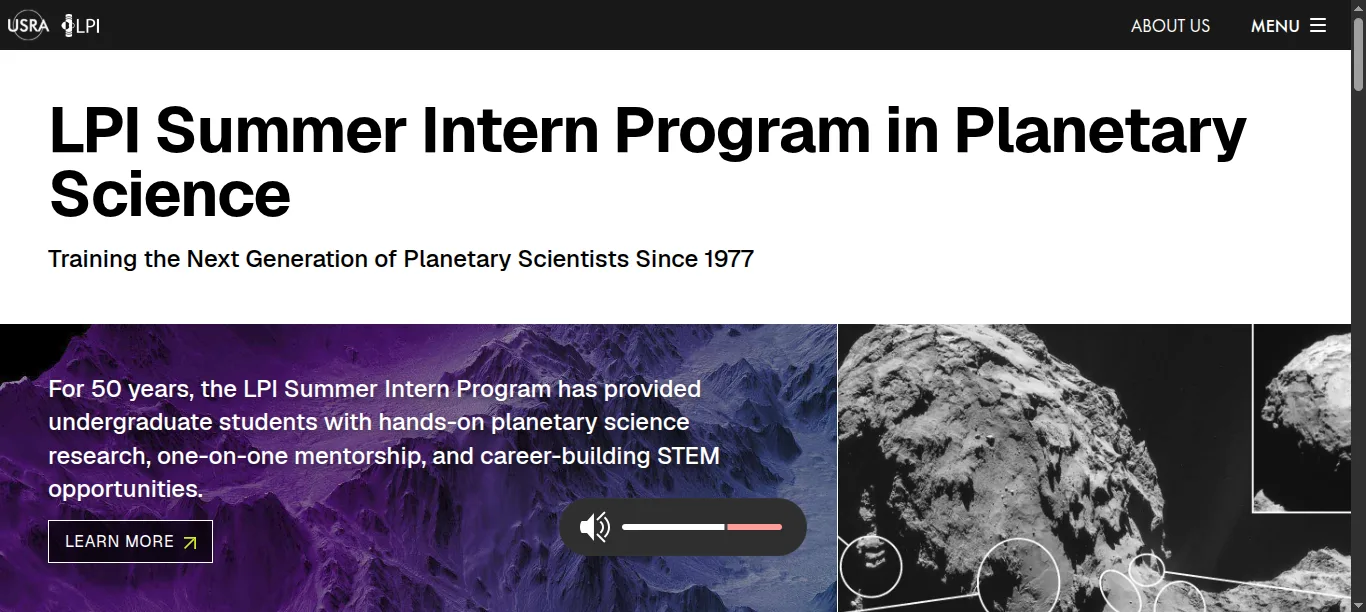
The LPI Summer Intern Program in Planetary Science is a 10-week undergraduate research internship at the Lunar and Planetary Institute in Houston, Texas. The 2027 programme runs from 7 June to 13 August 2027, applications opened on 19 October 2026, and the deadline is 14 December 2026 at 11:59 p.m. U.S. Central Time. Selected interns receive at least $13,639 in financial support covering a stipend, travel, housing and cost-of-living expenses.
The programme has trained undergraduate planetary scientists since 1977. Interns work alongside LPI and NASA Johnson Space Center scientists, attend lectures and career-development workshops, and present their research at a midterm session and the LPI Summer Intern Conference. It is an in-person programme, and interns are based at LPI or NASA JSC in Houston.
The short answer
The 2027 call is open now and closes on 14 December 2026. Applicants must be undergraduates who have completed at least 50 semester hours and are enrolled in a bachelor's degree programme in the semester before the summer. U.S. citizens and foreign nationals can apply, but citizens of countries on the NASA Designated Countries List are not eligible. Previous participants cannot participate again.
The application requires an online form with essay questions, at least two and at most three recommendation letters, an official transcript and a resume or CV. Foreign nationals whose primary language is not English must also provide TOEFL or IELTS scores, or a letter from a professor in their college's English department confirming sufficient English skills. LPI says applicants do not need to contact potential mentors before applying.
Quick Facts
| Item | What LPI publishes |
|---|---|
| Host | Lunar and Planetary Institute (LPI) |
| Location | Houston, Texas, at LPI or NASA Johnson Space Center |
| Opportunity type | Undergraduate summer research internship |
| Duration | 10 consecutive weeks, 7 June–13 August 2027 |
| Eligibility | Undergraduate with at least 50 semester hours; enrolled in a bachelor's programme the semester before |
| Citizenship | U.S. citizen or foreign national; NASA Designated Countries excluded |
| Funding | At least $13,639 covering stipend, travel, housing and cost of living |
| Housing | University Forest Apartments; cost deducted from the support total |
| Application opened | 19 October 2026 |
| Deadline | 14 December 2026, 11:59 p.m. U.S. Central Time |
| Notification | March 2027 |
| Official portal | LPI online application form |
What the programme is
The LPI Summer Intern Program is one of the longest-running undergraduate planetary science internships in the United States. LPI says it has provided hands-on planetary science research, one-on-one mentorship and career-building STEM opportunities since 1977, and the 2027 edition marks 50 years of the programme.
Interns conduct research alongside leading planetary scientists. The programme includes enrichment activities such as lectures and career-development workshops, and it is structured around a defined research project. LPI describes the benefits as developing new skills, working with planetary science experts, establishing contacts for future references and collaborations, and experiencing a research environment including laboratories.
The cohort also has a shared programme. Orientation takes place on the first day, midterm presentations are on 7 July 2027, and the LPI Summer Intern Conference is on 11 August 2027. The programme ends on 13 August, with departure on 14 August. Interns are expected to be present for the entire duration, and LPI says they may not miss orientation.
The internship is in person only. Interns work at the Lunar and Planetary Institute or NASA Johnson Space Center, both in Houston. Core working hours are Monday to Friday, 9:00 a.m. to 5:00 p.m., and the dress code is business casual and work appropriate.
Research areas and what you would work on
LPI's research topics cover the breadth of planetary science. They include planetary geology and surface processes, impact cratering, remote sensing and spectroscopy, geochemistry, petrology and mineralogy, planetary interiors and geophysics, atmospheres, astrobiology, lunar science, asteroids and small bodies, icy satellites, meteorites and sample analysis, interplanetary dust and presolar grains, and machine learning applications.
The research page describes the projects as spanning laboratory work, data analysis, modelling and mission-related science. Interns may work with samples, remote-sensing data, numerical models or spacecraft datasets, depending on the project. The programme is not limited to one method or one target body.
Applicants do not apply to a specific project in the same way as a faculty-led internship. LPI says selections are based on the application, including academic experience and scientific interests, as well as specific research project requirements. The selection process matches the applicant's interests with available research projects. That makes the essay questions and the statement of scientific interest important: they are how the programme learns what kind of project would fit.
Because the programme matches applicants to projects rather than asking them to choose a supervisor, the research statement should show flexibility as well as focus. An applicant who can explain why several related topics interest them, and what methods they have used, is easier to place than one who insists on a single narrow project. LPI's research page is the best starting point for understanding the range of work; the application essays are the place to connect that range to your own preparation.
Who is eligible
The eligibility rules are specific and worth checking before preparing an application.
Applicants must be undergraduate students who have completed at least 50 semester hours of credit. They must be enrolled in a bachelor's degree programme in the semester preceding the summer programme. Majors in physical or natural sciences, engineering, computer science or mathematics are preferred, but LPI says all eligible students will be considered.
Applicants can be U.S. citizens or foreign nationals. However, citizens of countries on the U.S. Department of State Designated Countries List are not eligible because of security requirements. LPI links to the NASA Designated Country List. Naturalised citizens, dual citizens from non-designated countries, and permanent residents can apply, but they need to provide the relevant documentation.
LPI also limits participation to one time. If selected, an intern may only participate once. Applicants who already hold a bachelor's degree are considered in some cases, but they are not the programme's main focus; eligible applicants should be actively pursuing a bachelor's degree and enrolled the semester before the internship.
Financial support
Selected interns receive at least $13,639 in financial support. LPI says the support covers the internship stipend, travel, housing and cost-of-living expenses. The exact breakdown is not published on the financial support page, and the total is described as a minimum rather than a fixed award.
Housing is provided at University Forest Apartments, and the cost is paid directly to the housing vendor on the intern's behalf and deducted from the total support amount. That means the $13,639 is not all cash: part of it is the housing benefit. Interns should budget accordingly and should ask LPI for the current breakdown if they need a precise figure.
The page does not state whether the stipend is taxable, but the FAQ says interns are responsible for reporting stipend earnings to the IRS and that LPI cannot offer specific tax guidance. Travel to and from Houston is included in the support total, but the page does not publish a separate travel allowance. A car is recommended in most cases, and interns are responsible for their own transport if a project requires travel to an off-site location.
How to apply
The application is submitted through LPI's online application form. Paper applications are not accepted. Once an application is started, all questions must be completed, including the essay-style questions. After submission, the applicant receives a confirmation email with an application number and a link to track recommendation letters.
The required materials are:
- At least two and at most three letters of recommendation, submitted independently through the online application system by the deadline. LPI prefers letters from faculty at the applicant's current institution, but teaching assistants, academic advisors, previous faculty, employers and supervisors can also write them. LPI staff and current JSC mentors should not submit letters.
- An official transcript. Both original and electronic transcripts are accepted; unofficial transcripts are not. Electronic transcripts must come directly from the institution's registrar or transcript service, with the application number included. Original transcripts can be mailed to the LPI Summer Intern Program address.
- A resume or curriculum vitae.
- English language proficiency for foreign nationals whose primary language is not English. LPI accepts TOEFL or IELTS scores, or a letter from a professor in the applicant's college English department confirming sufficient spoken and written English skills.
All materials must be in English and received by 14 December 2026 at 11:59 p.m. U.S. Central Time. LPI says incomplete applications will not be considered, and late recommendation letters are not accepted. Applicants can submit the application before the recommendations arrive, but the letters must still meet the deadline.
Selection and what makes a credible application
LPI publishes three selection criteria: scholarship, curriculum and experience; career objectives and scientific interest; and the match between the applicant's interests and available research projects. Those criteria are broad, but they point to the parts of the application that matter.
The academic record and experience criterion covers coursework, grades, research experience and relevant skills. A strong applicant will have taken substantive science courses and, where possible, done research, fieldwork, laboratory work or data analysis. The career objectives and scientific interest criterion is where the essay questions matter: LPI wants to see a genuine interest in planetary science, not just a general interest in space.
The project-match criterion is the reason the statement should be specific. Applicants do not need to name a mentor, but they should explain which planetary science questions interest them and what kind of project they would be prepared to undertake. A statement that lists every topic on the research page is less credible than one that focuses on a few connected questions and explains why.
The recommendation letters provide independent evidence. LPI prefers faculty from the current institution, but it accepts others who can speak to the applicant's qualifications, character and relevant experience. A letter from a supervisor who knows the applicant's research work is more useful than a generic letter from a prominent name.
Living in Houston and practical details
Interns are housed at University Forest Apartments, near the research facility. LPI says having access to a car is recommended in most cases, and interns who need to travel to an off-site location for their project are responsible for their own transportation. Houston is a car-dependent city, so applicants should think about transport before arrival.
The programme is full-time and in person. Interns are expected to guarantee their presence for the entire duration, and core hours are 9:00 a.m. to 5:00 p.m. Monday to Friday. A short absence is permitted for illness or binding personal and academic commitments, but interns must notify their advisor and programme coordinator promptly.
The dress code is business casual, conservative and work appropriate. LPI specifically excludes shorts, tank tops, flip-flops, workout gear and extremely casual attire. Interns should also be aware that NASA Johnson Space Center enforces the REAL ID Act, so access may require an acceptable form of identification; LPI's FAQ links to the Department of Homeland Security guidance.
Timeline and current status
The 2027 application opened on 19 October 2026. The deadline is 14 December 2026 at 11:59 p.m. U.S. Central Time. Notification of selection is in March 2027, and selected applicants must decide within two days of notification.
The programme begins with orientation on 7 June 2027. Midterm presentations are on 7 July, the LPI Summer Intern Conference is on 11 August, the programme ends on 13 August, and departure is on 14 August. The 10-week duration is consecutive, and interns cannot start after the programme start date.
As of 12 November 2026, the 2027 call is open. There is no indication on the page that the programme is paused or that the 2027 dates will change. Applicants should still check the application page before submitting, because LPI can update the form, the document requirements or the deadline.
What is confirmed and what is not yet announced
Confirmed for 2027: the 7 June–13 August dates; the 10-week duration; the 19 October 2026 opening; the 14 December 2026 deadline at 11:59 p.m. U.S. Central Time; the March 2027 notification; the two-day decision window; the at-least-$13,639 support total; the University Forest Apartments housing; the 50-semester-hour threshold; the citizenship and Designated Countries rules; the one-participation limit; the in-person requirement; and the application document list.
Not published: the exact breakdown of the $13,639 between stipend, travel, housing and cost of living; whether the stipend is taxable in a given intern's circumstances; the 2028 cycle dates; and the specific project list for 2027. The research topics page describes the range of possible projects, but the final match depends on the available projects and the applicant's interests.
Worth confirming: whether an applicant's semester hours meet the 50-hour threshold; whether their citizenship is affected by the Designated Countries List; whether their transcript will arrive by the deadline; and whether they need a car for the assigned project. LPI's FAQ and application page are the authoritative sources for those details.
Sources
- Lunar and Planetary Institute, "LPI Summer Intern Program in Planetary Science," accessed 12 November 2026
- Lunar and Planetary Institute, "Eligibility and Selection," accessed 12 November 2026
- Lunar and Planetary Institute, "Application Information," accessed 12 November 2026
- Lunar and Planetary Institute, "Financial Support," accessed 12 November 2026
- Lunar and Planetary Institute, "Frequently Asked Questions," accessed 12 November 2026
- Lunar and Planetary Institute, "Research Topics," accessed 12 November 2026
Frequently asked questions
- When is the LPI Summer Intern Program in 2027?
- The 2027 programme runs for 10 consecutive weeks from 7 June to 13 August 2027 at the Lunar and Planetary Institute in Houston, Texas. Orientation is on 7 June, midterm presentations are on 7 July, the LPI Summer Intern Conference is on 11 August, and departure is on 14 August.
- What is the LPI Summer Intern Program deadline for 2027?
- Applications opened on 19 October 2026 and close on 14 December 2026 at 11:59 p.m. U.S. Central Time. All application materials, including recommendation letters, must be received by that deadline.
- How much does the LPI Summer Intern Program pay?
- Selected interns receive at least $13,639 in financial support to cover the internship stipend, travel, housing and cost-of-living expenses. Housing costs are paid directly to the housing vendor on the intern's behalf and are deducted from the total support amount.
- Who is eligible for the LPI Summer Intern Program?
- Applicants must be undergraduate students who have completed at least 50 semester hours of credit, be enrolled in a bachelor's degree programme in the semester preceding the summer programme, and be a U.S. citizen or foreign national. Citizens of countries on the NASA Designated Countries List are not eligible.
- Do I need to contact a mentor before applying to LPI?
- No. LPI says applicants do not need to identify potential mentors before submitting an application. The selection process matches applicants' interests with available research projects.
- Can I participate in the LPI Summer Intern Program more than once?
- No. LPI says that if selected, an intern may only participate once.
- Is the LPI Summer Intern Program remote?
- No. The programme is in person only, and interns may not miss orientation on the first day. Interns are located at the Lunar and Planetary Institute or NASA Johnson Space Center in Houston, Texas.
- When are LPI selection decisions announced?
- Notification of selection is made in March 2027. Selected applicants should be prepared to make a decision within two days of notification; the offer is rescinded if there is no response within that timeframe.
Official application link
Open LPI's official summer intern application page
The 2027 application closes on 14 December 2026 at 11:59 p.m. U.S. Central Time. All materials, including at least two recommendation letters, must be received by the deadline.
Open official page

