
Academic guides · Guide
OECD Internship Programme 2027: €1,000 Monthly, Rolling
StatusOpen
A rolling, one-to-six-month OECD internship in Paris with a €1,000 monthly living allowance. Applications are accepted year-round.
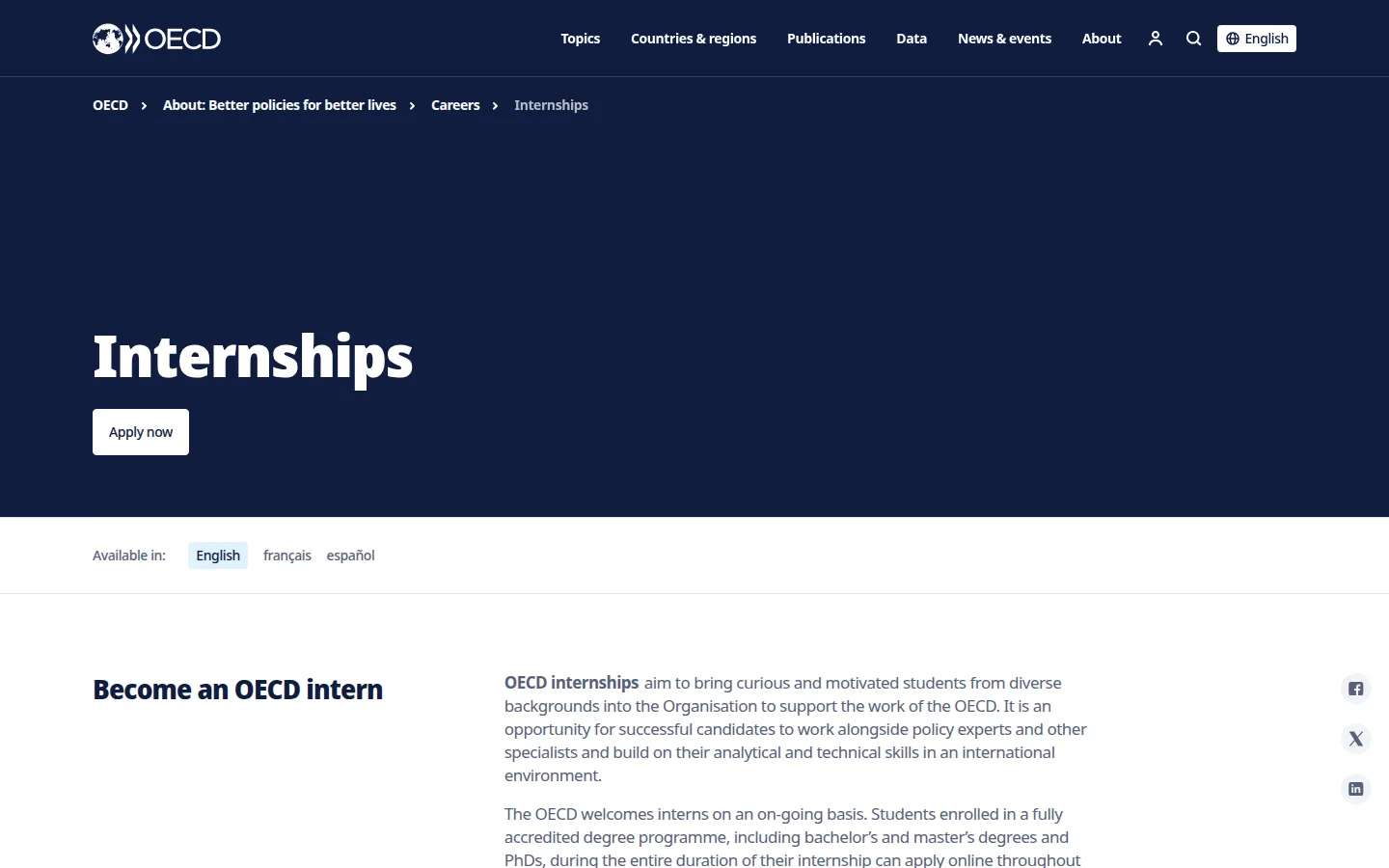
The OECD Internship Programme places enrolled bachelor's, master's, and PhD students in policy and corporate teams, mostly at the OECD's Paris headquarters. Applications are accepted on a rolling basis, internships last one to six months, and interns in Paris receive a €1,000 monthly contribution to living expenses. There is no fixed application deadline.
The short answer
The OECD Internship Programme has no fixed deadline. The OECD recruits on a rolling basis and accepts applications throughout the year. Internships last one to six months and can be renewed up to a total of twelve months. Most internships are in Paris, and interns there receive a €1,000 contribution to living expenses per full month worked.
The payment is not a salary, and the OECD does not provide accommodation, travel costs, public transport, or medical insurance. You must be enrolled in a full-time accredited degree programme for the entire internship, in a field related to the OECD's work, and be available for at least one month. The OECD recommends applying two to three months before your preferred start date.
OECD Internship Programme at a glance
The OECD says the majority of internships are at its Paris headquarters. A smaller number are at OECD centres or affiliated bodies, and the organisation occasionally recruits interns for communication or event-management roles outside Paris.
| Item | What the OECD publishes |
|---|---|
| Organisation | Organisation for Economic Co-operation and Development (OECD) |
| Location | Mostly Paris, France; some OECD centres and affiliated bodies |
| Format | In person, hybrid, or fully remote depending on the team |
| Duration | One to six months; renewable up to twelve months |
| Hours | Full time, 40 hours per week; part-time possible in exceptional cases |
| Application | Rolling, year-round through SmartRecruiters |
| Living allowance | €1,000 per full month worked in Paris |
| Leave | 2.5 working days per full month when the internship exceeds two months |
| Insurance | Not provided; interns must show proof of medical insurance |
| Housing and travel | Not provided or reimbursed |
| Eligibility | Full-time accredited degree, related field, at least one month, English or French |
What interns do
Interns work alongside policy experts and other specialists. The work depends on the directorate you join. The OECD says interns may prepare studies and documents, review existing material, collect and analyse data, support the production of working papers and publications, draft notes and technical annexes, attend meetings and seminars, and liaise with officials, researchers, international organisations, and country delegations.
Policy areas listed by the OECD include agriculture and fisheries, climate change, development, digital, economy, education and skills, employment, energy, environment, finance and investment, governance, health, industry and entrepreneurship, regional development, science and technology, society, taxation, trade, and transport. Corporate functions include audit, communications and public relations, event management, finance and accounting, human resources, information technology, legal services, office administration, and translation.
The OECD says the work may contribute directly to policy development or support a corporate function. It advises applicants to select up to three areas of interest and tailor the cover letter to those fields.
Who can apply
The OECD's eligibility rules are built around current student status. You must be enrolled in a full-time degree programme for the entire duration of the internship, and the degree must be accredited. The programme accepts bachelor's, master's, and PhD students, but the field must be related to the OECD's work. Online courses and programmes that do not require physical attendance, or that do not award a degree, are not recognised.
You must be available for at least one month. You need an excellent command of one of the OECD's two official languages, English or French, and a working knowledge of, or willingness to learn, the other. Knowledge of other languages can be an advantage. The OECD also asks for good quantitative and IT skills, good drafting and communication skills, and the ability to thrive in a multicultural team.
- You must remain enrolled for the whole internship. If you graduate during the planned internship period, you are not eligible.
- Internships are primarily allocated to OECD member country nationals, but non-member nationals can apply for specific programmes and projects, including across OECD-affiliated bodies such as the International Energy Agency, Nuclear Energy Agency, Financial Action Task Force, and International Transport Forum.
- The OECD does not accept spontaneous CVs. All applications must go through the published internship vacancy on its careers site.
- The application form must be completed in English or French.
- There is no published age limit or minimum GPA.
Allowance and benefits
Interns in Paris receive a €1,000 contribution to living expenses per full calendar month worked. The OECD explicitly says interns do not receive a salary. The payment is intended to contribute to living costs, not to replace a full salary, and it is not adjusted for dependants.
Interns are entitled to annual leave of two and a half working days for each full month worked when the internship lasts longer than two full-time months. French public holidays observed by the OECD duty station also apply. The OECD offers training opportunities, including language courses, an active intern community, and flexible working arrangements that may include telework from outside the duty station under OECD guidelines.
The OECD does not provide accommodation, travel costs to and from Paris, public transport, or medical insurance. Interns must provide proof of medical insurance before starting. The organisation can transfer the monthly allowance to an international bank account inside or outside the eurozone, so a French bank account is not mandatory.
| Benefit | What the OECD publishes |
|---|---|
| Living allowance | €1,000 per full month worked in Paris |
| Leave | 2.5 working days per full month when the internship exceeds two months |
| Public holidays | French public holidays observed at the duty station |
| Training | Online and teacher-led training, including language courses |
| Flexible work | Telework possible under OECD guidelines |
| Housing | Not provided |
| Travel and transport | Not provided or reimbursed |
| Medical insurance | Not provided; proof required |
Duration and timing
Internships last between one and six months and can be renewed for another six months, up to a total of twelve months. The OECD encourages candidates to pursue an internship of at least four months to get the most from the experience. The standard schedule is full time at 40 hours per week, Monday to Friday, though part-time internships of at least 20 hours per week can be authorised in exceptional circumstances.
Recruitment is rolling. There is no annual opening or closing date, and applications can be submitted at any time. The selection process can take up to three months, and the OECD recommends applying two to three months before the desired start date. Applicants must state their availability clearly; start dates are agreed between the selected intern and the hiring team.
If your plans change, you can update your availability in an existing application through the “Access My Application” button in the submission confirmation email. The OECD says applications remain visible to hiring directorates until the applicant graduates or the stated availability period passes.
Selection process
The OECD describes four stages. First, you submit an online application and cover letter through SmartRecruiters; the cover letter goes in the “Message to Hiring Manager” box. Second, the Internship Office screens applications and places suitable candidates on a shortlist made available to OECD directorates. Third, hiring teams may invite you to an interview and/or a written test. Fourth, selected candidates receive an internship offer and sign an internship agreement.
Interviews are currently conducted remotely by video call. The OECD uses a competency-based interview model and may ask scenario-based and technical questions, as well as questions about your motivation and knowledge of the directorate's work. Some directorates assess written English and/or French. Not every directorate requires a written test.
The OECD says you can expect to hear back within two or three weeks after submission about whether your profile has passed pre-screening. If you are not contacted by hiring teams within six months, your application has not been retained for that occasion. The OECD does not provide individual feedback because of the volume of applications.
| Stage | What happens |
|---|---|
| 1. Application | Online form plus cover letter in the Message to Hiring Manager box |
| 2. Pre-screening | Internship Office screens applications and shares a shortlist with directorates |
| 3. Interview or test | Hiring team may interview by video and/or set a written test |
| 4. Offer | Selected candidates receive an offer and sign the internship agreement |
Documents and agreement
The application itself asks for your personal details, education, availability, up to three areas of interest, and a cover letter. After you receive an offer, the OECD asks for documents to prepare the Memorandum of Agreement: a copy of your passport or ID, proof of full-time enrolment at your academic institution, proof of medical insurance for the internship, a copy of your visa or residence permit if applicable, and bank account details.
The Memorandum of Agreement is a tripartite agreement signed by the intern, the OECD, and the sending institution. The OECD says it does not complete or sign agreements or forms provided by universities. If your university requires its own template, the OECD will not sign it; the OECD's own agreement is the one that governs the internship.
The OECD's visa team can assist selected interns with a French visa. The OECD does not provide health insurance, so arrange medical coverage before the start date.
How to apply
Apply through the OECD's SmartRecruiters internship portal. Do not send a CV directly to the OECD or to individual directorates; the organisation says it does not accept spontaneous applications. Select up to three areas of interest and write a cover letter that connects your academic background and relevant experience to those areas.
The OECD recommends reading recent publications from the team or directorate you want to join. Use the cover letter to show what you would contribute, not only what you hope to gain. State your earliest available start date and the duration you are available for. If you are a non-member country national, check whether the specific programme or affiliated body accepts your nationality before investing time in the application.
Because recruitment is rolling, there is no deadline to wait for. Apply when your documents and availability are ready, and allow up to three months for the selection process.
Common mistakes to avoid
- Treating the internship as a salaried job. The €1,000 monthly payment is a contribution to living expenses, not a salary.
- Applying after you graduate or planning to graduate during the internship. You must remain enrolled for the whole period.
- Applying through a spontaneous CV or email instead of the SmartRecruiters portal.
- Leaving the availability dates vague. Start dates are agreed with the hiring team, and the OECD uses availability to match candidates.
- Assuming the OECD provides housing, travel, public transport, or insurance. It does not.
- Ignoring the language requirement. You need excellent English or French and a working knowledge of, or willingness to learn, the other.
- Naming three policy areas without tailoring the cover letter to any of them.
- Applying only a few weeks before the desired start date. The process can take up to three months.
Applications are handled by the Organisation for Economic Co-operation and Development (OECD), not by Feynman Research Labs. Start from the official application page and check that the call is open before preparing documents.
Sources and verification
This guide was checked against the official Organisation for Economic Co-operation and Development (OECD) page on 11 November 2026. The provider can change eligibility, funding, or dates at any time. Confirm every fact before applying.
Frequently asked questions
- Does the OECD Internship Programme have a deadline?
- No. The OECD recruits on a rolling basis and accepts applications throughout the year. Apply two to three months before your preferred start date.
- How much does the OECD internship pay?
- Interns in Paris receive a €1,000 contribution to living expenses per full month worked. It is not a salary. The OECD does not provide accommodation, travel, public transport, or medical insurance.
- Who is eligible for an OECD internship?
- You must be enrolled in a full-time accredited bachelor's, master's, or PhD programme for the entire internship, in a field related to OECD work, and available for at least one month. You need excellent English or French and a working knowledge of, or willingness to learn, the other.
- Can non-OECD member country nationals apply?
- Yes, but internships are primarily allocated to OECD member country nationals. Non-member nationals can apply for specific programmes and projects, including across OECD-affiliated bodies such as the International Energy Agency, Nuclear Energy Agency, Financial Action Task Force, and International Transport Forum.
- How long is an OECD internship?
- An internship lasts one to six months and can be renewed up to a total of twelve months. It is normally full time at 40 hours per week, with part-time arrangements possible in exceptional circumstances.
- Does the OECD provide housing or travel costs?
- No. The OECD does not provide accommodation, travel costs to and from Paris, public transport, or medical insurance. Interns must arrange and pay for these themselves.
- Can I do an OECD internship remotely?
- Possibly. The OECD says selected interns may work in person, in a hybrid format, or fully remotely depending on the needs of their team. The majority of internships are based in Paris.
- What documents do I need after an OECD internship offer?
- The OECD asks for a passport or ID copy, proof of full-time enrolment, proof of medical insurance, a visa or residence permit if applicable, and bank account details. You and your university also sign the OECD's Memorandum of Agreement.
Official application link
Apply through OECD's SmartRecruiters portal
The OECD recruits on a rolling basis, with no fixed deadline. Apply two to three months before your preferred start date and state your availability clearly.
Open official page

