
Academic guides · Guide
Summer@EPFL 2027: CHF 1,800 Monthly Research Fellowship
StatusOpen
A two-to-three-month EPFL research fellowship for computer science and engineering students, with CHF 1,800 per month. Applications close 29 November 2026.
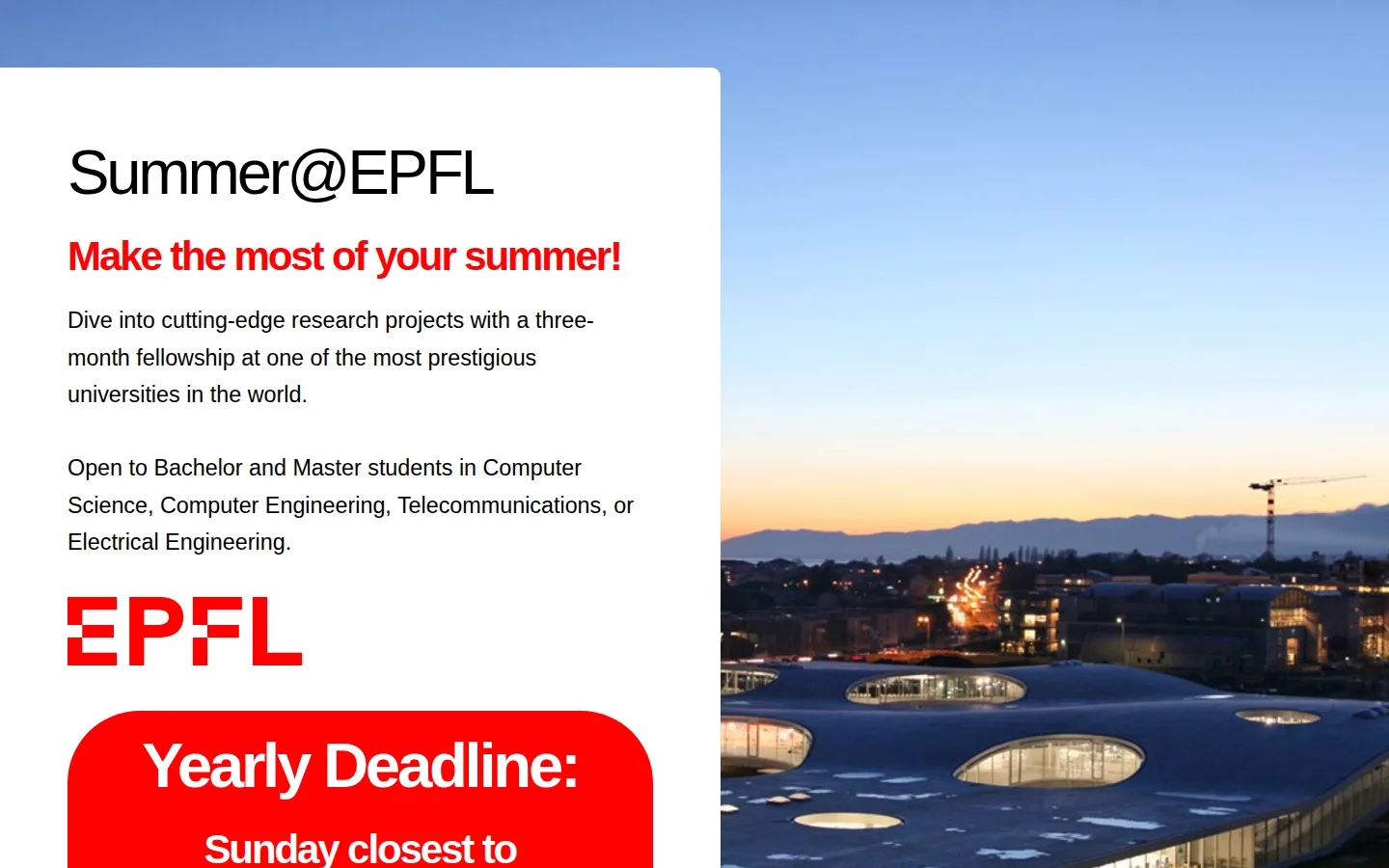
Summer@EPFL is a two-to-three-month, on-site research fellowship at EPFL's School of Computer and Communication Sciences in Lausanne. It is open to bachelor's and master's students in computer science, computer engineering, telecommunications, or electrical engineering. The next deadline is 29 November 2026 at 23:39 Anywhere on Earth, for internships in summer 2027. Fellows receive CHF 1,800 per month, pro rata, and reimbursement of travel costs.
The short answer
Summer@EPFL 2027 is open. The deadline is Sunday 29 November 2026 at 23:39 Anywhere on Earth (AOE), and decisions are communicated before 25 January 2027. The fellowship lasts two to three months, usually between May and September, with dates agreed directly with the host lab.
Fellows receive a living allowance of CHF 1,800 per month, pro rata to the actual duration, plus reimbursement of travel costs. Accommodation is not provided. The programme is only for students in computer science, computer engineering, telecommunications, or electrical engineering; PhD students and EPFL students are not eligible.
Summer@EPFL at a glance
The programme says applications may open as late as a couple of weeks before the deadline, so a short application window is normal. Do not wait for a reminder email; prepare your documents before the form opens.
| Item | What EPFL publishes |
|---|---|
| Host institution | EPFL, School of Computer and Communication Sciences |
| Location | Lausanne, Switzerland |
| Length | Two to three months |
| Period | Usually between May and September, agreed with the host lab |
| Application deadline | 29 November 2026, 23:39 Anywhere on Earth |
| Decision | Before 25 January 2027 |
| Living allowance | CHF 1,800 per month, pro rata |
| Travel | Reimbursed: second-class train ticket or low-cost/economy airfare |
| Housing | Not provided; EPFL may suggest places to look |
| Eligibility | BSc, BTech, MSc, MTech, or equivalent in computer science, computer engineering, telecommunications, or electrical engineering |
| Application | Online form with CV, transcripts, and motivation letter |
What the fellowship involves
Summer@EPFL places fellows in a research unit in EPFL's School of Computer and Communication Sciences. EPFL describes the work as participating in the life of a research unit, typically helping to solve problems that are part of larger research efforts. Many projects involve challenging programming or design tasks to prove new concepts.
There is no predefined project list. EPFL says projects are suggested by faculty directly to admitted candidates and can be discussed to find the best match between the candidate's interests and the lab's goals. That makes the application's domain and professor preferences important: they tell faculty where you might fit.
Applicants can choose up to three domains of scientific interest and up to three preferred professors. EPFL says you should express your domain preferences, but you should not name a professor if you are unsure or have no particular choice. Naming a professor who is not active in your chosen domain may hurt your application; leaving the professor field blank does not.
Who is eligible
The programme is restricted to students in computer science, computer engineering, telecommunications, or electrical engineering. You must be enrolled in a BSc, BTech, MSc, MTech, or equivalent programme at the time of the fellowship. At the time of application, you must be in at least the second year of a bachelor's degree and have successfully completed at least your first year.
EPFL says projects are offered competitively to students with excellent academic results. PhD students are not eligible. EPFL students are also not eligible; the programme is for students from other institutions, and EPFL students have a separate Summer in the Lab programme.
- You must still be enrolled in a bachelor's or master's programme during the fellowship. If you will complete your master's before the summer break, you are not eligible.
- Students from other disciplines can apply only if they have a strong interest and a provable record in the fields covered by the programme, such as relevant courses or projects. Explain that clearly in the motivation letter.
- There is no age limit or nationality restriction published on the programme page.
- The programme does not require a recommendation letter and explicitly says not to upload one.
- You need to be available for a period of two to three months, usually between May and September, as agreed with the host lab.
Allowance, travel, and accommodation
The fellowship pays CHF 1,800 per month, pro rata to the actual duration. EPFL calls this a living allowance, not a salary. The programme also refunds travel costs: a second-class train ticket or a low-cost/economy airfare. The page does not publish a fixed travel cap, so keep receipts and confirm the reimbursement process with the programme.
Accommodation is not provided. EPFL says you are in principle responsible for finding your own accommodation, although administrative staff may suggest a list of places or, in some cases, offer a specific place. Finding a room in Lausanne can be difficult, and EPFL notes that gender-segregated housing is particularly scarce. If you decline an offered place, you will generally need to find your own.
The programme does not publish a separate housing stipend, insurance allowance, or relocation payment. Budget for rent, food, local transport, and any visa costs from the CHF 1,800 monthly allowance and your own funds.
| Support | What EPFL publishes |
|---|---|
| Living allowance | CHF 1,800 per month, pro rata to the actual duration |
| Travel | Refund of a second-class train ticket or low-cost/economy airfare |
| Accommodation | Not provided; staff may suggest places to look |
| Insurance | Not described on the programme page |
| Visa | EPFL informs accepted fellows of the procedure |
| Duration | Two to three months, usually May–September |
Documents and application form
The application is submitted through EPFL's online system. You will need to fill in your personal details, choose up to three domains of scientific interest, and upload three documents: a CV, all your university transcripts, and a motivation letter. The motivation letter should be a PDF, ideally one page and no longer than two pages. Use it to describe your scientific interests and why you are applying.
Transcripts should cover your whole academic career, including your bachelor's and, if applicable, your master's so far. EPFL accepts transcripts in any form your university provides; if you only have paper copies, scan them. If your transcripts are not in English, include both the originals and a translation; the translation does not need to be official. Only PDF files are supported.
EPFL explicitly does not want recommendation letters. The programme says it does not need or consider them, and uploading letters of reference could jeopardise your application. Do not ask referees to send letters and do not upload them to the portal.
- CV: upload a current CV in PDF.
- Transcripts: upload all available university transcripts, including bachelor's and master's records.
- Motivation letter: PDF, ideally one page and no more than two pages.
- Domains: choose up to three scientific interest areas from the School of Computer and Communication Sciences.
- Professors: optionally choose up to three preferred professors, but only if you are sure their work matches your interests.
- Recommendation letters: do not upload them.
How to apply
Start by reviewing the School of Computer and Communication Sciences research pages and identifying the domains that match your background. The programme asks you to choose up to three domains, and that choice is important information for faculty in the selection process. If you are unsure about a professor, leave the professor field blank rather than guessing.
Prepare your CV, transcripts, and motivation letter before the application window closes. The form may open only a couple of weeks before the deadline, so waiting for the form to open before drafting the letter is risky. When the form is available, complete every field, upload PDFs, and submit before 29 November 2026 at 23:39 AOE.
EPFL says it does not grant individual extensions. The application website may stay open for 24 to 48 hours after the deadline to upload documents, but the programme does not guarantee this. Treat the published deadline as final.
Applications are handled by École polytechnique fédérale de Lausanne (EPFL), not by Feynman Research Labs. Start from the official application page and confirm the exact cutoff and time zone there before submitting.
Selection timeline
The deadline is 29 November 2026 at 23:39 Anywhere on Earth. Decisions are communicated by email to all applicants before 25 January 2027. EPFL says admitted candidates may receive an offer from a faculty member within approximately four to six weeks of the deadline, and applicants who are not selected receive an email when the selection process closes.
The fellowship itself usually runs between May and September, for two to three months, with the exact period agreed directly with the hosting lab. The programme says the period may or may not include the second week of July.
| Stage | Date |
|---|---|
| Application deadline | 29 November 2026, 23:39 AOE |
| Faculty offers | Usually about four to six weeks after the deadline |
| All decisions | Before 25 January 2027 |
| Fellowship period | Two to three months, usually May–September |
Common mistakes to avoid
- Missing the Anywhere on Earth deadline. 23:39 AOE is 23:39 UTC−12, not your local time.
- Applying as a PhD student. Summer@EPFL is only for bachelor's and master's students.
- Applying as an EPFL student. The programme is for students from other institutions.
- Uploading recommendation letters. EPFL says it does not consider them and they could jeopardise your application.
- Waiting for the application form to open before drafting your motivation letter.
- Naming a professor who is not active in your chosen domain, or naming one just to fill the field.
- Assuming EPFL will provide housing. Accommodation is your responsibility.
- Writing a motivation letter longer than two pages. EPFL asks for one page ideally and two pages maximum.
- Planning to finish your master's before the fellowship. You must remain enrolled during the programme.
Sources and verification
This guide was checked against the official École polytechnique fédérale de Lausanne (EPFL) page on 11 November 2026. The provider can change eligibility, funding, or dates at any time. Confirm every fact before applying.
Frequently asked questions
- Is Summer@EPFL 2027 open?
- Yes. Applications for summer 2027 are open, and the deadline is Sunday 29 November 2026 at 23:39 Anywhere on Earth.
- How much does Summer@EPFL pay?
- Summer@EPFL pays a living allowance of CHF 1,800 per month, pro rata to the actual duration, and reimburses travel costs such as a second-class train ticket or low-cost/economy airfare. Accommodation is not provided.
- Who is eligible for Summer@EPFL?
- Applicants must be enrolled in a BSc, BTech, MSc, MTech, or equivalent programme in computer science, computer engineering, telecommunications, or electrical engineering, be at least in the second year of a bachelor's, and have completed the first year. PhD students and EPFL students are not eligible.
- Does Summer@EPFL require recommendation letters?
- No. EPFL says it does not need or consider recommendation letters and asks applicants not to upload them. The required documents are a CV, transcripts, and a motivation letter.
- Can I choose my project before applying to Summer@EPFL?
- No. There is no predefined project list. Applicants choose up to three domains and optionally up to three professors; faculty suggest projects to admitted candidates and discuss the best match.
- Does Summer@EPFL provide housing?
- No. Accommodation is not provided. EPFL administrative staff may suggest places to look, but finding a place to stay in Lausanne is your responsibility.
- What is the deadline time zone for Summer@EPFL?
- The deadline is 29 November 2026 at 23:39 Anywhere on Earth (AOE), which is UTC−12. Convert it to your local time before submitting.
- When will I hear back from Summer@EPFL?
- EPFL says decisions are communicated by email to all applicants before 25 January 2027. Admitted candidates may receive a faculty offer within about four to six weeks of the deadline.
Official application link
Apply through Summer@EPFL
Applications close on 29 November 2026 at 23:39 Anywhere on Earth. EPFL controls eligibility, funding, and dates; confirm every detail on the official pages before applying.
Open official page

