
Academic guides · Guide
UTSIP Kashiwa: University of Tokyo Summer Internship Guide
StatusClosed
UTSIP Kashiwa is a seven-week research internship at the University of Tokyo's Kashiwa campus. The 2026 round is closed, with a JPY 130,000 scholarship and housing offered.
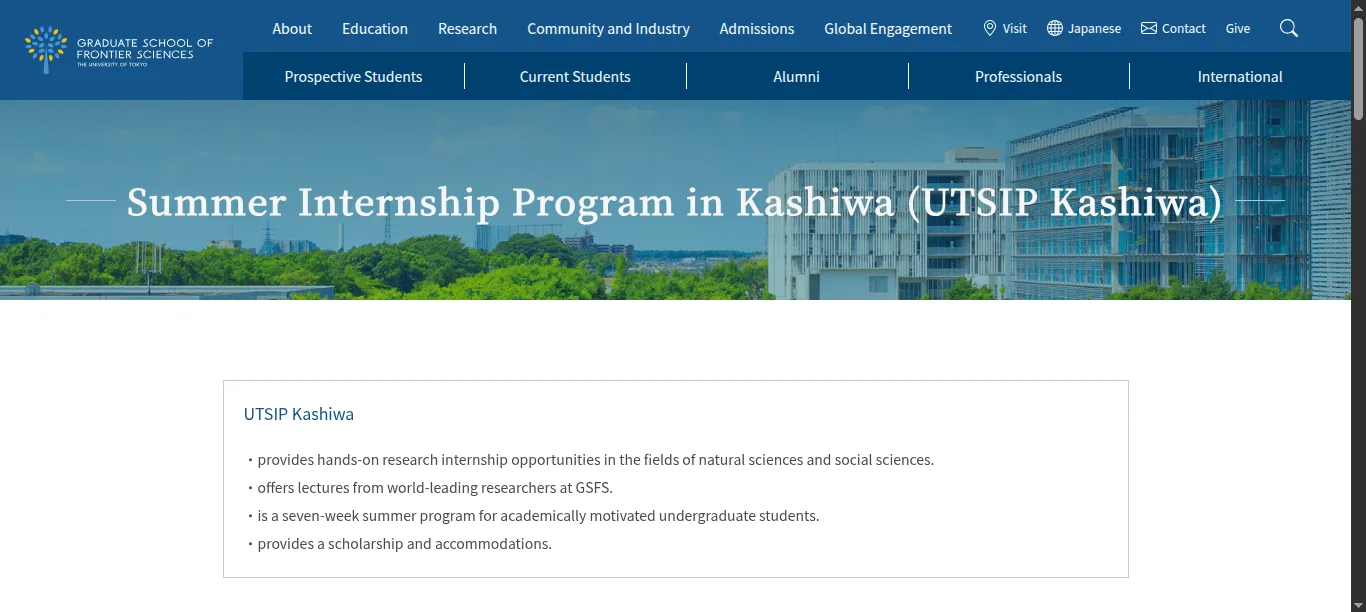
UTSIP Kashiwa is a seven-week summer research internship for undergraduates at the University of Tokyo's Kashiwa campus, run by the Graduate School of Frontier Sciences (GSFS). The 2026 programme ran from 25 May to 10 July 2026 and is now closed. Participants received a JPY 130,000 scholarship and programme accommodation, and paid a JPY 70,000 participation fee. The 2027 call has not been announced.
The short answer
UTSIP is a laboratory placement, not a lecture programme. You choose up to three host laboratories, the programme assigns you to one, and you spend most of the seven weeks working on a research project under a faculty member or senior graduate student. The 2026 round was limited to about 14 students across the natural and social sciences. The scholarship is JPY 130,000, the fee is JPY 70,000, and accommodation is provided. Applications for 2026 closed on 13 January 2026 at 17:00 Japan time; no 2027 deadline exists yet.
Quick Facts
| Item | What the official page says as of 12 November 2026 |
|---|---|
| Host | Graduate School of Frontier Sciences, University of Tokyo |
| Location | Kashiwa campus, Chiba, Japan |
| Opportunity type | Summer research internship |
| Duration | Seven weeks; 25 May to 10 July 2026 (47 days) |
| Participants | Approximately 14 in total |
| Eligibility | Undergraduate at an overseas university throughout; bachelor's not yet completed |
| Funding | JPY 130,000 UTSIP scholarship plus accommodation |
| Cost | JPY 70,000 participation fee, non-refundable |
| Application status | 2026 closed; 2027 not announced |
| Deadline | 13 January 2026, 17:00 Japan time (historical) |
| Official portal | GSFS UTSIP page |
What UTSIP is
The Graduate School of Frontier Sciences initiated UTSIP in 2013. It describes the programme as providing "hands-on research internship opportunities in the fields of natural sciences and social sciences", alongside lectures from GSFS researchers and a seven-week summer programme for "academically motivated undergraduate students".
The structure is simple. Every participant is assigned to a laboratory in which they are interested and conducts a research project under the guidance of a faculty member or senior graduate students. The programme also includes Japanese language classes and Japanese cultural experience events. The final day is a presentation summarising the research experience and findings, followed by a certificate ceremony.
UTSIP is not a general tour of Japanese science. The laboratory work is the centre of the programme. The first week is front-loaded with orientation, lectures, Japanese classes and a welcome party; the remaining weeks are spent in the laboratory after developing a research proposal, with a midterm presentation and cultural events. That shape rewards students who can work independently once they are in the group.
The programme is based at the Kashiwa campus, not the Hongo campus in central Tokyo. Kashiwa-no-ha Campus Station on the Tsukuba Express is the nearest station, about 30 minutes from Akihabara. The GSFS page notes that the campus has cafeterias and a sushi bar, with lunch around JPY 600 to 900 and dinner around JPY 700 to 1,000.
Research areas and host laboratories
UTSIP lists ten departments: Biology, Chemistry, Environmental Studies, Information Technology, International Studies, Materials Sciences, Advanced Energy, Ocean Science, Physics and Sustainability Science Studies. That breadth is unusual for a summer internship and is one reason the programme attracts students from both science and social-science backgrounds.
The host laboratories are grouped into three divisions on the 2026 laboratory list:
| Division | Research areas |
|---|---|
| Transdisciplinary Sciences | Advanced Materials Science; Complexity Science and Engineering |
| Biosciences | Integrated Biosciences; Computational Biology and Medical Sciences |
| Environmental Studies | Environment Systems; Human and Engineered Environment Studies; International Studies; Graduate Program in Sustainability Science |
Applicants choose up to three laboratories and prepare a separate cover letter for each. The programme does not require you to contact the professor in advance. That is a meaningful difference from programmes where a host acceptance is the first gate: at UTSIP, the matching is done by the programme after review.
The laboratory list is published as a PDF for each year. The 2026 list is still linked from the application page. It is the best source for project topics, because the department names are broad and the actual work is defined by the individual laboratory.
What the seven weeks look like
The 2026 schedule, labelled Program A, ran from 25 May to 10 July. The page describes the shape rather than a day-by-day timetable:
- Pre-departure: an online orientation.
- First week: orientation, lectures by leading GSFS researchers, Japanese language classes, and a welcome party.
- Remaining weeks: research under the guidance of the assigned laboratory after developing a research proposal, a midterm presentation, and Japanese cultural experience events.
- Final day: a presentation summarising the research and findings, followed by the Certificate of Completion Award Ceremony.
Participants are expected to take part in all activities, including classes, laboratory work, and special events. The page does not publish a weekly hour requirement, but the schedule implies a full-time commitment for the seven weeks.
The programme provides health insurance through GSFS for the entire period. The plan covers death or physical disability benefits up to JPY 1 million, medical benefits up to JPY 1 million, and liability up to JPY 100 million when other parties are injured. The page warns that some cases are not covered, for example damage or injury caused by the participant's own fault. All participants must submit a health certificate by the designated date.
Accommodation is in a designated facility. Participants check in one day before the programme starts and check out one day after it ends. The page warns that some participants may have to move to another accommodation mid-programme because it is difficult to secure one location for the entire period every year. That is a practical detail to plan for, not a reason to arrange your own housing.
Eligibility
The 2026 eligibility rules are short and specific:
- You must be in your undergraduate programme at an overseas college or university throughout the entire UTSIP period.
- You must not have completed your bachelor's degree or equivalent by the end of the programme.
- You should be considering matriculating to graduate-level study at GSFS, another University of Tokyo graduate school, or elsewhere in Japan.
- You must participate in all activities, including classes, laboratory work, and special events.
The page does not publish a minimum GPA, a year-of-study requirement, an age limit, or a nationality restriction. It also does not require prior research experience. The "considering graduate study in Japan" line is a statement of intent, not a commitment to enrol at UTSIP's host institution.
The English requirement is the main documentary hurdle. Applicants must submit a TOEFL iBT or PBT, IELTS, or TOEIC score report. The page does not publish minimum scores. Exemptions apply to nationals of Australia, Canada, New Zealand, the United Kingdom and the United States; students at universities in those countries; and students at universities where English is the official language. In the third case, the applicant must upload an official document from the university confirming that English is the medium of instruction.
There is no Japanese language requirement on the page. Japanese classes are part of the first week, and the research guidance may be in English or Japanese depending on the laboratory. The page does not state the language of instruction for every activity, so ask the International Liaison Office if you need confirmation for a specific laboratory.
Funding, fee and accommodation
The financial package has two sides. UTSIP provides a scholarship of JPY 130,000 and accommodation. Participants pay a participation fee of JPY 70,000. The fee must be remitted by the designated date and is non-refundable once paid, regardless of the reason.
The net cash contribution is therefore JPY 60,000 before travel, food, insurance and personal costs. The accommodation is provided in kind, not as a cash allowance. The page does not state whether the scholarship is paid before departure, on arrival, or in instalments.
The page does not state that flights are covered. It also does not state that meals are included, although it gives local meal prices. Participants should budget for return travel to Japan, local transport, food, and any visa costs. The health insurance is provided by GSFS, but the page says some cases are not covered, so additional travel insurance may be prudent.
The programme also notes that some past participants received a stipend from other organisations, including Friends of UTokyo, the MIT-Japan program, the Honda Foundation, and the UCLA Terasaki Center for Japanese Studies. Applying for another scholarship does not affect UTSIP selection, and applicants who have applied elsewhere are still considered for the UTSIP scholarship. The UTSIP application itself must still be completed by the deadline.
How to apply
The 2026 application had two steps: choose a laboratory, then apply through the UTSIP online system.
- Read the host laboratory list. The 2026 list is a PDF linked from the application page. You can apply for up to three laboratories, so rank them deliberately rather than choosing three in the same narrow area.
- Prepare a separate cover letter for each laboratory. The 2026 form asked two questions in 500 to 800 words in total: why you chose that laboratory and what you hope to gain from UTSIP, and how your experience and skills qualify you to conduct the project. Name each file with the laboratory or professor.
- Prepare a CV. Free format, A4, two to three pages. The page asks for detail on past projects, especially any research related to the project you want to do at UTSIP.
- Prepare your transcript. It must cover all undergraduate courses up to the most recent completed academic period and be in English or Japanese.
- Arrange a recommendation letter. It should come from someone who can assess your current academic ability, such as a professor at your university or a research supervisor. UTSIP provides a form in Word and PDF, and also accepts a free-format letter. The recommender may send it directly to the International Liaison Office.
- Prepare the certificate of registration, English score, passport copy and photograph. The registration certificate must show your name, university and faculty, and year and month of enrolment. The passport page must show your photograph; if you do not have a passport, submit an alternative ID with name, photo and date of birth.
- Submit before the deadline. The 2026 deadline was 13 January 2026 at 17:00 Japan time. The online system becomes inaccessible after the deadline. Late applications are not accepted.
The application page warns that the automatic reply emails can land in spam, especially for Gmail users. If you do not receive the account registration email, try again with a university address or a different provider. Your application is not complete until you have uploaded all materials using the issued user ID and password.
Timeline and current status
The 2026 cycle ran on a tight schedule:
| Stage | 2026 date |
|---|---|
| Application deadline | 13 January 2026, 17:00 Japan time |
| Selection result | 6 to 9 February 2026 |
| Confirmation of participation | Within five days of the result |
| Official acceptance letter | Early March 2026 |
| Fee payment | Late March 2026 |
| Visa application and health certificate | Late April 2026 |
| Arrival and check-in | 24 May 2026 |
| Programme start | 25 May 2026 |
| Programme end | 10 July 2026 |
| Check-out | 11 July 2026 |
As of 12 November 2026, the GSFS page says: "Applications for UTSIP 2026 are now closed. The following information is provided for your reference." It does not publish a 2027 call, deadline, programme period, fee, scholarship amount, or laboratory list.
Do not treat the 2026 dates as a 2027 timetable. The programme may change the dates, the number of places, the fee, or the scholarship. The only reliable statement is that the 2026 round is over and the 2027 round has not been announced.
If you are planning ahead, the useful preparation is not a calendar reminder. It is a shortlist of laboratories, a CV that describes your research experience in detail, and a draft cover letter that explains why each laboratory fits your background. Those materials can be adapted when the next call appears.
Selection and what makes a credible application
The page says successful participants are selected through "a comprehensive assessment of all the submitted application materials". It does not publish a rubric, a shortlisting process, or a selection rate. With about 14 places, the programme is small, and the written materials carry the decision.
A credible application has three features. First, the cover letter is laboratory-specific. It names the professor or group, explains why the work matters to you, and connects your skills to a project that could be done in seven weeks. A generic letter that could be sent to any laboratory is easy to spot.
Second, the CV shows what you have actually done. The page asks for detail on past projects and specifically invites you to describe any research related to the project you want to conduct. That is more useful than a list of courses.
Third, the recommendation letter speaks to your ability to work in a laboratory. A professor who has supervised your project can say more than a lecturer who only knows your exam grade. The page allows the letter to be sent directly, which is useful if your recommender prefers confidentiality.
The programme does not require prior contact with a professor, and the page does not encourage it. That means the cover letter has to do the work of explaining fit. If you have read the laboratory's recent papers, say so specifically. If you have a technique or programming language that the group uses, name it.
What is confirmed and what is not yet announced
Confirmed for 2026: the seven-week duration, the 25 May to 10 July dates, the approximately 14 places, the ten departments, the three laboratory divisions, the JPY 130,000 scholarship, the provided accommodation, the JPY 70,000 non-refundable fee, the insurance cover, and the document checklist.
Not announced for 2027: the application dates, the programme dates, the fee, the scholarship amount, the number of places, the laboratory list, and whether the programme will run at all. The page has not been updated with a 2027 call.
The page also does not state whether the programme will continue to be limited to Program A, whether the participation fee will change, or whether the accommodation arrangement will be the same. Check the GSFS page before you rely on any 2026 figure for a future application.
Sources
- University of Tokyo, Graduate School of Frontier Sciences, "Summer Internship Program in Kashiwa (UTSIP Kashiwa)", accessed 12 November 2026
- University of Tokyo, Graduate School of Frontier Sciences, "How to Apply", accessed 12 November 2026
- University of Tokyo, Graduate School of Frontier Sciences, UTSIP Kashiwa overview, accessed 12 November 2026
- University of Tokyo, "Special and Short-term Programs", accessed 12 November 2026
- University of Tokyo, Graduate School of Frontier Sciences, UTSIP FAQs, accessed 12 November 2026
Keep exploring
Compare this placement with other verified programmes in the opportunity finder. The UTokyo Amgen Scholars Program guide covers a different University of Tokyo summer route in biomedical research, and the OIST Research Internship guide covers a laboratory internship in Okinawa. The research programmes directory groups listings by type.
Frequently asked questions
- Is the UTSIP Kashiwa 2026 programme open for applications?
- No. The Graduate School of Frontier Sciences says applications for UTSIP 2026 are closed and that the published information is for reference. No 2027 dates, deadline, or document list have been announced as of 12 November 2026.
- Who is eligible for UTSIP Kashiwa?
- Applicants must be undergraduates at an overseas college or university for the entire programme and must not have completed a bachelor's degree. They should be considering graduate study at the Graduate School of Frontier Sciences, another University of Tokyo graduate school, or elsewhere in Japan, and must take part in all activities.
- How much does UTSIP Kashiwa pay?
- The 2026 programme offered a UTSIP scholarship of JPY 130,000 and provided accommodation. Participants paid a non-refundable participation fee of JPY 70,000. The page does not state that flights, insurance, or daily meals are covered.
- Do I need to find a professor before applying?
- No. Applicants choose up to three host laboratories from the published list, and the programme assigns participants to a laboratory. The application asks why you chose each laboratory and what you hope to gain, but it does not require prior contact with a professor.
- Is there an English language requirement?
- Yes, unless you are exempt. UTSIP asks for a TOEFL iBT or PBT, IELTS, or TOEIC score report. Exemptions apply to nationals of Australia, Canada, New Zealand, the United Kingdom and the United States, students at universities in those countries, and students at universities where English is the official language.
- Is the participation fee refundable?
- No. The page says the JPY 70,000 fee is non-refundable once paid, regardless of the reason. It must be remitted by the designated date.
- Can University of Tokyo students apply?
- Yes, but through a separate route. UTSIP was opened to students of the University of Tokyo's College of Liberal Arts in 2022, and the Graduate School of Frontier Sciences publishes a separate application page for them.
Official application link
Check the official UTSIP application page
UTSIP 2026 is closed. The Graduate School of Frontier Sciences says the page is for reference; confirm the 2027 call, dates, and documents before applying.
Open official page

