
Academic guides · Guide
DESY Summer Student Programme 2027: Application Guide and Funding
StatusClosed
DESY's 2027 summer programme is in preparation. A verified guide to the 7.5-week placement, €28.50 daily salary, free hostel, eligibility, and what is still unannounced.
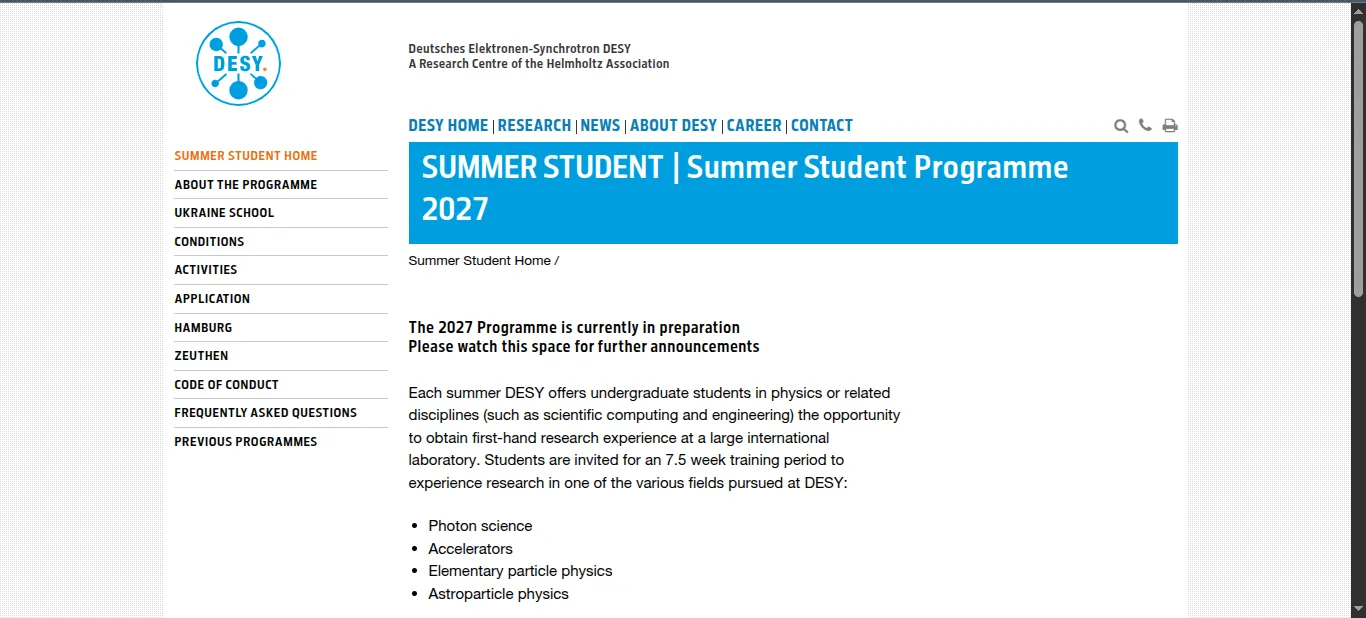
The DESY Summer Student Programme 2027 is not yet open. DESY's official programme page says the 2027 edition is "currently in preparation" and asks readers to watch the page for announcements. The application page adds that applications "will open later this year" and that DESY is not currently accepting submissions. As of 12 November 2026, there is no 2027 start date, end date, application window, deadline, or document checklist on the site.
What DESY does publish is the shape of the programme: a 7.5-week training period at the laboratory's Hamburg or Zeuthen site, for undergraduate students in physics or related disciplines, with a salary of €28.50 per calendar day, free DESY hostel accommodation, and at least partial reimbursement of travel costs. This guide separates those standing facts from the 2026 details that are still visible on parts of the site, and explains what you can prepare while the 2027 call is being written.
The short answer
The 2027 programme is announced but not open. DESY has confirmed the research areas, locations, working pattern, pay rate, accommodation, and the broad eligibility framework, but it has not published the 2027 dates or the application deadline. The most recent complete cycle, 2026, ran from 21 July to 10 September 2026 and closed applications on 31 January 2026. Those dates are useful for planning, not for quoting as 2027 facts.
The programme is structured as a paid research internship rather than a lecture course. Students join a DESY research group, carry out an individual project, attend lectures in English, and visit accelerators, experiments, and the computer centre. DESY says the working week is 39 hours, including project work and lectures.
Quick Facts
| Item | What DESY publishes as of 12 November 2026 |
|---|---|
| Status | 2027 programme in preparation; applications not open |
| Host | Deutsches Elektronen-Synchrotron (DESY), a Helmholtz Association research centre |
| Locations | Hamburg, and Zeuthen in Brandenburg, close to Berlin |
| Duration | 7.5-week training period |
| Participants | Up to 100 students in the 2026 programme |
| Who it is for | Undergraduate students in physics or related disciplines, including scientific computing and engineering |
| Salary | €28.50 per calendar day |
| Accommodation | Free DESY hostel accommodation for the full programme period |
| Travel | At least partial reimbursement; the 2025 scheme paid a €125 lump sum, plus 80% of proven costs above €300 for longer journeys |
| Working hours | 39 hours per week, including lectures and organised visits |
| Language | English; DESY says lectures are given in English |
| Credit | A certificate equivalent to 10 ECTS points |
| 2027 deadline | Not published |
What the programme is
DESY was founded in Hamburg on 18 December 1959 and now operates from two sites: its main campus in Hamburg and a smaller site in Zeuthen, close to Berlin. It is a publicly funded national research centre in the Helmholtz Association, with roughly 3,000 employees and more than 3,000 guest researchers from over 40 countries each year. Its research covers photon science, particle physics, astroparticle physics, and accelerator physics.
The summer programme is one of DESY's routes into that laboratory for students. DESY describes it as an opportunity for undergraduates to obtain "first-hand research experience at a large international laboratory". Selected students join the day-to-day work of a research group rather than following a separate teaching curriculum. The project is the centre of the placement. DESY lists the possible project types as practical work on detectors or experimental equipment, physics data analysis, software development, theory, and scientific computing.
Around the project, DESY runs a lecture series tailored to the laboratory's key research topics. The lectures are given in English, and the programme includes visits to the accelerators, experiments, and computer centre. Students are expected to work 39 hours per week, and DESY counts lectures and other officially organised activities within those hours. Social events in the evening are not counted.
DESY's 2026 announcement poster, still linked from the programme page, says the laboratory invites "up to 100 students in physics and related disciplines" each summer. The poster is the source for the cohort figure and for the 2026 dates and deadline used later in this guide. It is not a 2027 announcement.
Where you would work
DESY runs the programme at both of its sites, and the choice of site shapes the project you can be offered.
Hamburg is the larger campus and the main site for photon science, with major accelerator facilities. Students on the photon science programme work with synchrotrons, free-electron lasers, and optical lasers, and some projects run in connection with the European XFEL. The campus hosts PETRA III, the PETRA IV upgrade project, and the FLASH free-electron laser. Hamburg also hosts particle physics groups working on the ATLAS and CMS experiments at the LHC, the Belle II experiment, and the ALPS II experiment.
Zeuthen is the smaller site, in Brandenburg close to Berlin. DESY describes its research as focusing on astroparticle physics, particle physics, accelerators, and quantum computing. Astroparticle projects at Zeuthen connect to gamma-ray observatories such as CTAO and H.E.S.S., neutrino observatories such as IceCube and RNO-G, and the ULTRASAT ultraviolet telescope. Accelerator work at Zeuthen centres on PITZ, a photoinjector test facility that develops high-brightness electron sources.
The Hamburg and Zeuthen pages give travel information, local organisers, and links to lecture programmes from previous years. DESY has not published a 2027 lecture programme.
Research areas and project categories
DESY groups summer projects into three programmes, with subcategories that applicants rank. The structure is unusually detailed for a summer internship, and it is worth reading before you apply because it determines what you can be offered.
| Programme | Site | Subcategories |
|---|---|---|
| A: Photon science | Hamburg only | A1 solid-state physics and nanoscience; A2 molecular sciences; A3 soft-matter sciences; A4 development of experimental techniques; A5 lasers and optics; A6 theory and computing |
| B: Elementary particle physics, accelerators, theory, computing | Hamburg and Zeuthen | B1 physics data analysis and performance; B2 development of experimental equipment; B3 theory of elementary particles; B4 computing; M research on accelerators |
| C: Astroparticle physics | Zeuthen only | C1 analysis and observations; C2 instrumentation; C3 theory |
The activities page also gives the typical mix of Programme B projects: B1 accounts for about 40%, B2 for 33%, B3 for 10%, B4 for 3%, and accelerator projects for 12%. Those fractions describe the projects offered, not the number of places or your chance of selection.
The subcategories are not cosmetic labels. B1 projects typically involve reconstructing particles from detector data, triggering, calibration, data-quality monitoring, Higgs or top-quark physics, standard-model measurements, QCD, searches for new physics, or flavour physics, using Python, C++, and machine-learning tools. B2 projects are hardware-oriented and involve silicon trackers, gaseous detectors, data-acquisition systems, and test beams. B3 projects range from guided reading in collider phenomenology, particle cosmology, or string theory to small research projects. B4 covers data acquisition, storage, offline processing, and simulation on DESY clusters within the Worldwide LHC Computing Grid. M projects cover accelerator technology, beam instrumentation, beam dynamics, free-electron laser sources, AI-supported operation, and plasma wakefield acceleration.
Photon science projects are similarly specific. A1 covers surface preparation, nanostructure growth, and X-ray characterisation. A2 covers imaging of molecular structure and dynamics in chemistry, biology, and physics. A3 covers soft matter, including small-angle X-ray scattering, X-ray photon correlation spectroscopy, and colloidal samples. A4 covers new diffraction, scattering, spectroscopy, and imaging techniques. A5 covers laser sources, optics, diagnostics, strong-field physics, and attosecond science. A6 covers theory and numerical methods for light-matter interaction and imaging.
Applicants mark up to three categories in the online application, and DESY says the choices can be mixed. Examples on the activities page include A1, A4, A5 or B1, M, B3 or C3, C2, C1, and cross-programme combinations such as A5, B1, C1. DESY warns that the number of places differs between subcategories, so a first-choice topic is not guaranteed.
One sentence on the activities page deserves emphasis: "Please be aware that the large majority of projects we offer are for physics students!" The programme is open to related disciplines, but it is not a general science internship.
Who is eligible
DESY's conditions page still carries 2026 wording. It says applicants should have completed at least three years of full-time study at university level in physics, related natural science disciplines, or computing "by the summer of 2026", and it refers to the 2026 programme dates. DESY has not yet updated the page for 2027. The rules below are therefore the current published framework, not a confirmed 2027 rulebook.
- Study level. Applicants should have completed at least three years of full-time university study in physics, a related natural science discipline, or computing.
- Stage. DESY targets two groups: students who are about to obtain a bachelor's degree, and students who hold a bachelor's degree and are enrolled in a master's programme.
- Master's holders. Applicants who already hold a master's degree, or will hold one by the summer of the programme, cannot be accepted.
- Previous participation. Applicants who have previously been at DESY as a summer student are not eligible.
- Enrollment. Students must be enrolled at their university for the whole period of the programme. DESY says this is a necessary condition under German employment law for paid internships and that it cannot make exceptions.
- Language and computing. Applicants should have a good working knowledge of English and some basic computing skills.
- Nationality and institution. DESY has suspended all participation of Russian and Belarusian institutes in its scientific projects, and says it does not accept applications from students enrolled at Russian or Belarusian universities, regardless of citizenship.
- Full-period participation. Students are expected to take part for the full programme period. DESY's FAQ says the dates are fixed and that participation over a different period is not possible, although it allows a possible exception of up to one week for strong reasons, ideally discussed before accepting a place.
The phrase "undergraduate" on the home page and the "three years of full-time study" rule on the conditions page fit together more narrowly than they first appear. DESY is not inviting students in the first two years of a bachelor's degree. It is inviting students near the end of a bachelor's, or already in a master's. If you are in the second year of a four-year degree, you are likely to be too early, even though you are an undergraduate.
The enrollment rule is the one that catches final-year students. If your bachelor's ends before the programme finishes, or if you graduate in the summer and are not enrolled in a master's for the full period, you may not meet the German employment requirement. DESY states the rule plainly, and it is worth checking with your university's registrar before you spend time on an application.
Funding and conditions
DESY publishes the core financial terms on its home page and expands them in the FAQ. The figures below are the published rates; the 2027 total depends on the number of days DESY finally schedules.
| Item | What DESY publishes |
|---|---|
| Salary | €28.50 per calendar day |
| 2026 example | 52 days from 21 July to 10 September 2026, calculated by DESY as €1,482, paid in three instalments |
| Payment method | Bank transfer to an IBAN account, or a cheque exchangeable within eight days at a nearby bank |
| Accommodation | Free DESY hostel for the full programme period; single room with private bathroom, furnished, bed linen and towels provided, shared kitchens and laundry |
| Travel | At least partial reimbursement; 2025 scheme: €125 lump sum, plus 80% of proven costs above €300 for longer journeys |
| Health insurance | Mandatory for the entire stay at DESY |
| Liability insurance | Strongly recommended but not mandatory |
| Credit | Certificate stating the work is equivalent to 10 ECTS points |
| Meals, local transport, visa fees | Not listed as covered |
The salary is a daily rate, not a lump sum. DESY's FAQ calculates the 2026 payment as €1,482 for 52 calendar days and says it is paid in three instalments: at the end of July for the days worked to that point, at the end of August for the full month, and at the end of September, or shortly before departure for students paid by cheque. A bank account in a currency other than euros may attract conversion fees.
Accommodation is provided in the DESY hostel at no cost for the programme period. The FAQ describes single rooms with private bathrooms, furnished with a bed, blankets, bedsheets, towels, a desk, and a chair. Common kitchens and laundry and ironing facilities are available. The hostel is for DESY guests only and cannot house family or friends. Students who choose alternative accommodation pay for it themselves.
Travel support is partial, not full. The FAQ's rules were written for 2025 and say DESY expected a similar scheme for 2026, to be updated once finalised. Under those rules, every summer student receives a €125 lump sum regardless of actual travel costs. Students travelling from further abroad who incur more than €300 in total travel costs can apply after arrival for 80% of the costs above €300. DESY reimburses only proven costs for the most economical connections, such as economy-class flights and second-class trains. The FAQ gives a worked example: €1,200 in travel costs produces €125 plus 80% of €900, or €845. The 2027 scheme has not been published.
Health insurance is mandatory for the entire stay. DESY's FAQ links to the International Office's guidance on medical insurance and on liability insurance. Liability insurance is not mandatory but is strongly recommended.
The current conditions page also says DESY will issue a certificate stating that the work performed is equivalent to 10 ECTS points. That is a recognition statement from DESY, not a guarantee that your home university will award transfer credit. Ask your department how it treats the certificate before you rely on it.
How to apply
DESY has not opened the 2027 application. The application page currently says: "We are not currently accepting applications!" and "Applications for the 2027 programme will open later this year." There is no form, no document list, and no deadline on the page.
The most detailed official application instructions still accessible are from the 2025 cycle, preserved in the Internet Archive. They are useful as a preparation checklist, but they are not 2027 rules. In that cycle, DESY asked applicants to:
- Read the conditions and activities pages first. DESY asked applicants to proceed only if they accepted the conditions, including full-period participation, and to identify preferred research areas before starting the form.
- Upload a single PDF containing a CV in tabular form and university grade certificates. DESY suggested one to two pages for the CV and asked for personal data, educational history, relevant work experience, and computing and other skills.
- Upload a second PDF if applying from a non-EU or non-EEA country. This was for the German work permit and had to contain a passport copy, a certificate of enrollment covering the whole programme period, and a "Declaration of Certificate of Enrollment" signed and stamped by the university.
- Name two referees. Applicants had to ask permission before entering referees' names and email addresses; the system then emailed each referee instructions for uploading a letter.
- Choose three activity areas in order of priority in the online form.
- Submit before the deadline. In 2025 the deadline was 31 January 2025, and DESY warned that a missing document would mean the application was not considered.
DESY also said the selection process would take place after the online phase closed, that all applicants would be notified by the end of March, and that project supervisors might contact applicants in February or March with questions about their interest and suitability for specific projects.
None of that is confirmed for 2027. The 2027 form may ask for different documents, different referee arrangements, or a different declaration. Use the 2025 list to gather materials early, then check the 2027 page before uploading anything.
What is already confirmed about the 2027 application is the structure of the choice: applicants mark up to three project categories, can mix categories, and can indicate a preference for Hamburg or Zeuthen. The activities page says applicants are encouraged to state whether they prefer Hamburg or Zeuthen and, for Hamburg, whether they have a preferred research area. Selection for projects in specific fields typically requires a minimum level of prior knowledge, for example from relevant lecture courses.
Timeline: what is known and what is not
DESY has not published a 2027 timeline. The two previous cycles are the best available guide to the rhythm of the programme, but they are history, not a schedule.
| Cycle | Application deadline | Programme dates | Cohort |
|---|---|---|---|
| 2025 | 31 January 2025 | 22 July to 11 September 2025 | Not stated on the pages reviewed |
| 2026 | 31 January 2026 | 21 July to 10 September 2026 | Up to 100 students |
| 2027 | Not published | Not published | Not published |
Both recent cycles closed on 31 January and ran for 52 days from late July to early September. That is a consistent pattern, and it is reasonable to plan as if a late-January deadline is possible. It is not reasonable to treat 31 January 2027 as the deadline until DESY says so. The application page says only that the window will open "later this year", which, on a page published in 2026, most naturally means later in 2026.
The programme page also still links to the 2026 poster, and the conditions page still refers to summer 2026 and to 21 July to 10 September. These are signs of a site in the middle of its annual update, not evidence that the 2027 dates have been set.
Selection
DESY does not publish selection criteria, a scoring rubric, an acceptance rate, or a 2027 notification date on the pages reviewed for this guide. The 2025 application page said only that selection would happen after the application phase and that all applicants would be notified by the end of March. It did not describe how projects are assigned beyond the category choices and the possibility that supervisors would make contact.
Some inferences are safe because DESY states them. The large majority of projects are for physics students. Some subcategories require prior knowledge: B3 says selection for specific fields typically requires a minimum level of prior knowledge from relevant lecture courses. B1 projects use Python and C++, and the conditions page asks for basic computing skills. Photon science projects range from sample preparation and hands-on optics to numerical theory, so the relevant preparation depends on the subcategory.
Beyond that, the strongest application is likely to be one that matches the published categories rather than one that lists prestigious areas without evidence. A CV that shows relevant coursework, a computational project, a laboratory course, or a previous research placement gives reviewers something concrete to match to a project. Reference letters from people who have seen you work are more useful than letters that only confirm attendance.
Practical preparation
The waiting period is useful. Several tasks can be done now, and doing them early avoids the usual January compression.
- Check your enrollment dates. Map your university's enrollment periods against a late-July-to-early-September placement. If there is a gap, ask your registrar whether you can remain enrolled for the full period. DESY says it cannot make exceptions.
- Request grade certificates. The 2025 form asked for university grade certificates in the same PDF as the CV. Transcripts can take weeks to issue, especially at the end of a semester.
- Confirm your passport. If you need a visa, DESY sends an invitation letter by courier after you accept a place. The FAQ says to book an embassy appointment only once you have the invitation letter and a copy of your medical insurance policy. Check passport validity now.
- Ask referees early. The 2025 form required two referees and asked for their permission before entering their details. Tell them what the programme is, why you are applying, and which projects you are targeting.
- Prepare a tabular CV. DESY asked for a tabular CV of one to two pages, with education, relevant work experience, and computing skills. A dense academic narrative is less useful than a clear table.
- Read the activities page properly. Choose three subcategories that you can justify. If you are applying to B3, be ready to name relevant lecture courses. If you are applying to B1, show programming. If you are applying to A5, show optics or laser laboratory experience.
- Arrange insurance. Health insurance is mandatory for the entire stay. The DESY International Office publishes guidance; read it before you compare policies.
- Do not book travel. Wait for the invitation and the programme dates. Travel reimbursement is partial and is paid after arrival.
- Use the official contact sparingly. DESY asks applicants to check the webpages and FAQ first, then write to summie-org@desy.de if the answer is not there. It warns that email replies may be slow at some periods.
What is confirmed and what is not yet announced
The distinction matters more than usual this year, because DESY's site mixes 2026 content with 2027 headings. The table below separates the two.
| Confirmed for the programme | Not yet announced for 2027 |
|---|---|
| The 2027 programme exists and is "currently in preparation" | 2027 start and end dates |
| The training period is 7.5 weeks | Application opening date |
| The programme runs in Hamburg or Zeuthen | Application deadline |
| Research areas: photon science, accelerators, elementary particle physics, astroparticle physics | Application form and portal |
| Participants work 39 hours per week | Required documents and referee arrangements |
| Lectures are given in English | Notification date |
| Visits to accelerators, experiments, and the computer centre | 2027 salary total and payment schedule |
| Salary of €28.50 per calendar day | 2027 travel reimbursement scheme |
| Free DESY hostel accommodation for the full period | 2027 cohort size |
| At least partial travel reimbursement | Whether the conditions page will change its study-level wording |
| A certificate equivalent to 10 ECTS points (current conditions page) | Whether the 2027 programme will again run for 52 days |
| Eligibility framework on the current conditions page | Confirmation that the 2026 eligibility rules carry over unchanged |
Two inconsistencies are worth flagging. First, the home page describes a 7.5-week training period, while the FAQ describes the 2026 programme as "seven weeks" from 21 July to 10 September, which is 52 days or about 7.4 weeks. The difference is small, but it shows why the final 2027 dates matter for budgeting and for your university's enrollment certificate. Second, the conditions page still refers to summer 2026, and the home page still links to the 2026 poster. Neither has been updated for 2027.
Keep exploring
Compare this programme with other verified placements in the opportunity finder. The research programmes directory groups guides by programme type, and the CERN doctoral studentship guide explains how to read a large laboratory's official requirements without filling gaps from third-party summaries.
Sources
This guide was checked against DESY's official pages on 12 November 2026. The 7.5-week duration, research areas, 39-hour week, €28.50 daily rate, free hostel, travel support, English lectures, and visits are taken from the programme home page and FAQ. The eligibility framework is from the conditions page, which still carries 2026 wording. The 2026 dates, deadline, and cohort figure are from DESY's official 2026 poster. The application document list is from DESY's 2025 application page as archived by the Internet Archive.
- DESY, "Summer Student Programme 2027," accessed 12 November 2026
- DESY, "About the Programme," accessed 12 November 2026
- DESY, "Conditions," accessed 12 November 2026
- DESY, "Activities," accessed 12 November 2026
- DESY, "Application," accessed 12 November 2026
- DESY, "Frequently Asked Questions," accessed 12 November 2026
- DESY, "Hamburg," accessed 12 November 2026
- DESY, "Zeuthen," accessed 12 November 2026
- DESY, "Code of conduct," accessed 12 November 2026
- DESY, "About DESY," accessed 12 November 2026
- DESY, "Summer Students" poster for 2026, archived 17 June 2026
- DESY, "Application" page for the 2025 cycle, archived 18 November 2024
Frequently asked questions
- Is the DESY Summer Student Programme 2027 open for applications?
- No. DESY says the 2027 programme is currently in preparation and that applications will open later this year. As of 12 November 2026 the application page is not accepting submissions, and no 2027 deadline has been published.
- What are the 2027 programme dates?
- DESY has not published them. The 2026 programme ran from 21 July to 10 September 2026, but DESY has not said that the 2027 edition will use the same dates. Treat every 2026 date as historical, not as a 2027 deadline.
- How much does the DESY Summer Student Programme pay?
- DESY pays €28.50 per calendar day, provides free DESY hostel accommodation for the full programme, and reimburses at least part of travel costs. For the 52-day 2026 programme, DESY's FAQ calculated €1,482 paid in three instalments. The 2027 total depends on the final dates.
- Who is eligible for the DESY Summer Student Programme?
- DESY invites undergraduate students in physics or related disciplines such as scientific computing and engineering. Its conditions page, still written for 2026, asks for at least three years of full-time university study, targets students about to finish a bachelor's degree or already enrolled in a master's, excludes applicants who already hold a master's, and excludes anyone who has previously been a DESY summer student.
- Do I have to be enrolled at university during the programme?
- Yes. DESY says German rules for paid internships require students to be enrolled at their university for the whole programme period, and that it cannot make exceptions. This condition is easy to miss in a final bachelor's year, so confirm your enrollment status before applying.
- Is accommodation included?
- Yes. DESY provides free accommodation in the DESY hostel for the full programme period. Rooms are single rooms with private bathrooms and are furnished; common kitchens and laundry facilities are available. If you choose alternative accommodation, you pay for it yourself.
- Can international students apply?
- Yes. DESY accepts applications from students at universities outside Germany, subject to German work-permit rules. In the 2025 cycle, applicants from non-EU and non-EEA countries had to upload a passport copy, an enrollment certificate covering the full programme period, and a signed university declaration. DESY has not published the 2027 document list yet.
- Which research areas can I choose?
- Applicants can mark up to three project categories and can mix them. The categories are photon science (Hamburg only), elementary particle physics, accelerators, theory and computing (Hamburg and Zeuthen), and astroparticle physics (Zeuthen only). A first-choice category is not guaranteed.
Official application link
Check DESY's official 2027 application page
DESY says the 2027 programme is in preparation and applications will open later this year. No 2027 deadline or document list has been published as of 12 November 2026.
Open official page

