
Academic guides · Guide
RIKEN CBS Summer Program 2027: Neuroscience Internship Guide
StatusOpen
RIKEN CBS 2027 offers a two-month neuroscience internship or a five-day lecture course near Tokyo, with travel and accommodation support by region. Applications close 8 January 2027.
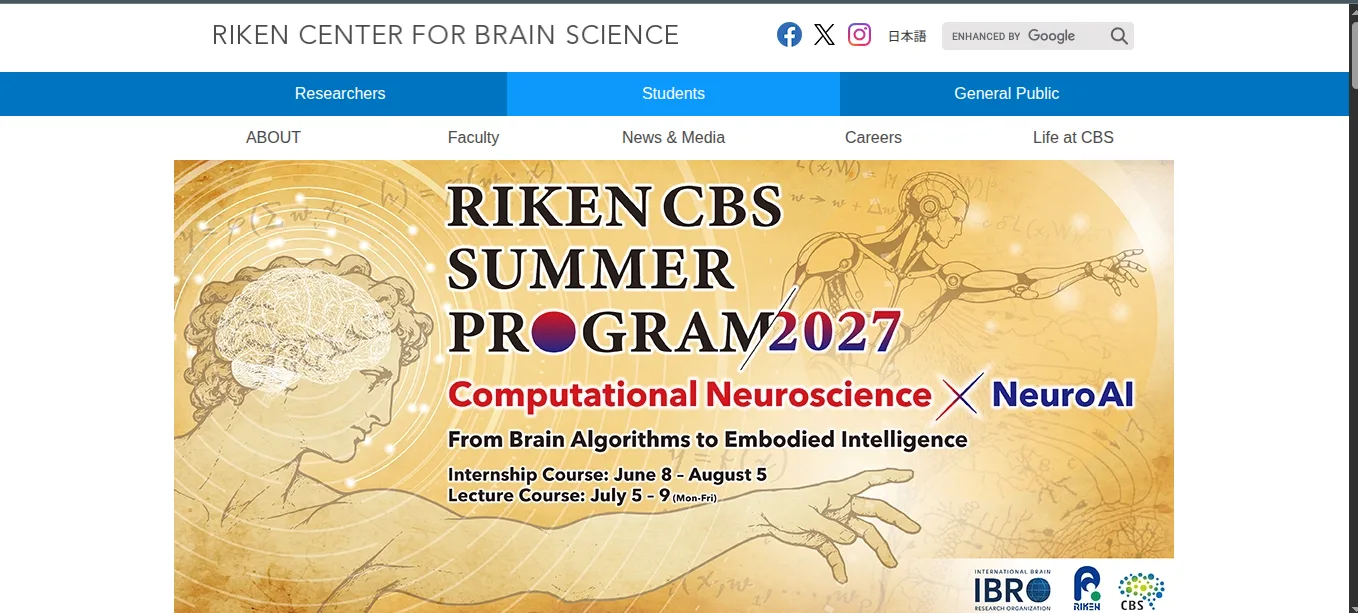
The RIKEN CBS Summer Program 2027 offers two routes into the Center for Brain Science: Plan A, a two-month laboratory internship from 8 June to 5 August 2027, and Plan B, a five-day lecture course from 5 to 9 July 2027. Both run on site at RIKEN's Wako Campus in Saitama, just outside Tokyo. Applications opened on 9 November 2026 and close at 9:00 a.m. Japan Standard Time on 8 January 2027, and financial support for travel and accommodation is available on request, subject to regional caps.
Quick Facts
| Item | Detail |
|---|---|
| Host | RIKEN Center for Brain Science (RIKEN CBS) |
| Location | RIKEN Wako Campus, 2-1 Hirosawa, Wako, Saitama, Japan |
| Opportunity type | Two-month laboratory internship (Plan A) or five-day lecture course (Plan B) |
| Duration | Plan A: 8 June – 5 August 2027; Plan B: 5–9 July 2027 |
| Eligibility | Beyond high school; enrolled at an institution or company throughout; full on-site participation |
| Funding | Accommodation and airfare or Shinkansen reimbursement up to 100,000–300,000 JPY by region, on approval |
| Application status | Open |
| Deadline | 9:00 a.m. JST, 8 January 2027 |
| Official portal | https://cbs.riken.jp/en/summer/ |
What the RIKEN CBS Summer Program is
RIKEN CBS is the brain science institute of RIKEN, Japan's national research organisation. Its summer programme is built around a single annual theme and admits participants from a wide range of academic backgrounds. RIKEN says participants are usually enrolled in graduate programmes or have recently begun postdoctoral research, but that applicants in other positions are also encouraged to apply.
The two plans are different commitments rather than two tiers of the same programme. Plan A places an intern in a host laboratory for two months and requires participation in the lab's research activities, a poster during the lecture week, a Neuroethics workshop and a final research presentation. Plan B is a five-day taught course with poster sessions and lab visits.
Applicants can choose either plan or both. Those applying for both select "Both" in the application form rather than submitting separate applications. Interns may attend the lecture course as well, provided their laboratory schedule permits, and RIKEN says they will have opportunities to interact with lecture-course participants and invited speakers.
All lectures, discussions and poster sessions are in English, and every application document must be prepared in English. Japanese is not required. The programme is sponsored by the International Brain Research Organization.
Plan A and Plan B compared
| Feature | Plan A: Internship | Plan B: Lecture Course |
|---|---|---|
| Dates | 8 June – 5 August 2027 | 5–9 July 2027 |
| Length | Two months | Five days |
| Format | Research in a host laboratory | Lectures, poster sessions, lab visits |
| Accommodation | RIKEN I-House E/G/H | Hotel Toyoko Inn in front of Wako-Shi Station |
| Project description required | Yes | No |
| Poster required | Yes, during lecture week | Yes |
| Final presentation | Yes, at the end of the internship | No |
| Neuroethics workshop | Required | Included in the lecture schedule |
The internship period is fixed and cannot be adjusted for individual convenience. RIKEN states this directly: the internship must take place within the designated two months. Applicants who cannot be on site for the whole period, or who need a shorter placement, are not eligible for Plan A.
Plan A also carries two requirements that Plan B does not: accident insurance purchased at the participant's own expense, and a medical examination completed within six months before departure, with the form completed by a physician in English or Japanese.
The 2027 theme and speakers
The 2027 theme is "Computational Neuroscience x NeuroAI — From Brain Algorithms to Embodied Intelligence." RIKEN frames it around how brains achieve intelligence so flexibly and efficiently, and what that can teach the next generation of AI.
The programme brings together lecturers in computational and systems neuroscience, NeuroAI, embodied intelligence, brain-computer interfaces and AI ethics. The aim, as RIKEN describes it, is to connect neural circuits, learning theory, robotics and embedded systems, and to ask how biological principles can inspire adaptive, interpretable and resource-efficient AI.
The confirmed speakers are:
- Yoram Burak, Hebrew University
- Lea Duncker, Columbia University
- Marta Garrido, University of Melbourne
- Yasuo Kuniyoshi, University of Tokyo and RIKEN CBS
- Daniel Wolpert, Columbia University
- Daniel Yamins, Stanford University
- Karen Yan, National Yang Ming Chiao Tung University
- Natsue Yoshimura, Institute of Science Tokyo
- Zhengtuo Zhao, Institute of Neuroscience, University of Chinese Academy of Sciences
- Toshitake Asabuki, Takuya Isomura and Louis Kang, RIKEN CBS
RIKEN notes that speakers are subject to change. The organising committee is chaired by Taro Toyoizumi and includes Toshitake Asabuki, Takuya Isomura, Asako Kanezaki of AIP, Louis Kang, Masato Taki of iTHEMS and Aya Takeoka. The programme is also designed to foster exchanges with researchers from RIKEN CBS, AIP and iTHEMS.
Host laboratories
Thirteen laboratories are listed as potential hosts for the 2027 internship. The list is the most useful part of the site for anyone choosing Plan A, because the project description must be written for a specific lab.
| Principal investigator | Laboratory |
|---|---|
| Adrian Moore | Neurodiversity |
| Aya Takeoka | Motor Circuit Plasticity |
| Hokto Kazama | Circuit Mechanisms of Sensory Perception |
| Jun Nagai | Glia-Neuron Circuit Dynamics |
| Kazuhisa Shibata | Human Cognition and Learning |
| Kentaro Miyamoto | Imagination and Executive Functions Team |
| Louis Kang | Neural Circuits and Computations Unit |
| Lukas Ian Schmitt | Distributed Cognitive Processing |
| Masako Tamaki | Cognitive Somnology RIKEN Hakubi Research Team |
| Nobutaka Hattori | Neurodegenerative Disorders Collaboration Laboratory |
| Takuya Isomura | Brain Intelligence Theory Unit |
| Taro Toyoizumi | Neural Computation and Adaptation |
| Thomas McHugh | Circuit & Behavioral Physiology |
The range covers experimental systems neuroscience, human cognitive work, computational modelling and clinical collaboration. Several units — Brain Intelligence Theory, Neural Computation and Adaptation, Neural Circuits and Computations — are theory-heavy, while others are primarily experimental.
RIKEN encourages applicants to contact prospective lab heads in advance with a proposal describing what they would like to do. That is unusual among Japanese summer programmes and is the single most important preparation step for Plan A.
Eligibility and requirements
RIKEN's eligibility rules are short but strictly applied.
| Requirement | Detail |
|---|---|
| Education level | Beyond high school; high school students are not eligible |
| Enrolment | Enrolled at an academic institution or company at application and throughout the programme |
| Gap year | Certificate of enrolment required from the institution to be attended during the programme |
| Attendance | Full on-site participation for the entire period; no shortened participation |
| Passport | Valid passport required for non-Japanese nationals |
| Visa | Participant's responsibility if one is required |
| Language | English for all documents, lectures and poster sessions |
The enrolment rule is the one most likely to catch applicants out. RIKEN requires an official institutional affiliation from the time of application through the end of the programme. A student who graduates in the spring and has not yet enrolled in a graduate programme must supply a certificate of enrolment from the institution they will attend during the summer.
The on-site rule is equally firm. RIKEN states that both plans require full on-site participation, that applicants must be able to travel to the venue, and that there is no shortened participation period. Plan A's two months are fixed and cannot be moved for individual convenience.
There is no published minimum GPA, no language test score, and no subject-specific degree requirement. The motivation letter and, for Plan A, the project description carry the burden of showing fit.
Funding, stipend and costs
RIKEN does not offer a stipend or salary. What it offers is reimbursement of specific costs, and only if the participant requests support at application and the request is approved.
| Cost | What RIKEN provides |
|---|---|
| Registration fee | None |
| Accommodation | Covered if financial support is approved; otherwise paid by the participant |
| Round-trip airfare, or Shinkansen fare within Japan | Reimbursed up to a regional cap, if approved |
| Meals and daily living costs | Participant's responsibility |
| Accident insurance (Plan A) | Participant's responsibility |
| Medical examination (Plan A) | Participant's responsibility |
| Local transport and incidental costs | Participant's responsibility |
The regional caps are published on the Before Applying page. They apply to flight ticket reimbursement, and RIKEN notes that actual amounts may vary with exchange rates:
- Europe, the Middle East, Africa, and North and Latin America: 300,000 JPY
- India and Oceania: 150,000 JPY
- Asia: 100,000 JPY
Two conditions narrow eligibility for support. Participants who receive a salary or other financial support are not eligible, and anyone who does not submit a financial support request at the time of application cannot be reimbursed later. The request is a separate letter explaining why support is needed; there is no format or length requirement.
The reimbursement mechanism also imposes practical constraints. Participants must buy airfare and domestic transport in advance and are reimbursed only after returning home and submitting the required documents. They must follow RIKEN's travel itinerary and regulations, and any extra cost from personal travel arrangements is theirs. That means an approved applicant still needs enough cash or credit to cover the ticket up front.
Accommodation is assigned rather than chosen. All participants except those living within commuting distance are placed in designated accommodation, and only those with approved financial support are exempt from the cost. Plan A participants stay at RIKEN I-House E/G/H; Plan B participants stay at the Hotel Toyoko Inn in front of Wako-Shi Station. Rooms are single in principle but may be shared depending on availability, and participants cannot choose their room type or stay with family or friends who are not in the programme.
How to apply
The application cannot be saved as a draft, so every document must be ready before the form is opened. RIKEN also warns that incomplete applications are not reviewed and that failure to follow instructions may lead to elimination at an early stage.
- Confirm your eligibility and dates. Check that you are beyond high school, enrolled throughout the programme period, and able to be on site for the full period of your chosen plan.
- Choose Plan A, Plan B, or both. If you want both, select "Both" in the form rather than submitting two applications.
- Contact potential lab heads for Plan A. RIKEN encourages this, and a project description written after a conversation with the lab is far stronger than one written cold.
- Prepare the CV. Include education with current affiliation, highest degree and years attended, listed from the most recent degree, plus research experience and publications. Any format is accepted.
- Write the motivation letter. About 500 words, covering your reasons for applying, your research background, and how you plan to use what you learn in your current and future research.
- Write the internship project description (Plan A only). Be as specific as possible, state whether you are familiar with the experimental techniques you plan to use, and define goals that can be achieved within two months. There is no format or length requirement.
- Write the financial support request if needed. This is a separate letter explaining why you require support. It must be submitted with the application.
- Ask your supervisor for the recommendation letter. One letter is required for either plan. The recommender uploads it directly through a link sent automatically after you submit, and the applicant is responsible for ensuring it arrives by the deadline. Late letters are not accepted.
- Submit before the deadline and keep the confirmation email. It contains a URL that lets you edit the application until the deadline. Multiple applications are permitted, but only the most recent submission is considered valid.
Documents required for Plan A are a CV, motivation letter, internship project description, one letter of recommendation, and a financial support request letter if applicable. Plan B requires the CV, motivation letter, one letter of recommendation, and the financial support letter if applicable.
Timeline and current status
As of 12 November 2026, the 2027 application is open. The window runs from 9 November 2026 at 9:00 a.m. JST to 8 January 2027 at 9:00 a.m. JST.
| Date | What happens |
|---|---|
| 9 November 2026, 9:00 JST | Applications open |
| 8 January 2027, 9:00 JST | Applications and recommendation letters close |
| Mid-February 2027 | Selection results announced by email |
| 8 June 2027 | Plan A orientation |
| 5–9 July 2027 | Plan B lecture course |
| 5 August 2027 | Plan A final presentation and closing ceremony |
The deadline time is worth noting twice. It is 9:00 a.m. JST, not midnight, and Japan Standard Time is nine hours ahead of UTC. An applicant in Europe or the Americas loses most of the final day unless they plan for the time difference.
RIKEN also warns that acceptance does not guarantee participation: a visa may fail to arrive in time because of political or global circumstances.
Selection and what makes a credible application
RIKEN publishes almost nothing about its selection criteria. It says results are announced around mid-February, that individual feedback is not provided, and that the office cannot accept inquiries about project proposals. Applicants must infer the basis from the documents.
The document set is the best guide. The motivation letter is capped at about 500 words, which is short enough that a generic statement about an interest in neuroscience will not carry much weight. RIKEN asks specifically how you plan to incorporate what you learn into your current and future research, which rewards applicants who can describe a trajectory rather than an ambition.
For Plan A, the project description does most of the differentiating work. RIKEN asks for clearly defined goals achievable within the internship period and for an explicit statement of whether you are familiar with the experimental techniques you propose. A proposal that names a technique you have not used, without saying so, is weaker than one that is honest about what you can already do. Because RIKEN encourages contact with prospective lab heads in advance, an applicant who has discussed a project with a lab has a large advantage over one who has not.
The recommendation letter is the only external assessment. RIKEN asks for one letter from an academic supervisor, uploaded directly by the referee, so the choice of referee matters more than the number of letters.
The theme also shapes fit. The 2027 programme is explicitly about computational neuroscience and NeuroAI, linking brains, bodies, behaviour and machines. An applicant whose background is in machine learning, robotics, control theory or physics can make a credible case, but the application should connect that background to the theme rather than to neuroscience in general.
What is confirmed and what is not yet announced
Confirmed: the 2027 theme, the two plans and their dates, the 9 November 2026 to 8 January 2027 application window, the 13 host laboratories, the speaker list, the document requirements, the one-letter recommendation rule, the regional reimbursement caps, the designated accommodation, and the mid-February results date.
Not announced: the number of places in either plan, the number of applicants in previous years, the acceptance rate, and the exact amount of accommodation support. RIKEN says detailed financial support and travel arrangements are provided to successful applicants only. The speaker list is explicitly subject to change, and the programme office does not give feedback on individual applications.
Sources
- RIKEN CBS, "RIKEN CBS Summer Program 2027," accessed 12 November 2026
- RIKEN CBS, "Before Applying," accessed 12 November 2026
- RIKEN CBS, "Apply 2027," accessed 12 November 2026
- RIKEN CBS, "Theme & Speakers 2027," accessed 12 November 2026
Keep exploring
For a Japanese internship in genetics with a different funding model, the NIG-INTERN 2026 guide explains the prefinal-year route at the National Institute of Genetics. The OIST research internship guide covers a graduate-level placement in Okinawa. The research programmes directory groups opportunities by type.
Frequently asked questions
- Is the RIKEN CBS Summer Program 2027 open for applications?
- Yes. Applications opened on 9 November 2026 at 9:00 a.m. Japan Standard Time and close on 8 January 2027 at 9:00 a.m. JST. Late applications are not accepted for any reason.
- What is the difference between Plan A and Plan B at RIKEN CBS?
- Plan A is a two-month laboratory internship from 8 June to 5 August 2027 in a RIKEN CBS laboratory. Plan B is a five-day lecture course from 5 to 9 July 2027. Applicants may apply for either or both, and interns may attend the lecture course if their laboratory schedule permits.
- Does the RIKEN CBS Summer Program pay for travel and accommodation?
- Financial support is available on request and subject to approval. It covers accommodation and round-trip airfare, or Shinkansen fare for travel within Japan, up to regional caps: 300,000 JPY for Europe, the Middle East, Africa and the Americas; 150,000 JPY for India and Oceania; and 100,000 JPY for Asia.
- Who is eligible for the RIKEN CBS Summer Program?
- Applicants must be beyond high school level, enrolled in an academic institution or company at the time of application, and enrolled throughout the programme. Full on-site participation for the entire period is required, and non-Japanese nationals need a valid passport.
- Do I need to speak Japanese for RIKEN CBS?
- No. RIKEN CBS states that all lectures, discussions and poster sessions are conducted in English, and all application documents must be prepared in English.
- How many host laboratories are available for the 2027 internship?
- RIKEN CBS lists 13 host laboratories for 2027, covering neurodiversity, motor circuit plasticity, sensory perception circuits, glia-neuron dynamics, human cognition and learning, imagination and executive functions, neural circuits and computation, cognitive processing, sleep, neurodegenerative disorders, brain intelligence theory, neural computation and adaptation, and circuit and behavioural physiology.
- When are RIKEN CBS selection results announced?
- RIKEN CBS says selection results are announced by email around mid-February. Individual feedback on selection results is not provided.
- Is there a registration fee for the RIKEN CBS Summer Program?
- No. RIKEN CBS states that there is no registration fee to apply. Participants are responsible for meals and other daily living costs, and those without approved financial support also pay their own airfare, domestic transport and accommodation.
Official application link
Check the official RIKEN CBS Summer Program page
Applications close at 9:00 a.m. JST on 8 January 2027 and cannot be saved as a draft, so prepare every document before starting the form.
Open official page

