
Academic guides · Guide
NIG-INTERN 2026: Japan Genetics Internship Guide
StatusClosed
NIG-INTERN 2026 placed six students in Japanese genetics labs for seven weeks. The 2026 round is closed; here is how eligibility, costs and selection worked.
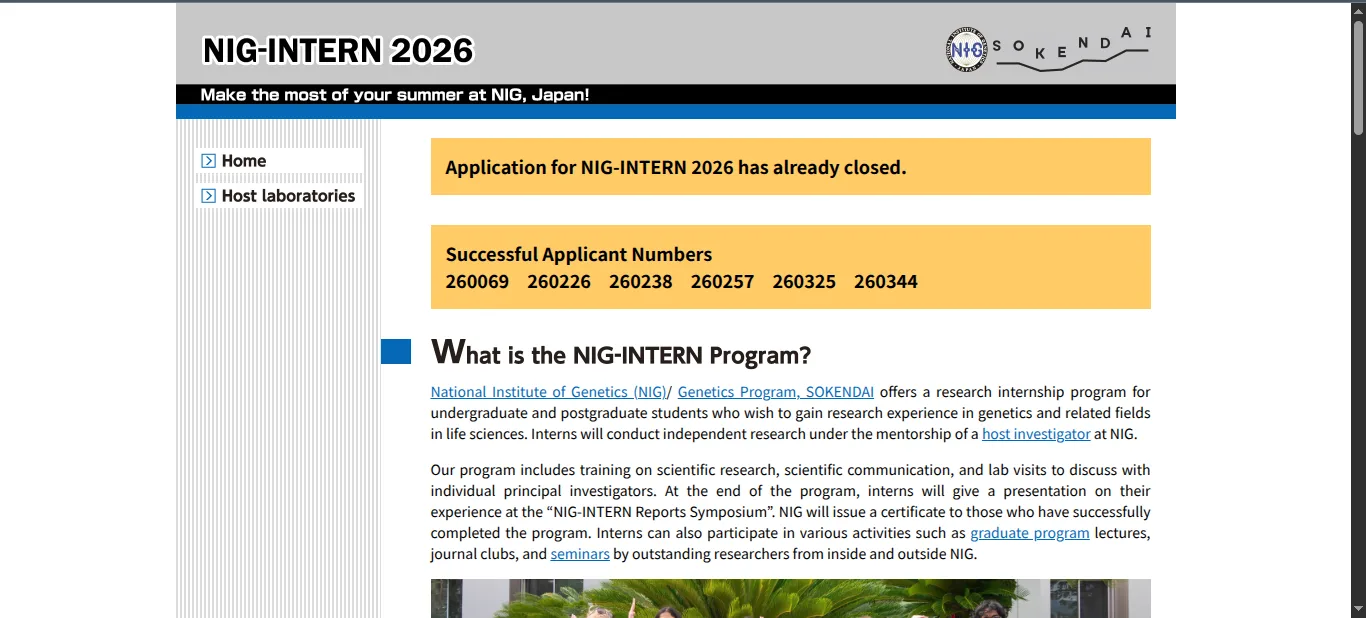
NIG-INTERN 2026 was a seven-week summer research internship at the National Institute of Genetics (NIG) in Mishima, Japan, run with the Genetics Program of SOKENDAI. The 2026 round is closed: applications ran from 1 December 2025 to noon on 5 January 2026, Japan Standard Time, and the internship itself ran from 8 June to 17 July 2026. Unlike earlier years, the 2026 programme was not fully funded — NIG covered airfare up to 200,000 JPY and travel insurance, while interns paid accommodation of about 70,000 JPY for 39 nights plus living costs.
Quick Facts
| Item | Detail |
|---|---|
| Host | National Institute of Genetics (NIG), with the Genetics Program, SOKENDAI |
| Location | Mishima, Shizuoka, Japan |
| Opportunity type | Summer research internship in genetics and life sciences |
| Duration | 8 June – 17 July 2026 (seven weeks); no shorter or longer periods |
| Eligibility | Prefinal-year undergraduate or master's students living outside Japan |
| Funding | Partial: airfare up to 200,000 JPY and travel insurance; intern pays the rest |
| Application status | Closed for 2026; no 2027 call announced |
| Deadline | Noon JST, 5 January 2026 (closed) |
| Official portal | https://www.nig.ac.jp/en/students/nig-intern/ |
What NIG-INTERN is
NIG is an inter-university research institute under the Research Organization of Information and Systems (ROIS). Its Genetics Program is part of SOKENDAI, the Graduate University for Advanced Studies. NIG-INTERN is the institute's flagship summer internship for students who want research experience in genetics and related life sciences before applying to graduate school.
The structure is closer to a short research visit than to a coursework programme. Each intern conducts independent research under the mentorship of a host investigator at NIG. The programme adds training in scientific research and scientific communication, laboratory visits and discussions with individual principal investigators. At the end, interns present their experience at the NIG-INTERN Reports Symposium, and NIG issues a certificate to those who complete the programme.
Interns can also join activities in the wider graduate programme: Genetics Program lectures, journal clubs, and seminars by researchers from inside and outside NIG. That access is one reason the internship functions as a recruitment pipeline as well as a research placement. NIG says students interested in enrolling in its PhD programme are encouraged to apply, though the internship does not guarantee admission.
The 2026 page lists six successful applicant numbers, matching the small cohort size that NIG describes elsewhere on the page.
What you would work on
NIG's research is organised into five departments, and host investigators are drawn from across them. The department structure gives a useful map of what an internship project could involve.
- Department of Informatics — computational and data-driven genetics, including the Biological Networks Laboratory, Human Population Genomics Laboratory, Genetic Informatics Laboratory, Genome Evolution Laboratory, Genome Diversity Laboratory and Genome Informatics Laboratory.
- Department of Genomics and Evolutionary Biology — Evolutionary Genetics, DNA Data Analysis, Ecological Genetics, Molecular Life History, Plant Genetics and Comparative Genomics.
- Department of Gene Function and Phenomics — Neurobiology and Pathology, Brain Function, Mammalian Neural Circuits, Mouse Genomics Resource, Bacterial Motility Machinery, Symbiosis and Cell Evolution, Microbial Physiology, Plant Cytogenetics and Multicellular Organization.
- Department of Chromosome Science — Molecular Cell Engineering, Cell Architecture, Genome Dynamics, Chromosome Biochemistry, Invertebrate Genetics, and Physics and Cell Biology.
- Department of Frontier Research — Plant Evolution, Gene Quantity Biology, and Theoretical Ecology and Evolution.
The range matters for applicants who assume NIG is only a wet-lab institute. Several laboratories are computational or theoretical, and the programme describes genetics and "related fields in life sciences" rather than bench work alone.
NIG also hosts the Biological Data Research Center, the Integrated Research Core with advanced genomics, genetic resources and phenotype centres, and the National BioResource Project. Those facilities support projects that depend on large-scale sequencing, strain resources or phenotype data.
The institute is also unusual in the breadth of its organismal coverage. Its laboratories work on plants, invertebrates, mice, bacteria and cell lines, and the theoretical groups work on ecology and evolution rather than molecular mechanisms alone. An applicant coming from a general biology degree should be able to find a laboratory that matches their existing skills, whether those are wet-lab, computational or theoretical.
The programme does not publish a project list in advance. Interns are matched to a host investigator, and the research question is settled with that investigator. That makes the host laboratory choice the single most consequential part of the application.
Eligibility and requirements
The eligibility rule is narrow and strictly applied. Applicants had to be in their prefinal year at the time of application, defined by NIG as:
- third year of a four-year bachelor's programme;
- second year of a three-year bachelor's programme;
- fourth year of a five-year programme;
- first year of a two-year master's programme; or
- fifth year of a six-year programme.
Two consequences follow. First, students who would become prefinal-year during the internship but were not yet prefinal-year at application were not eligible; NIG answers that exact question in its FAQ with a no. Second, PhD students were not considered at all. NIG attributes both exclusions to the highly competitive selection process.
Applicants also had to live outside Japan at the time of application. NIG welcomes applications from any country or nationality, and a student's university does not have to be in their country of citizenship. The only geographic condition is residence outside Japan at the time of application.
The programme asks for an interest in life sciences rather than a specific degree title. NIG does not publish a minimum GPA, a required major, or a language test score. The application materials are in English, and NIG advises applicants to use an institutional email address because free accounts may not reliably receive correspondence.
Funding, stipend and costs
The 2026 funding model is the most important change to understand. NIG states plainly: "Unlike previous years, the NIG-INTERN2026 is not a fully-funded program." Costs were shared.
| Cost | Who paid |
|---|---|
| Round-trip airfare between the intern's place of residence and Japan | NIG, up to 200,000 JPY actual expense |
| Travel insurance | NIG |
| Airfare above 200,000 JPY | Intern |
| Domestic travel in Japan | Intern |
| NIG Guest House accommodation, about 70,000 JPY for 39 nights | Intern |
| Living and miscellaneous expenses | Intern |
No stipend, salary or daily allowance is listed for 2026. That is a material difference from a programme like NIMS, which pays a daily allowance, and it means applicants should budget for meals, local transport and incidental costs in addition to the accommodation figure.
Because the model changed in 2026, older accounts of NIG-INTERN describing a fully funded internship are out of date. Anyone planning for a future cycle should treat the 2026 cost-sharing terms as the most recent official position, while recognising that NIG could change them again.
How to apply
The 2026 application was online only, and the process had several steps that are easy to underestimate.
- Check eligibility before anything else. Confirm your year of study at the time of application, not at the time of the internship, and confirm that you live outside Japan.
- Choose a host laboratory. Applicants indicate their field of interest and preferred host laboratory during registration. NIG publishes a host investigator list, and the laboratory pages describe current research.
- Register on the online system during the window. The 2026 system opened on 1 December 2025 and closed at noon on 5 January 2026 JST. Registration required your postal address, field of interest and preferred host laboratory.
- Name two recommenders at registration. NIG asks for the names and email addresses of two recommenders at the initial registration stage. The system then emails them directly to submit letters. Talk to both before you register.
- Write the motivation letter. NIG calls it a "Letter of Motivation / Self advertisement" and limits it to 500 English words.
- Prepare the CV. It must be in English and include education records starting from high school, with your current academic year clearly indicated.
- Upload the transcript. Submit the latest undergraduate or postgraduate transcript you can obtain. If it is not in English or Japanese, attach a translation to each document and combine multiple documents into a single file.
- Make sure both letters arrive through the system. Materials sent by email are not accepted. Only applications completed before the deadline were considered.
During screening, applicants could be contacted by the prospective host laboratory's principal investigator. That contact is part of the assessment, not an informal chat, and it is worth preparing to discuss the lab's work specifically.
A useful way to shortlist laboratories is to read the last two or three papers from each group rather than the one-paragraph description. NIG's laboratory pages link to current research themes, and the department structure tells you whether a group is primarily experimental, computational or theoretical. Because the programme does not publish projects in advance, that reading is also the best preparation for a conversation with the host investigator.
NIG also draws a clear line between this programme and informal internships. For any internship opportunity other than NIG-INTERN, the institute says to contact potential host principal investigators directly, and in those cases "costs and arrangements for travel, visas, accommodation and living expenses are the responsibility of the interns or their sponsoring institutions." NIG-INTERN is the structured route with defined dates and partial support; a direct arrangement is a separate, self-funded matter.
One practical detail is easy to miss. NIG states that the 2026 internship was not fully funded, but it does cover travel insurance. The programme page does not describe a medical examination, a vaccination requirement or a separate health insurance purchase, so applicants with particular health needs should ask NIG directly rather than assume what the travel policy covers.
Timeline and current status
The 2026 cycle ran on a fixed calendar. Applications opened on 1 December 2025 and closed at noon JST on 5 January 2026. Results were announced by the end of February 2026, with successful applicant numbers posted on the NIG website and individual notifications sent by email.
Travel arrangements began in March to May. Successful applicants were asked to submit a copy of a valid passport by early March, which means anyone without a passport would have had little time. The internship ran from 8 June to 17 July 2026. Assignments — an essay, a questionnaire and a boarding pass stub or copy — were due by 24 July 2026.
NIG's office was closed from 27 December 2025 to 4 January 2026 for the New Year holiday, which fell inside the application window. Applicants who waited until the last week had fewer working days to resolve problems.
As of 12 November 2026, the 2026 programme is over and NIG has not published a 2027 call on the page reviewed for this guide. The page still displays the 2026 dates and the closed notice. Do not assume that a 2027 cycle will repeat the same dates, the same seven-week length or the same funding split.
Selection and what makes a credible application
NIG is explicit that selection is highly competitive and that the number of places is small. For 2025, the institute says six students were selected from over 1,240 applications. The 2026 page lists six successful applicant numbers, so the cohort size was similar.
The published criteria are thin, which is typical of Japanese internship programmes. NIG asks for interest in life sciences, a prefinal-year status, and a completed application with a motivation letter, CV, transcript and two references. It does not publish a shortlisting rubric or interview format.
What the programme structure implies is more useful. Because interns join a specific laboratory and work under a host investigator, a credible application shows that you have read that laboratory's research and can explain why it fits your background. The 500-word motivation letter is short; a generic statement about loving genetics will not distinguish you from 1,200 other applicants.
The two recommendation letters carry weight partly because they are the only external assessment in the file. NIG asks for teachers' letters, submitted directly by the recommenders, so choose people who can speak to research aptitude rather than only to coursework performance.
What is confirmed and what is not yet announced
Confirmed for 2026: the 1 December 2025 to 5 January 2026 application window, the 8 June to 17 July internship dates, the prefinal-year eligibility rule, the 500-word motivation letter, the two recommendation letters, the airfare cap of 200,000 JPY, the travel insurance, and the accommodation estimate of about 70,000 JPY for 39 nights.
Not announced: any 2027 dates, the number of 2027 places, whether funding will remain partial or return to full funding, and whether the internship length will stay at seven weeks. NIG also does not publish a stipend, a GPA threshold, or an English test requirement. The page states that the number of successful applicants varies from year to year.
Sources
- National Institute of Genetics, "Summer Internship (NIG-INTERN)," accessed 12 November 2026
- National Institute of Genetics, "Application guideline," accessed 12 November 2026
- National Institute of Genetics, host investigator list, accessed 12 November 2026
- National Institute of Genetics, laboratory directory, accessed 12 November 2026
- SOKENDAI Genetics Program at NIG, accessed 12 November 2026
Keep exploring
For a contrasting Japanese internship with a daily allowance, the NIMS internship guide sets out how a host-researcher-led application works. The RIKEN CBS summer programme guide covers a neuroscience programme with an open 2027 call. The research programmes directory groups opportunities by type.
Frequently asked questions
- Is the NIG-INTERN 2026 application still open?
- No. The National Institute of Genetics states that the application for NIG-INTERN 2026 has already closed. The 2026 window ran from 1 December 2025 to noon on 5 January 2026, Japan Standard Time.
- Who was eligible for NIG-INTERN 2026?
- Applicants had to be in their prefinal year at the time of application: third year of a four-year bachelor's, second year of a three-year bachelor's, fourth year of a five-year programme, first year of a two-year master's, or fifth year of a six-year programme. They also had to live outside Japan at the time of application.
- Was NIG-INTERN 2026 fully funded?
- No. NIG says that, unlike previous years, NIG-INTERN 2026 was not a fully funded programme. NIG covered round-trip airfare up to 200,000 JPY and travel insurance; interns paid any airfare above that cap, domestic travel, accommodation of about 70,000 JPY for 39 nights, and living costs.
- How long was the 2026 internship?
- The 2026 internship ran from 8 June to 17 July 2026. NIG states that requests for shorter or longer periods were not considered.
- Do I need to speak Japanese to join NIG-INTERN?
- NIG does not list Japanese as a requirement. Applications, the CV, the motivation letter and the transcript translation are submitted in English, and the programme includes seminars and lectures that are part of the SOKENDAI Genetics Program.
- How competitive is NIG-INTERN?
- NIG says six highly qualified students were selected from over 1,240 applications for 2025, and that the number of successful applicants varies from year to year. The 2026 page lists six successful applicant numbers.
- Can PhD students apply to NIG-INTERN?
- No. NIG says applications from students in a PhD course are not considered, and neither are applications from non-prefinal students, because of the highly competitive selection process.
- Does NIG-INTERN lead to a PhD at SOKENDAI?
- It does not guarantee admission. NIG says students interested in enrolling in its PhD programme are encouraged to apply, and interns can attend graduate programme lectures, journal clubs and seminars during the internship.
Official application link
Check the official NIG-INTERN page
The 2026 round is closed and NIG has not announced a 2027 cycle. Check the official page for a new call before preparing documents.
Open official page

