
Academic guides · Guide
NIMS Internship Program: Japan Materials Science Guide
StatusClosed
NIMS runs a host-researcher-led materials science internship in Tsukuba with a 2,560 yen daily allowance. The 2026 round is closed; the next is expected in December 2026.
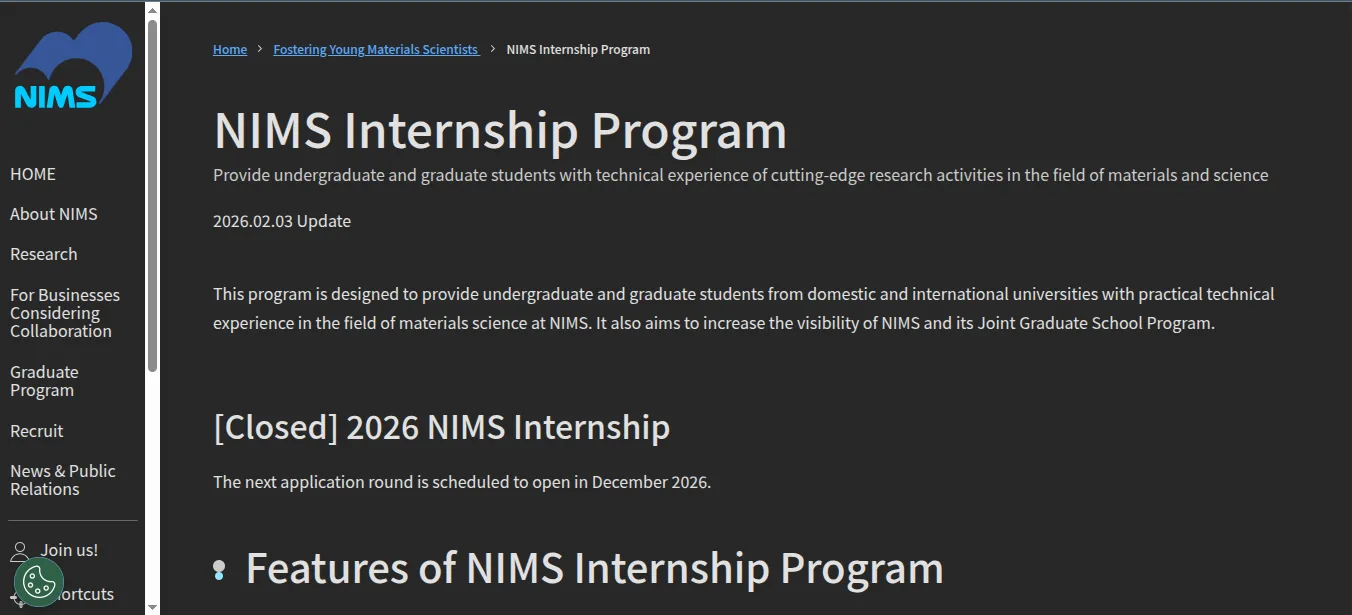
The NIMS Internship Program is a host-researcher-led research placement in materials science at the National Institute for Materials Science in Tsukuba, Japan. The 2026 round is closed, and NIMS says the next application round is expected to open in December 2026 for approximately one month. Selected interns receive a daily allowance of 2,560 yen and covered accommodation, but generally pay their own travel costs.
Quick Facts
| Item | Detail |
|---|---|
| Host | National Institute for Materials Science (NIMS) |
| Location | Tsukuba, Ibaraki, Japan |
| Opportunity type | Research internship in materials science |
| Duration | Up to 90 consecutive calendar days, including arrival and departure |
| Eligibility | Current undergraduate and graduate students, domestic and international |
| Funding | 2,560 JPY daily allowance plus accommodation; travel generally not covered |
| Application status | 2026 closed; next round expected to open December 2026 |
| Deadline | No fixed central deadline; host researcher must submit the file |
| Official portal | https://www.nims.go.jp/eng/hr-development/internship.html |
What the NIMS Internship Program is
NIMS describes the programme as providing undergraduate and graduate students "with practical technical experience in the field of materials science." It is open to students from domestic and international universities, and it has a second institutional purpose: raising the visibility of NIMS and its Joint Graduate School Program.
The programme is old by internship standards. NIMS says it launched in 2006 and has since welcomed over 2,000 students from universities and graduate schools around the world, with participants from approximately 60 countries. It accepts about 100 students each year, which makes it one of the larger research internships in Japan.
The structure is decentralised. There is no central matching process and no single annual project list. An applicant identifies a NIMS researcher, contacts them directly, sends the required documents, and is accepted or declined by that researcher. The Graduate Program Section only processes files that a NIMS researcher has forwarded.
That design explains most of the programme's quirks: the rolling nature, the absence of a published cohort profile, and the fact that the researcher — not a central admissions committee — controls the timeline.
The internship sits alongside two other NIMS routes for students: the NIMS Graduate School Program and the International Cooperative Graduate Program. NIMS says the internship is partly intended to increase the visibility of the Joint Graduate School Program, so an intern who wants to continue at NIMS has a natural next conversation with their host group. That does not make the internship an admission route, and no credit or admission advantage is published.
What you would work on
NIMS is Japan's national institute for materials science, and its research spans metals, ceramics, polymers, nanomaterials, electronic and optical materials, magnets and spintronics, energy and environmental materials, and biomaterials. Interns join a host group and work within its existing research programme.
The institute's research centres give a practical map of possible placements:
- Research Center for Energy and Environmental Materials — materials for energy conversion, storage and environmental applications.
- Research Center for Electronic and Optical Materials — semiconductors, photonic materials and electronic devices.
- Research Center for Magnetic and Spintronic Materials — magnetism, spintronics and magnetic devices.
- Research Center for Structural Materials — mechanical behaviour, alloys and structural integrity.
- Research Center for Materials Nanoarchitectonics (MANA) — nanoscale design and self-assembly.
- Research Center for Macromolecules and Biomaterials — polymers, soft matter and biomedical materials.
- Center for Basic Research on Materials — foundational characterisation and measurement science.
The work is experimental in most groups, and the programme expects interns to use NIMS facilities rather than to work remotely. NIMS describes the internship as an opportunity to "use world-class research facilities, participate in cutting-edge research projects, or interact with researchers from around the world."
There is no published project catalogue. The project is agreed with the host researcher, and NIMS says the researcher decides the final start and end dates in consultation with the intern.
Eligibility and requirements
The eligibility rule is short, and the FAQ adds an important clarification. NIMS says the programme is open to students "currently enrolled in a university or graduate school," and that interns "must remain a student for the duration of the training period."
That second clause rules out a common plan: graduating in the spring and starting an internship afterwards. If you complete a bachelor's degree and plan to enter graduate school, NIMS asks you to include a certificate of acceptance with your application documents.
| Requirement | Detail |
|---|---|
| Enrolment | Current undergraduate or graduate student at a university or graduate school |
| Status during internship | Must remain enrolled for the whole training period |
| Gap between degrees | Certificate of acceptance required if you have finished a bachelor's and plan to start graduate school |
| Duration | Up to 90 consecutive days; period includes arrival and departure |
| Start and end dates | Cannot begin the day before a national holiday or on a Friday or Saturday; cannot end the day after a holiday or on a Sunday or Monday |
| Other activity | Not permitted during the internship |
The start and end restrictions are unusual and easy to overlook. They exist because NIMS arranges accommodation and administrative processing around working days, and they can shift a planned arrival by several days. Anyone booking flights before confirming dates with the host researcher risks an expensive change.
NIMS does not publish a minimum GPA, a language test requirement, or a list of eligible majors. The programme is aimed at materials science and related fields, but the host researcher makes the judgement about fit.
Funding, stipend and costs
NIMS publishes a more specific funding package than many Japanese internships, though it is not a full scholarship.
| Item | What NIMS provides |
|---|---|
| Daily allowance | 2,560 JPY per day |
| Accommodation | Covered up to a specified maximum; NIMS arranges and reserves the room |
| Utilities | Excluded from the accommodation support |
| Travel | Generally the student's responsibility |
| Undergraduate travel (2026 round) | NIMS may cover transport for undergraduates only, if they remain enrolled as undergraduates throughout |
| Optional accommodation services | Student's responsibility |
The daily allowance is intended to support expenses during the internship, and NIMS states that it is not considered income. That matters for tax and for anyone receiving other funding.
Two conditions can remove the support entirely. If you commute from within Tsukuba City, or if you do not stay in NIMS-designated accommodation, NIMS says neither the daily allowance nor the accommodation will be provided. The package is tied to the residential format, not paid as a cash bursary.
Applicants who already receive Japanese government funding — a MEXT, JSPS or JST fellowship, for example — must check with their provider. NIMS warns that additional support may count as duplicate funding and may not be permitted. It also offers a fallback: such applicants may still participate at their own expense, with the same application documents.
NIMS is explicit that the programme "does not guarantee the acceptance of all applicants' internship/financial support." Acceptance and funding are separate decisions, and the host researcher's agreement is the first hurdle.
The page does not publish a meal allowance, a local transport allowance, or a figure for the accommodation cap. Interns should therefore budget for food, local travel and utilities from the 2,560 yen daily allowance and treat the accommodation support as covering rent rather than living costs. NIMS says it arranges and reserves the room, and that optional service fees at the accommodation are generally the student's responsibility.
How to apply
The application process runs through the host researcher, not through a central portal. The steps are sequential and each one can stall the file.
- Search the NIMS researcher directory. Use SAMURAI to find researchers in your field. Read their recent work before writing.
- Contact one researcher directly by email. NIMS asks applicants to avoid contacting multiple researchers simultaneously. Include the documents listed below. The researcher may then ask your supervisor for a reference letter.
- Send the required documents. The set is: the NIMS Student Application form in English (an XLSX template is published on the programme page), a CV in English, a student enrolment or registration certificate in English issued within the last three months, and an official academic transcript in English.
- Check the transcript rule carefully. Only an officially issued transcript is acceptable, and doctoral and master's students must submit both undergraduate and graduate transcripts. A diploma or a master's degree certificate is not accepted in place of an enrolment certificate.
- Wait for the researcher's review. If the researcher agrees to accept you, they forward the file to the Graduate Program Section, Academic Collaboration Office. NIMS says the review takes about one month, and the researcher communicates the result directly.
- Agree the dates. Once accepted, the final start and end dates are settled with the researcher, within the 90-day limit and the working-day restrictions.
Two failure modes are worth stating plainly. Documents sent by the student directly to the Graduate Program Section are not processed, and applications sent to the office email address are not processed either. The researcher is the only valid route.
NIMS also excludes some potential hosts: ICYS Research Fellows and NIMS Postdoctoral Researchers are not available to accept intern students. Applicants who approach a postdoc rather than a permanent researcher may wait for a reply that never becomes an acceptance.
Timeline and current status
As of 12 November 2026, the 2026 NIMS Internship is closed. The programme page says the next application round is "expected to open in December 2026 for approximately one month," with exact dates to be announced on the website. That is a forward-looking statement, not a confirmed calendar.
The 2026 round's terms also set an end date: internships had to be completed by the end of March 2027. That deadline belongs to the current round, and it is not safe to assume the next round will use the same end date. What is likely to persist is the pattern: a roughly one-month application window in December, followed by host review, then placements in the following year.
Because there is no central deadline, the practical timeline is set by the researcher. A group that has already filled its intern slots will decline regardless of the programme window. Applicants who wait until the window opens to start reading about laboratories are already behind those who made contact earlier.
The documents also take time to assemble. An official transcript may need to be ordered from a registrar, and the enrolment certificate must be issued within the last three months, so it cannot be prepared months in advance. Between now and December, the useful preparation is to shortlist three or four SAMURAI groups, read their recent papers, and draft a short email that states your dates and skills.
Selection and what makes a credible application
NIMS does not publish selection criteria. It says the specifics of assessment are confidential and that it cannot respond to individual inquiries about them. That leaves applicants to infer the basis from the process.
Three things are clear from the published rules. First, the host researcher is the decision-maker, so the quality of the initial email and the fit with the group's current work matter more than any central ranking. Second, the documents are checked for completeness and formal validity — an unofficial transcript or an out-of-date enrolment certificate can stop a file before it is read. Third, funding is a separate approval, so a researcher's willingness to host does not guarantee the allowance.
A credible approach is to treat the first email as a short research proposal. State your degree, year, institution and dates; explain which of the group's recent results interests you and why; list the techniques or computational skills you can already use; attach the required documents; and ask whether the group can host an intern in the proposed window. NIMS says the project is based on the intern's academic interests, maturity and prior experience, so specificity helps.
NIMS also publishes a list of universities that have sent interns, including Oxford, Cambridge, Delft, KU Leuven, Sorbonne, RWTH Aachen, Johns Hopkins, UC Berkeley, UCLA, McGill, Toronto and Waterloo. That list is illustrative rather than restrictive; it is not an eligibility list.
What is confirmed and what is not yet announced
Confirmed: the 2026 round is closed, the next round is expected in December 2026, the daily allowance is 2,560 JPY, accommodation is covered up to a maximum, travel is generally the student's responsibility, the maximum stay is 90 days, and the host-researcher application route.
Not announced: the exact opening and closing dates of the next round, the number of places, whether the undergraduate travel support will continue, whether the daily allowance will change, and the end date for the next round's internships. NIMS says the allowance "may be subject to change." The programme also does not publish a project list, a GPA threshold or an English test requirement.
Sources
- NIMS, "NIMS Internship Program," accessed 12 November 2026
- NIMS, "FAQ" for the internship programme, accessed 12 November 2026
- NIMS, "Fostering Young Materials Scientists," accessed 12 November 2026
- NIMS SAMURAI researcher directory, accessed 12 November 2026
- NIMS, research centre list, accessed 12 November 2026
Keep exploring
The NIG-INTERN guide covers a genetics internship with a different funding model and a central application window. For a materials-adjacent programme in the United States, the NIST SURF guide explains the federal application route. The research programmes directory groups opportunities by type.
Frequently asked questions
- Is the NIMS Internship Program open for applications?
- The 2026 NIMS Internship is closed. NIMS says the next application round is expected to open in December 2026 for approximately one month, with exact dates to be announced on its website.
- How much does the NIMS internship pay?
- NIMS provides a daily allowance of 2,560 yen per day and covers accommodation fees up to a specified maximum. Travel expenses are generally the student's responsibility, although for the 2026 round NIMS said it may cover transport for undergraduate students who remain enrolled throughout.
- Who is eligible for the NIMS Internship Program?
- The programme is open to students currently enrolled in a university or graduate school. Applicants must remain a student for the whole training period. If you have completed a bachelor's degree and plan to enter graduate school, NIMS asks for a certificate of acceptance with the application.
- How long can a NIMS internship last?
- The internship can run for up to 90 consecutive calendar days, including arrival and departure days in Tsukuba. For the 2026 round, NIMS said the period must be completed by the end of March 2027. Requests exceeding 90 days go to the host researcher.
- Do I need to find a host researcher before applying to NIMS?
- Yes. Applicants must search the NIMS SAMURAI researcher directory and contact a researcher directly. The Graduate Program Section only accepts application documents from a NIMS researcher, and the office does not introduce or recommend researchers.
- Can I contact several NIMS researchers at once?
- No. NIMS explicitly asks applicants to avoid reaching out to multiple researchers simultaneously. ICYS Research Fellows and NIMS Postdoctoral Researchers are also not available to host interns.
- Is the NIMS internship fully funded?
- No. NIMS covers a daily allowance and accommodation, but students generally pay travel costs. The programme also states that it does not guarantee acceptance or financial support for every applicant.
- Can I take another job or activity during the NIMS internship?
- No. NIMS says interns are not permitted to engage in activities outside NIMS during the internship period, and asks anyone with unavoidable circumstances to consult their host researcher in advance.
Official application link
Check the official NIMS Internship Program page
The 2026 round is closed and the next round is expected in December 2026; NIMS has not published exact dates, so confirm before contacting a host researcher.
Open official page

