
Academic guides · Guide
NIST SURF 2027: Stipend, Eligibility and Application Guide
StatusOpen
NIST SURF 2027 is open to US citizens and permanent residents, pays $6,390–$7,810 for 9–11 weeks, and runs at Gaithersburg or Boulder. Deadlines sit on USAJobs.
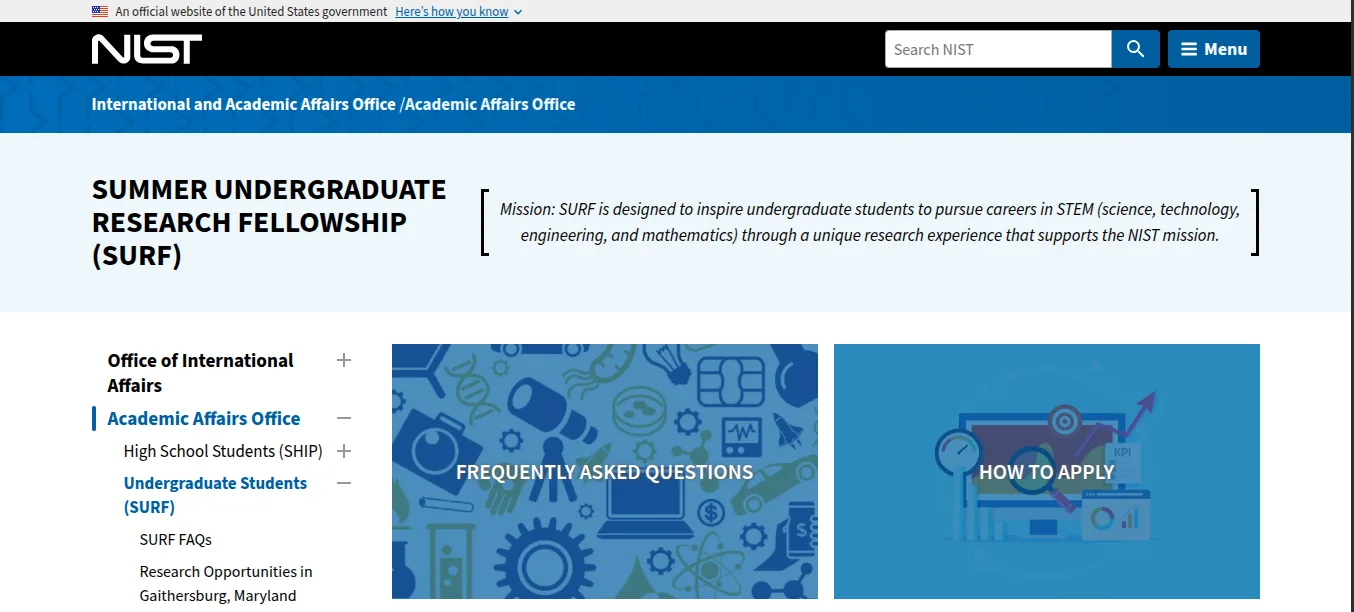
NIST's Summer Undergraduate Research Fellowship (SURF) is an 11-week, in-person summer research programme for undergraduates at US colleges, run by the National Institute of Standards and Technology. The 2027 vacancy announcements are open, with separate calls for Gaithersburg, Maryland and Boulder, Colorado, and a stipend listed at $6,390 to $7,810 depending on programme length. Only US citizens and US permanent residents are eligible, and the closing date sits on each USAJobs announcement rather than on the NIST SURF page.
Quick Facts
| Item | Detail |
|---|---|
| Host | National Institute of Standards and Technology (NIST), International and Academic Affairs Office |
| Location | Gaithersburg, Maryland, or Boulder, Colorado |
| Opportunity type | Full-time summer undergraduate research fellowship |
| Duration | 11 weeks (2 June – 13 August 2027) or 9 weeks (14 June – 13 August 2027); offset 11-week option 14 June – 27 August 2027 |
| Eligibility | US citizens or permanent residents, full-time undergraduates at US colleges, at least 18 by 2 June 2027 |
| Funding | $6,390–$7,810 stipend; housing assistance up to $4,500; travel support up to $500 |
| Application status | Open for 2027 |
| Deadline | Closing date on each USAJobs announcement; NIST does not publish a single date on nist.gov/surf |
| Official portal | https://www.nist.gov/surf |
What NIST SURF is
SURF is one of the US federal government's largest undergraduate research programmes. NIST describes its mission as inspiring undergraduates "to pursue careers in STEM (science, technology, engineering, and mathematics) through a unique research experience that supports the NIST mission."
The programme places students in NIST laboratories for a full-time summer appointment. Participants work 40 hours per week, Monday to Friday during business hours, under the guidance of a research mentor. They attend orientation and a seminar series, submit an abstract halfway through, and deliver an oral presentation in the final week. NIST describes participants as guest researchers rather than federal employees.
SURF runs at two campuses. Gaithersburg is NIST's headquarters in Maryland, outside Washington DC. Boulder is the Colorado campus that houses NIST's quantum, time and frequency, and communications work, among other programmes. Applicants choose one or both, and each has a separate vacancy announcement.
The programme has run for decades and publishes past project books; NIST links a 2026 SURF Abstract Book for prospective applicants who want to see the range of work.
What you would work on
SURF is not confined to physics. NIST lists disciplines including biochemistry, biology, biophysics, chemistry, computer science, engineering, materials science, mathematics, nanoscale science, neutron research, physics and statistics.
The Gaithersburg announcement names the laboratories and offices that host SURF students:
- Communications Technology Laboratory (CTL) — wireless, networks and communications metrology.
- Engineering Laboratory (EL) — buildings, manufacturing, fire research and structural performance.
- Information Technology Laboratory (ITL) — cybersecurity, software, statistics and applied mathematics.
- Material Measurement Laboratory (MML), in partnership with the NIST Center for Neutron Research (NCNR) — materials characterisation, chemistry and neutron science.
- Physical Measurement Laboratory (PML) — quantum, electrical, optical and time standards.
Other offices occasionally host participants: the Office of Advanced Manufacturing, the Communications and Outreach Office, the Research Data and Computing Office, the Technology Partnerships Office and the Standards Coordination Office.
Applicants must select a first-choice and second-choice host laboratory or office. NIST says the completed application is considered primarily by the first-choice host, which makes that choice consequential. The institute encourages applicants to look beyond the obvious lab: it gives the example of a computer science student finding projects in CTL, PML and EL as well as ITL.
NIST publishes laboratory descriptions and prior acceptance rates on its Gaithersburg research programmes page. That page is the best source for judging which laboratory actually takes students with your background.
The work itself is a real project rather than an observation exercise. NIST says each SURF student is assigned to a specific research project under a mentor, and the summer ends with a technical presentation to the laboratory. The abstract submitted at the midpoint is not a formality: it is reviewed by the programme office and becomes part of the record of the cohort. Past abstract books are published online, and reading one is the fastest way to understand the level of independence expected.
Eligibility and requirements
The eligibility rules are stricter than most summer programmes because SURF is a federal appointment.
| Requirement | Detail |
|---|---|
| Citizenship | US citizen or US permanent resident, with documentary proof |
| Enrolment | Full-time undergraduate at an accredited two-year or four-year college or university in the US or US territories |
| Age | At least 18 by 2 June 2027 |
| Academic standing | Good standing; GPA of 3.0 or higher on a 4.0 scale preferred |
| Health insurance | Proof required |
| Background check | Must pass a credentialing background check |
| Payment | Direct deposit required |
| Availability | 11 continuous weeks, or a minimum of nine full weeks |
NIST's FAQ closes one common question firmly: "The SURF program is only open to U.S. citizens and U.S. permanent residents enrolled as undergraduate students at U.S. colleges or universities. Students with student visas (F1 visas) are not eligible."
First-year students and graduating seniors are explicitly eligible and encouraged. NIST defines graduating seniors as those participating in the winter or spring commencement, which means a student graduating in May 2027 can still take part in the summer programme.
The citizenship proof is specific. Acceptable documents include a certified birth certificate, a current US passport, a passport card, a naturalisation certificate, a certificate of citizenship, a consular report of birth abroad, or a certification of birth. For permanent residents, an unexpired green card is required. NIST states that social security cards and driver's licences do not meet the requirement.
Two further conditions are easy to miss because they appear in the announcement rather than the FAQ. Selected participants must complete NIST's credentialing process, which includes a background check and fingerprinting, before they can begin work on site. They must also be able to receive payment by direct deposit into a US bank account. Neither step is unusual for a federal appointment, but both take time, and an offer in late March leaves roughly two months to complete them before the June start.
Funding, stipend and costs
NIST publishes both a stipend range and a set of supplementary allowances. The figures below come from the NIST programme page and the Gaithersburg USAJobs announcement.
| Item | Amount |
|---|---|
| Student stipend | $6,390 to $7,810, depending on 9-week or 11-week appointment |
| Weekly rate | $710 per week, as stated on the NIST SURF page |
| Housing assistance | Up to $4,500 for students who need to relocate |
| Travel support | Up to $500 |
| Local commuting support | Available in some cases; NIST says the amount varies |
| Housing itself | Not arranged by NIST; participants find their own |
There is a small inconsistency in NIST's own pages that applicants should know about. The programme page says: "In 2026, we expect to provide $7,810 for the 11-week summer stipend ($710 per week)." The 2027 USAJobs announcement lists $6,390 to $7,810. The lower figure corresponds to the 9-week option at the same weekly rate. Neither page states a separate 2027 cost-of-living increase.
NIST does not pay for housing directly. It provides the allowance and shares a list of affordable options in Gaithersburg and Boulder. In-person participants who live locally may receive commuting support instead, at a rate NIST does not publish.
The stipend is taxable in the United States, but NIST declines to give tax advice. Its FAQ refers applicants to a tax adviser and to the IRS guidance on grants and scholarships. International applicants are not eligible, so the usual US tax-treaty questions do not arise.
How to apply
Applications go through USAJobs, but with a twist: the vacancy does not accept documents uploaded to a USAJobs profile. Applicants are redirected to a separate application system from the NIST link.
- Choose your campus. Apply to SURF Gaithersburg or SURF Boulder. To be considered for both, submit two applications; the same documents can be reused.
- Read the announcement's closing date. NIST does not publish a single deadline on nist.gov/surf. The binding date and time are on the USAJobs announcement, and the cut-off is 11:59 p.m. Eastern time.
- Prepare the documents. You need responses to the online questions, a resume covering professional and research experience, an undergraduate transcript, proof of citizenship or permanent residency, proof of health insurance, a personal statement, and two letters of recommendation.
- Redact sensitive data. Transcripts and citizenship documents must have social security numbers and dates of birth removed before upload. NIST rejects documents that still show them.
- Choose two host laboratories. The application asks for a first and second choice. NIST says the file is considered primarily by the first-choice laboratory, so order them deliberately.
- Submit the application, then check the references. Letters are uploaded through the application module, not USAJobs, and referees have three days after the vacancy closes to submit. The applicant is responsible for notifying referees.
- Track the status. After submitting, return to USAJobs to verify the application status, and use the application portal to see whether both letters have arrived.
The personal statement is the main free-text component. NIST asks for commitment to laboratory work, relevant coursework or research experience, prioritised research interests, expected personal benefit, and career goals. Its FAQ adds that the statement is used to match applicants to projects, so specific interests are more useful than generic enthusiasm.
Timeline and current status
The 2027 cycle is open as of 12 November 2026. The three programme windows are fixed: the main 11-week programme runs from 2 June to 13 August 2027, the 9-week programme from 14 June to 13 August, and the offset 11-week programme from 14 June to 27 August.
Offers are made in the spring. The USAJobs announcement says eligible students may receive an offer by email at any time between 1 March and 2 April 2027, and that all applicants will be notified of their status by 15 April 2027. NIST's application page says offers are extended from 1 March to 15 April, and its FAQ says applicants receive offers by 20 April. The three statements are close but not identical, so treat 15 April as the conservative outer date for a final notification.
Because offers can arrive from 1 March, applicants should be ready to accept promptly. NIST's application page notes that a waiting list operates and that successful applicants must accept quickly after receiving an offer.
Selection and what makes a credible application
NIST's FAQ gives a rare published statistic: approximately one of every three applicants receives an offer, and about 150 students participate each summer. Acceptance rates vary by campus and are posted on the location-specific pages.
The evaluation criteria are published in the USAJobs announcement. They include fit between the applicant's stated interests and NIST priorities, fit with available projects in the chosen laboratory, relevance of coursework, academic accomplishments, and whether the laboratory experience would be a new opportunity that encourages postgraduate study. The announcement also lists preferred qualities: strong computer and laboratory skills, motivation, and interest in a STEM graduate degree.
That last criterion is worth reading carefully. NIST is not only selecting the strongest academic record; it is selecting students for whom the placement would change something. An applicant who has already had three federal laboratory internships may be a weaker fit on this criterion than an equally strong applicant who has had none.
The laboratory choice does most of the sorting. Because the first-choice laboratory reviews the file first, an application aimed at a laboratory with no relevant projects will struggle regardless of GPA. Reading the laboratory descriptions and prior acceptance rates before choosing is the highest-value preparation step.
What is confirmed and what is not yet announced
Confirmed: the 2027 vacancy announcements are open, the three programme windows, the $6,390 to $7,810 stipend range, the $710 weekly rate, housing assistance up to $4,500, travel support up to $500, the citizenship and enrolment rules, the 3.0 GPA preference, and the 15 April 2027 final notification date.
Not announced: the number of 2027 places at each campus, the exact closing date on each USAJobs announcement, the 2027 housing allowance if it differs from 2026, and the list of 2027 projects. NIST says projects depend on the availability of funds, and the sponsors and projects are not published in advance. The FAQ also leaves open whether the 2027 stipend will match the 2026 figure exactly.
Sources
- NIST, "Summer Undergraduate Research Fellowship (SURF)," accessed 12 November 2026
- NIST, "SURF Application," accessed 12 November 2026
- NIST, "SURF FAQs," accessed 12 November 2026
- NIST, "Research Opportunities in Gaithersburg, Maryland," accessed 12 November 2026
- USAJobs, SURF Gaithersburg 2027 announcement SURF-2027-0001, accessed 12 November 2026
- USAJobs, SURF Boulder 2027 announcement, accessed 12 November 2026
Keep exploring
If you are comparing US and European summer programmes, the Caltech SURF 2027 guide covers a university-run fellowship with a different funding model, and the DESY summer student programme guide covers a European laboratory placement. The research programmes directory groups opportunities by type.
Frequently asked questions
- Is NIST SURF 2027 open for applications?
- Yes. NIST says the 2027 SURF vacancy announcements are open, with separate USAJobs announcements for Gaithersburg, Maryland and Boulder, Colorado. The closing date is published on each USAJobs announcement rather than on the NIST SURF page.
- How much does NIST SURF pay in 2027?
- The Gaithersburg USAJobs announcement lists a student stipend of $6,390 to $7,810, reflecting the 9-week and 11-week options. NIST's programme page describes a $710 weekly rate and a $7,810 stipend for the 11-week programme, plus housing assistance up to $4,500 and travel support up to $500.
- Can international students apply to NIST SURF?
- No. NIST limits SURF to US citizens and US permanent residents enrolled as undergraduate students at US colleges or universities. The FAQ states that students with F1 visas are not eligible.
- What are the 2027 NIST SURF programme dates?
- NIST lists three options: an 11-week main programme from 2 June to 13 August 2027, a 9-week programme from 14 June to 13 August 2027, and an offset 11-week programme from 14 June to 27 August 2027.
- Do I need a 3.0 GPA for NIST SURF?
- NIST describes a cumulative GPA of 3.0 or higher on a 4.0 scale as preferred, not as a strict minimum. The USAJobs announcement also asks for good academic standing and transcripts that show current enrolment.
- How competitive is NIST SURF?
- NIST's FAQ says approximately one of every three applicants receives an offer, and that about 150 students participate in SURF each summer. Selection depends on the number and quality of applications and the number of NIST projects available.
- Does NIST SURF provide housing?
- NIST does not arrange housing. It provides a housing allowance of up to $4,500 and shares a list of affordable housing options in Gaithersburg and Boulder. In-person participants are responsible for finding their own accommodation.
- Can first-year students and graduating seniors apply?
- Yes. NIST says first-year undergraduates and graduating seniors are eligible and encouraged to apply. Graduating seniors are defined as those participating in the winter or spring commencement.
Official application link
Check the official NIST SURF page
The 2027 vacancy announcements are open; apply through the Gaithersburg or Boulder USAJobs link and confirm the closing date on the announcement itself.
Open official page

