
Academic guides · Guide
Caltech SURF 2027: Application Guide, Stipend, and Eligibility
StatusOpen
Caltech's 10-week SURF programme pays $8,354 in 2027. A verified guide to eligibility, the 22 February deadline, the mentor requirement, and how to apply.
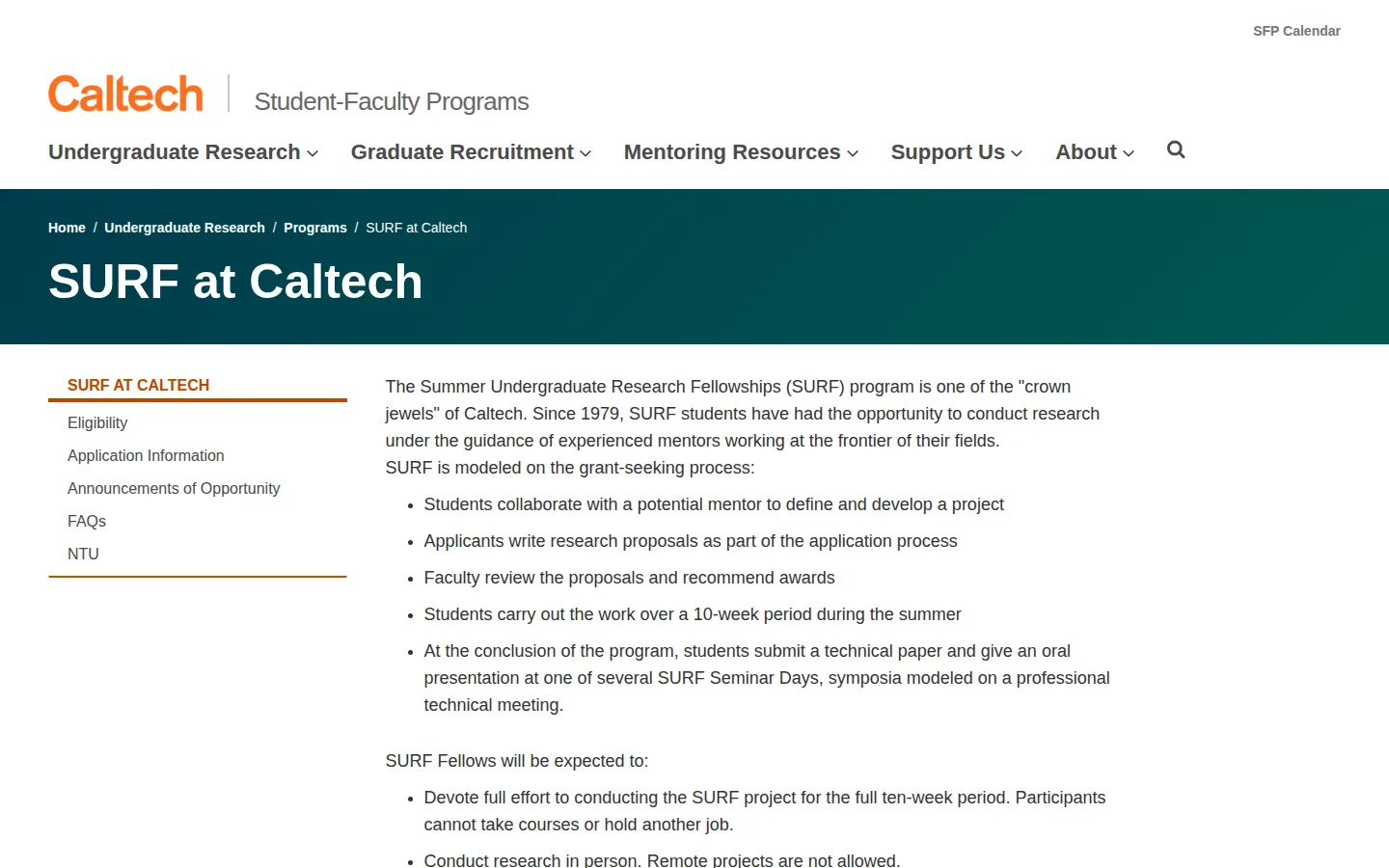
Caltech's Summer Undergraduate Research Fellowships (SURF) programme pays continuing undergraduates $8,354 for ten weeks of in-person research in Pasadena. The 2027 application and recommendation deadline is 22 February 2027, and Caltech says awards will be announced on 1 April 2027. This guide separates what Caltech publishes from details that circulate in third-party summaries.
The short answer
Caltech SURF 2027 is a full-time, in-person summer research fellowship: $8,354 for ten weeks, a Caltech faculty mentor, and a technical research proposal. Applications and recommendation letters are due on 22 February 2027; Caltech publishes the date but not a time of day. Visiting students need a 2.5/4.0 GPA and at least two semesters or three quarters of undergraduate study; Caltech students need a 2.0 GPA and three terms. International students can apply for campus projects, but JPL placements are restricted to US citizens and permanent residents.
What Caltech SURF is
Caltech's Student-Faculty Programs (SFP) office runs SURF. The programme has existed since 1979, and Caltech describes it as "one of the 'crown jewels' of Caltech." It is modelled on the grant-seeking process: a student and a faculty mentor define a project, the student writes a proposal, faculty review the proposals, and selected students carry out the work over ten weeks. At the end, fellows submit a technical paper and give an oral presentation at one of Caltech's SURF Seminar Days.
SURF expects intellectual ownership rather than shadowing. Caltech says the benchmark for a suitable project is the potential for publication in the refereed literature. Fellows work full-time for the full ten-week period, cannot take courses or hold another job, and must conduct research in person. They also submit two interim reports, an abstract, and a final technical paper approved by the mentor.
The programme is based at Caltech in Pasadena, California. The 2027 start date is 15 June 2027. Caltech allows approved alternate start dates, but all students must begin by 12 July 2027, and the SURF period must conclude by the third Friday in September.
What the 2027 award covers
| Item | What Caltech publishes |
|---|---|
| Award | $8,354 for the ten-week period |
| Duration | Ten weeks, full-time and in person |
| Start date | 15 June 2027; all students begin by 12 July 2027 |
| End date | The SURF period must conclude by the third Friday in September |
| Housing | Available to visiting students but limited and not guaranteed; the cost is not part of the award |
| Additional funding | Caltech says there is no additional funding beyond the SURF award |
| Programming | Weekly seminars, professional development, communication workshops, social and cultural activities, student-faculty dinners |
Caltech does not publish a weekly rate, a housing allowance, or a travel budget on the pages reviewed for this guide. The $8,354 is the award for the ten-week period, not a promise that housing, meals, visa fees, or travel are covered. Visiting students can apply for on-campus housing, but Caltech says housing is limited, not guaranteed, and must be paid for by the student. Caltech says housing applications are sent to SFP students in early April and are accepted until capacity. Students living on campus also need a declining balance card for Caltech eateries.
Caltech's FAQ says there is no additional funding beyond the SURF award. If you need a precise budget, start with the award and add the cost of housing, food, transport, and any visa or authorization fees. Ask SFP about anything the official page does not state.
Who is eligible
| Requirement | Caltech students | Visiting (non-Caltech) students |
|---|---|---|
| Status | Continuing undergraduate, eligible for fall term registration | Continuing undergraduate, eligible for fall term registration |
| GPA | At least 2.0 cumulative | At least 2.5/4.0 cumulative |
| Academic progress | Completed the third term at Caltech | Completed at least the second semester or third quarter at the home institution |
| Sanctions | Not under academic or disciplinary sanctions | Not under academic or disciplinary sanctions |
| Mentor | A Caltech faculty mentor must agree to support the application | A Caltech faculty mentor must agree to support the application |
| Commitment | Full-time, in person, no courses or other job | Full-time, in person, no courses or other job |
Caltech also excludes high school students who are co-enrolled in college courses. Students who plan to graduate during the typical SURF period or immediately afterward are not eligible. Applicants from the University of Iceland or the named Cambridge colleges (St. John's, St. Catherine's, Corpus Christi, or Pembroke) may only apply through the established exchange programmes with those schools.
The mentor requirement is not a formality. Caltech says a Caltech faculty mentor must agree to support the application, help develop and define the project, assist in writing the research proposal, and contribute financially to the award. Caltech explicitly says not to submit an application without a mentor's approval. Non-Caltech students may find this harder; Caltech suggests using your academic network and tailoring each email rather than sending broad requests.
International applicants and visas
International students are eligible for SURF projects on the Caltech campus. The restriction is specific to JPL: only US citizens and US permanent residents are eligible for SURF placements at JPL.
International students coming to the US for SURF receive instructions about applying for an F-1 or J-1 student visa after they receive an award. Students already studying in the US must obtain appropriate off-campus employment authorization before starting. Caltech lists Curricular Practical Training (CPT) or pre-completion Optional Practical Training (OPT) for F-1 students, and Academic Training through the J-1 programme sponsor for J-1 students. CPT and academic training are authorized by the student's current institution or programme sponsor; pre-completion OPT requires USCIS approval and can take several months. Caltech says to consult an international student advisor as soon as you apply.
How to apply
- Find a Caltech faculty mentor early. Read faculty and research-group pages, use your academic network, and write specific emails. Caltech warns against broad, spam-like messages. Confirm that the mentor will support the application, help shape the project, and contribute financially.
- Define the project and write the proposal. Caltech says proposals are typically two to three pages, with no formal minimum or maximum length. A good proposal explains the technical background, objectives, approach, work plan, and references. It should be specific enough for faculty in the field to evaluate, and realistic for ten weeks.
- Prepare the application materials. You need the online application, the research proposal, an unofficial transcript if you are a visiting student, and two confidential letters of recommendation. At least one letter must be from a faculty member; the other can come from an instructor, graduate TA, RA/RLC, coach, or someone else who can speak to your strengths. The mentor completes a separate evaluation and should not write one of the two letters.
- Submit by 22 February 2027. Caltech says applications and recommendations are due on 22 February. The page does not publish a time of day, so confirm the cutoff in the SFP Online system. Submit recommender information well before the deadline so the letters arrive on time.
- Complete the mentor evaluation. After you submit, Caltech contacts your prospective mentor for a confidential evaluation. Make sure your mentor knows the application has been submitted and what they need to do.
- Wait for the 1 April 2027 decision. Caltech says awards will be announced on 1 April. Successful applicants receive email notification and instructions for accepting the award, housing, and any visa or authorization steps.
Caltech also publishes a statement on generative AI. The SFP office says applicants should consult their mentor or the SFP office about policies for using generative AI in applications, proposals, interim reports, and final reports; any use that is not specifically permitted is not allowed. If you use these tools, keep the writing and the research thinking your own and ask before you rely on them.
What Caltech looks for
Caltech's published review criteria are more useful than a list of generic application tips. The proposal should be a clear description of the project, show that you understand its purpose and how it relates to the field, and include a work plan. The project should allow intellectual ownership, have potential for publication in a refereed journal, and be feasible in ten weeks. Reviewers also consider your preparation (coursework, experience, and skills), the mentor's evaluation, and the two recommendation letters. Returning SURF students are expected to show a stronger application that reflects their prior experience.
Caltech does not publish a minimum publication count, a required programming language, or a fixed list of preferred courses for SURF. Those details vary by project. The strongest evidence is a specific, technically credible proposal that your mentor has reviewed, plus recommendations that can speak to how you work. Caltech says awards are made on the strength of the application and available funding.
Common mistakes to avoid
- Treating the deadline as 23:59 PST. Caltech publishes 22 February but no time of day. Confirm the cutoff in the portal.
- Applying without a mentor. Caltech says you need a faculty member's support and permission to apply.
- Assuming housing is included. It is available but limited and not guaranteed; the cost is yours.
- Confusing campus SURF with JPL. JPL placements are restricted to US citizens and permanent residents.
- Submitting a generic proposal. Caltech wants a technical, specific project that can be done in ten weeks.
- Missing the recommendation deadline. Recommendations are due on 22 February, along with the application.
- Assuming a J-1 "Short-Term Scholar" route. Caltech describes F-1 CPT or pre-completion OPT and J-1 Academic Training; confirm your authorization with your international advisor.
Limits and open questions
Caltech publishes the core facts, but several details remain open. The application page gives a date, not a time of day. The programme page does not publish a weekly stipend, a housing allowance, or a travel budget. Housing is not guaranteed. Visa and employment authorization depend on your current institution and, for pre-completion OPT, USCIS processing times. The 2027 project list is not fixed; the mentor and project define the work. Caltech can update its pages, so check the official application page before you rely on a date, amount, or eligibility rule.
One date needs care: Caltech says all students must begin by 12 July 2027 and that the SURF period must conclude by the third Friday in September. If you need an alternate start date, ask your mentor and then the SFP office; do not assume an exception. This guide covers campus-based SURF at Caltech. Caltech students can also pursue Off-Campus SURF, which has separate mentor and cost-sharing arrangements.
Sources and verification
This guide was checked against Caltech's official SURF pages on 11 November 2026. The $8,354 award, 22 February deadline, 1 April notification date, eligibility rules, mentor requirement, and housing language are taken from those pages. Where Caltech does not publish a detail, this guide says so rather than filling the gap.
- Caltech Student-Faculty Programs, "SURF at Caltech," accessed 11 November 2026
- Caltech Student-Faculty Programs, "Eligibility," accessed 11 November 2026
- Caltech Student-Faculty Programs, "Application Information," accessed 11 November 2026
- Caltech Student-Faculty Programs, "FAQs," accessed 11 November 2026
- Caltech Student-Faculty Programs, "SURF Proposals," accessed 11 November 2026
- Feynman Research Labs, "Caltech SURF 2027" listing
Keep exploring
Compare this call with other verified programmes in the opportunity finder. If you are preparing a research application, the CERN doctoral studentship guide and the EMBL EIPOD-LinC guide show how to separate official requirements from third-party summaries. The research programmes directory groups listings by type.
Frequently asked questions
- How much does Caltech SURF pay in 2027?
- Caltech says the 2027 SURF award is $8,354 for the ten-week period. The award does not include housing, and Caltech says there is no additional funding beyond the SURF award.
- What is the Caltech SURF application deadline for 2027?
- Applications and recommendation letters are due on 22 February 2027. Caltech publishes the date but not a time of day, so confirm the exact cutoff in the SFP Online system before submitting.
- Can international students apply to Caltech SURF?
- Yes. International students are eligible for SURF projects on the Caltech campus. Placements at JPL are restricted to US citizens and permanent residents, and international students must obtain the appropriate F-1 or J-1 employment authorization before starting.
- Do I need a Caltech faculty mentor before applying?
- Yes. Caltech requires a Caltech faculty mentor to support the application, help define the project, assist with the proposal, and contribute financially to the award. Caltech says you cannot apply without a faculty member's support and permission.
- What GPA do I need for Caltech SURF?
- Visiting (non-Caltech) applicants need a cumulative GPA of at least 2.5 on a 4.0 scale. Caltech students need at least 2.0. Both groups must be continuing undergraduates who are eligible for fall registration and are not under academic or disciplinary sanctions.
- When are Caltech SURF awards announced?
- Caltech says awards will be announced on 1 April 2027. Applicants receive email notification of the outcome and instructions for accepting an award.
- Is Caltech SURF remote?
- No. Caltech requires research to be conducted in person, and participants cannot take courses or hold another job during the ten-week period.
Official application link
Open Caltech's official SURF application page
Caltech lists 22 February 2027 as the application and recommendation deadline but does not publish a time of day. Confirm the current instructions in the SFP Online system before submitting.
Open official page

