
Academic guides · Guide
Space Astronomy Summer Program 2027: Stipend, Dates, and How to Apply
StatusClosed
STScI's Space Astronomy Summer Program runs 31 May to 30 July 2027 in Baltimore, with a tentative stipend of $880 a week. Here is what is confirmed so far.
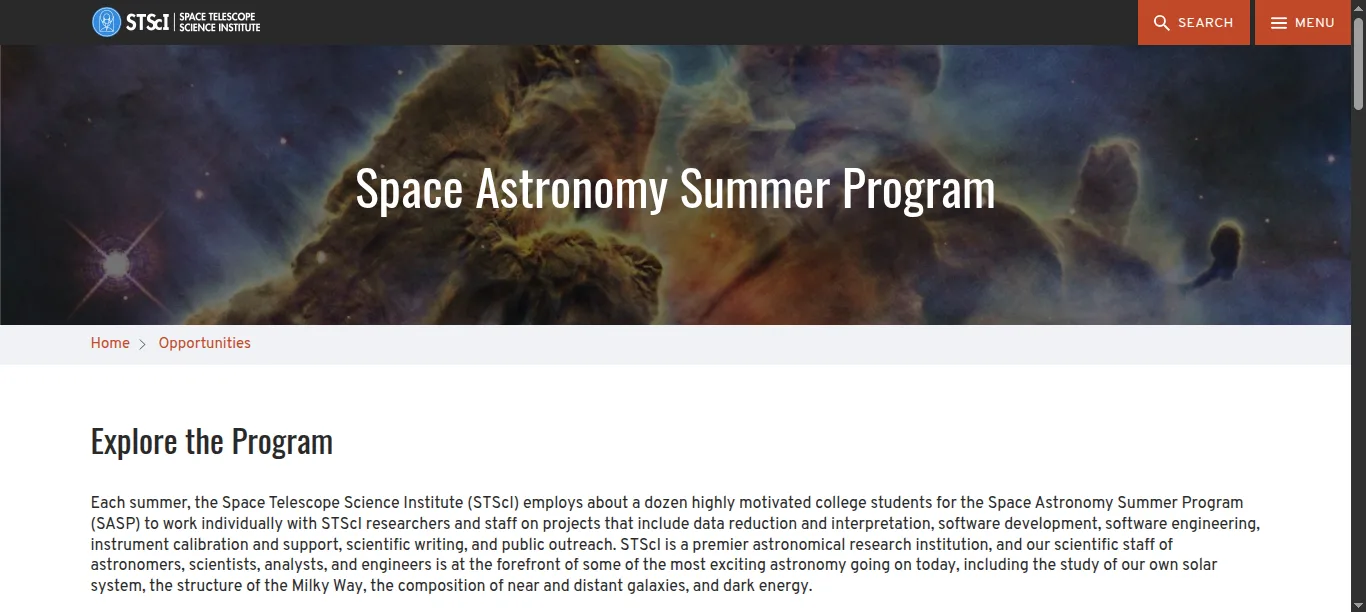
The Space Astronomy Summer Program (SASP) is a nine-week paid summer internship at the Space Telescope Science Institute (STScI) in Baltimore, Maryland. The 2027 programme runs from 31 May to 30 July 2027, and STScI says the stipend is tentatively $880 per week, with travel and housing assistance provided. Applications open in January 2027. The single most important caveat is that STScI has not yet published the 2027 application deadline: the application page still displays the 2026 cycle, which opened on 1 January 2026 and closed on 31 January 2026.
Quick Facts
| Item | Detail |
|---|---|
| Host | Space Telescope Science Institute (STScI) |
| Location | STScI campus, Johns Hopkins University Homewood campus, Baltimore, Maryland, USA |
| Opportunity type | Paid summer research internship |
| Duration | Nine weeks: 31 May–30 July 2027 |
| Eligibility | Primarily upper-division undergraduates in astronomy, engineering or outreach; others considered individually |
| Funding | Tentative stipend of $880 per week; travel and housing assistance |
| Application status | Opens January 2027; 2027 deadline not yet published |
| Deadline | Not announced; the page still shows the 2026 deadline of 31 January 2026 |
| Official portal | STScI SASP application information |
What SASP is
STScI runs the Hubble Space Telescope and the James Webb Space Telescope's science operations, and its staff include astronomers, scientists, analysts and engineers. Each summer the institute employs about a dozen college students to work individually with those staff on real projects. SASP is not a lecture course with a research taster attached; interns are placed with a mentor and contribute to the institute's work for nine weeks.
The programme's stated goals are to expose undergraduates to leading astrophysics research and to the workings of a space-based observatory, to give participants opportunities for growth and personal development, and to place them in a cohort of peers. STScI is explicit that not every student works directly on an astronomical research project: all students learn about the research and support work conducted at the institute, and some are placed in software, calibration or outreach roles.
The cohort is small. STScI says it employs "about a dozen" students each summer, and it describes the programme as competitive. That scale is part of the appeal: interns share office space, attend lectures together and present at a symposium at the end of the programme. The 2026 symposium was held on 30 July 2026.
The 2027 dates and the stale 2026 announcement
Two official pages matter for dates, and they currently tell a slightly awkward story.
The SASP programme page says the 2027 programme dates will be 31 May through 30 July 2027, that accepted interns will be brought to the STScI campus in Baltimore to work directly with their mentors, and that applications will open in January 2027. The programme details page repeats the dates and the January 2027 opening.
The application information page, however, still carries an announcement headed "Applications for 2026 Internships Open on January 1, 2026," with a deadline of 31 January 2026. That is last cycle's text. It has not been replaced with a 2027 deadline at the time of writing.
The practical reading is straightforward. The 2027 dates and stipend are published. The 2027 application opening month is published. The 2027 deadline is not. Anyone who quotes a 2027 deadline in November 2026 is inferring it from the 2026 cycle. Check the application page in January 2027 before you plan around a date.
What you would work on
STScI groups SASP projects into four broad types, and the balance changes each year depending on which mentors offer projects.
Astrophysics research. Students contribute to astronomers' research through statistical analysis and physical interpretation of astronomical data, coding, or other skills. Specific topics vary, but STScI lists solar system objects, extrasolar planets, stars and stellar populations, galaxies and the intergalactic medium, cosmology, and black holes as possible areas.
Software engineering. STScI staff build and maintain tools for astronomers who use the telescopes, and they calibrate and archive data for the Mikulski Archive for Space Telescopes (MAST). Students may work with physicists and mechanical engineers on instrumentation and testing, with software engineers on internal or external tools, with flight operations staff on scripts that operate science instruments, or with scientists analysing large data volumes.
Instrument calibration. Each instrument on Hubble or Webb has a team of scientists, analysts and engineers who calibrate and characterise its raw data. Interns can join that work and learn how a space telescope instrument is operated and how its data are processed for precise measurement.
Public outreach. STScI communicates the science of NASA observatories to the public. Outreach interns may help with image processing, science writing, astronomical artwork, video production, citizen science projects or applications for the astronomical community.
That range matters for applicants who assume SASP is only for future astronomers. STScI says the programme is open to students with a strong interest in space-based astronomy, engineering or public outreach. A software portfolio or a communications record can be as relevant as a physics transcript, depending on the projects available.
Eligibility and requirements
The core eligibility statement is short: SASP is "primarily open to upper-division undergraduates with a strong interest in space-based astronomy, engineering, or public outreach," and other candidates may be considered on an individual basis. The application page adds that the programme primarily serves college undergraduates from the US and other countries between their junior and senior years, and that exceptional students in earlier years are also accepted.
There is no published GPA cut-off, no required major and no fixed list of courses. STScI describes the qualities that tend to predict success rather than formal requirements: a strong background in astronomy, mathematics and/or physics; hands-on experience with astronomical data and analysis; research experience; the ability to work independently; confidence in your limits; and a willingness to ask for help. It then says plainly that none of those qualities is a requirement.
The practical requirements are about participation. Students must spend the entire internship at STScI, must start on a single date in June, and must complete at least eight of the nine weeks. STScI says you cannot start early. If your term dates clash with the programme, that is a real constraint, not a negotiable detail.
International applicants are eligible. STScI says both US and non-US citizens are welcome to apply, and that non-US citizens need a visa to work in the US regardless of where their college or university is located. The institute provides assistance to qualified international applicants in obtaining the appropriate visa and work documents.
Funding, stipend and costs
The headline figure is a tentative stipend of $880 per week for the 2027 programme. Over nine weeks that is roughly $7,920 before tax, though STScI describes the rate as tentative and the final amount depends on the programme's budget. The stipend is meant to be comparable to other astronomical summer internships in the United States.
Travel is covered in a specific way. STScI says all travel to and from the institute must be coordinated through its Human Resources department, and interns may not book their own travel. The institute covers round-trip transportation between the intern's preferred airport and Baltimore. The FAQ states simply that transportation to and from Baltimore is included.
Housing is subsidised, not free. STScI secures rooms at a local apartment complex close to the institute as one option, and it subsidises roughly one third of the housing cost. The remaining cost is borne by the intern and deducted from bi-weekly paychecks in equal amounts. If you arrange your own housing, there is no housing stipend. That distinction matters: the coordinated option comes with a subsidy and a payroll deduction, while the independent option comes with neither.
STScI does not publish a figure for the total housing cost, a meals allowance or a relocation payment. The programme provides a laptop and shared office space. Interns are responsible for their own food and personal expenses.
How to apply
- Wait for the January 2027 opening, then check the application page. The 2027 application will open in January 2027. The page still shows the 2026 announcement, so confirm that the new cycle is live before you start.
- Prepare your application through the portal. The application is submitted through the SlideRoom portal linked from STScI's application page. The page reviewed for this guide does not publish a document checklist in its text, so read the portal instructions carefully when the cycle opens.
- Make the case for a specific kind of project. SASP matches students to projects after selection. Explain whether you are strongest in astrophysics research, software, instrument calibration or outreach, and give evidence: code you have written, data you have reduced, writing or imaging you have produced.
- Submit before the deadline. The 2026 deadline was 31 January 2026. The 2027 deadline has not been published. Do not assume it will fall on the same date, and do not wait for a reminder.
- Monitor the email address in your application. STScI says it contacts candidates at the address listed in the application and that you cannot check your status during review.
- Respond quickly to an offer. Offers go out at the beginning of March, and STScI asks candidates to accept or decline by a deadline approximately five business days after the letter is sent.
The application page lists saspinfo@stsci.edu for urgent questions. Use it for procedural questions, not to ask whether you have been selected.
Selection and what makes a credible application
STScI says the selection process takes approximately six weeks and involves both assessing applicants and matching their skills and interests to available projects and supervisors. You cannot review your status during that period.
The published guidance is unusually candid. STScI says it receives hundreds of complete applications each year, that the majority are very good, and that demand exceeds supply. It encourages unsuccessful applicants to apply again. That is not a formality: reapplying with a stronger record is a legitimate strategy for a programme with a dozen places.
What does a credible application look like? STScI's list of success factors is the best guide. It names a strong background in astronomy, mathematics and/or physics; hands-on experience with astronomical data and analysis; research experience; independent working; and the confidence to ask for help. The strongest applications show evidence rather than assertion. A description of a dataset you reduced, a tool you built, an outreach product you made or a research question you pursued is more useful than a statement that you are passionate about space.
The matching process also means fit matters. If your evidence points clearly to software engineering, say so and show it. If it points to public outreach, show the work. A generic application that could be for any astronomy programme gives the reviewer nothing to match.
Living and working in Baltimore
STScI is on the Homewood campus of Johns Hopkins University. Interns work in shared office space as a cohort, and each student has access to a laptop. The institute has an on-site restaurant, Carma's Cafe, for breakfast and lunch, and there are restaurants and shops within walking distance.
You do not need a car. STScI says Baltimore has ample housing, restaurants, shops, banks and entertainment nearby, and students have access to the Johns Hopkins Blue Jay Shuttle. Local transport is primarily bus routes run by the Maryland Transportation Administration. For travel to Washington, Philadelphia or New York, Amtrak departs from Baltimore's Penn Station in the nearby Mount Vernon neighbourhood.
The housing page is also honest about safety: the area around the Homewood campus is described as one of the safer neighbourhoods in Baltimore, but not crime-free, and STScI provides personal safety information on arrival. Interns can borrow books from the Eisenhower library free of charge and use the athletic facilities for a fee.
What is confirmed and what is not yet announced
Confirmed on STScI's official pages as of 12 November 2026:
- the 2027 programme runs 31 May–30 July 2027 at STScI in Baltimore;
- the 2027 stipend is tentatively $880 per week;
- travel and housing assistance will be provided, with coordinated housing subsidised by roughly one third;
- round-trip transport between the intern's preferred airport and Baltimore is covered and must be booked through STScI;
- applications open in January 2027;
- the programme is primarily for upper-division undergraduates, with other candidates considered individually;
- students must complete at least eight of the nine weeks and start on a single June date;
- non-US citizens are eligible and receive visa assistance.
Not yet announced or not stated on the official pages reviewed:
- the 2027 application deadline (the page still shows 31 January 2026 for the 2026 cycle);
- the exact 2027 start date in June, which the housing page mentions without giving a day;
- the full list of 2027 projects and mentors;
- the total cost of coordinated housing and the precise cash value of the housing subsidy;
- whether the tentative $880 weekly rate will be confirmed;
- the number of applications received or the acceptance rate.
Sources
- STScI, "Space Astronomy Summer Program," accessed 12 November 2026
- STScI, "Program Details," accessed 12 November 2026
- STScI, "Application Information," accessed 12 November 2026
- STScI, "Housing and Transportation," accessed 12 November 2026
- STScI, "Frequently Asked Questions," accessed 12 November 2026
- Feynman Research Labs, "Space Astronomy Summer Program" listing
Keep exploring
The SNOLAB undergraduate research guide covers a very different route: long paid work terms inside an underground physics laboratory. If you are aiming at graduate research, the CERN doctoral studentship guide explains a European alternative, and the research programmes directory groups opportunities by type and country.
Frequently asked questions
- When is the Space Astronomy Summer Program in 2027?
- STScI says the 2027 programme dates are 31 May through 30 July 2027. Interns work at the STScI campus in Baltimore, Maryland, and applications open in January 2027.
- How much does SASP pay in 2027?
- STScI says the stipend for the 2027 programme is tentatively $880 per week, which it describes as comparable to other astronomical summer internships in the United States. Travel and housing assistance are also provided.
- Is housing included in SASP?
- STScI secures rooms at a local apartment complex as one option and subsidises roughly one third of the housing cost. The rest is deducted from bi-weekly paychecks. If you find your own housing, there is no housing stipend.
- Who is eligible for SASP?
- The programme is primarily open to upper-division undergraduates with a strong interest in space-based astronomy, engineering or public outreach. STScI says other candidates may be considered on an individual basis.
- Can international students apply to SASP?
- Yes. STScI says both US and non-US citizens are welcome to apply, and it assists qualified international applicants with obtaining a work visa. Non-US citizens need a visa to work in the US regardless of where their university is located.
- What is the SASP application deadline for 2027?
- STScI has not yet published a 2027 deadline. The application page says applications will open in January 2027 but still displays the 2026 announcement, which opened on 1 January 2026 and closed on 31 January 2026. Treat that date as the previous cycle, not the 2027 deadline.
- Do I have to stay for the whole nine weeks?
- STScI requires students to complete at least eight weeks of the nine-week programme. It also says students must start on a single date in June, so you cannot begin early.
- Do I need a car in Baltimore?
- No. STScI says there is ample housing, food, shops and entertainment within walking distance, and students have access to the Johns Hopkins University Blue Jay Shuttle. Local buses and Amtrak are available for travel beyond the campus area.
Official application link
Check STScI's official SASP application page
The 2027 application window opens in January 2027, but the page still shows the 2026 cycle announcement. Confirm the new deadline before applying.
Open official page

