
Academic guides · Guide
ThinkSwiss Research Scholarships: Asia-Pacific Guide
StatusClosed
ThinkSwiss funds two- to three-month research stays in Swiss laboratories at CHF 60 a day for students from India, Singapore, Australia, Brunei and six Pacific island countries.
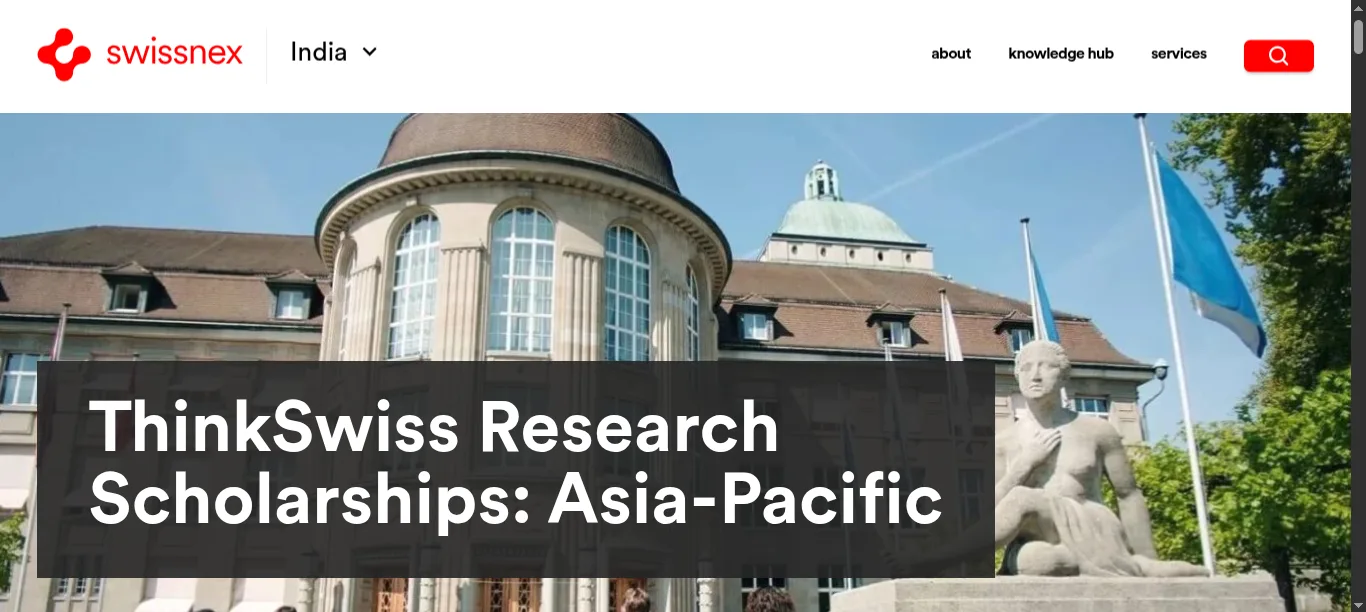
ThinkSwiss Research Scholarships are closed for applications. The scheme, run through swissnex in India with Switzerland's State Secretariat for Education, Research and Innovation (SERI), places students from India, Singapore, Australia, Brunei and six Pacific island countries in Swiss laboratories for two to three months. The published support is CHF 60 per day for living expenses only, and swissnex says details of the next application round will be announced in due course.
The short answer
ThinkSwiss is a research mobility scholarship, not a degree programme. You find a Swiss professor who will host you, secure written acceptance, and then apply to swissnex for a daily living allowance. The award runs for at least two months and at most three. Eligibility is limited to the named Asia-Pacific countries, and doctoral and postdoctoral applicants are excluded. The current call is closed, no deadline is published, and the page does not promise that the next round will repeat an earlier timetable.
Quick Facts
| Item | What the official page says as of 12 November 2026 |
|---|---|
| Host | Swissnex in India, part of the Swissnex network, with SERI |
| Location | Switzerland; the host laboratory chooses the city |
| Opportunity type | Research scholarship for a short laboratory stay |
| Duration | Minimum two months, maximum three months |
| Eligible countries | India, Singapore, Australia, Brunei, Kiribati, Nauru, Papua New Guinea, Solomon Islands, Vanuatu, Fiji |
| Eligibility | Master's student, or undergraduate who has completed second year; written Swiss host acceptance |
| Funding | CHF 60 per day for living expenses only |
| Application status | Closed; next round to be announced |
| Deadline | Not published |
| Official portal | swissnex India ThinkSwiss page |
What the programme is
ThinkSwiss is one of Switzerland's instruments for connecting researchers in Asia-Pacific with Swiss laboratories. The swissnex India page describes it as offering "fully-funded research stints in a Swiss laboratory of their choosing". The operative funding line is narrower: CHF 60 per day, "to cover living expenses only".
That distinction matters when you budget. The page does not state that ThinkSwiss pays for flights, health insurance, visa fees, accommodation deposits, or laboratory consumables. A three-month stay at CHF 60 a day comes to CHF 5,400 before any of those costs; a two-month stay comes to CHF 3,600. Those figures are arithmetic from the published rate, not additional awards.
The programme is administered through the Swissnex network rather than a single central admissions office. Swissnex describes its mission as supporting "the international exchange of knowledge, ideas and talent". The India page carries the common eligibility framework and country-specific contacts: Smriti Chawla at Swissnex in India for Indian applicants, Joël Henri Brunner at the Embassy of Switzerland in Singapore for Singapore and Brunei, and Tristan Piguet at the Embassy of Switzerland in Australia for Australian applicants. The page does not list a separate contact for the Pacific island countries.
The page footer identifies SERI, part of the Federal Department of Economic Affairs, Education and Research, as the government body behind the scheme. That matters for how you read the award: it is a government mobility grant administered through a science network, not a company internship or a university exchange.
Which countries and institutions are eligible
The country list is explicit: India, Singapore, Australia, Brunei, and Kiribati, Nauru, Papua New Guinea, Solomon Islands, Vanuatu and Fiji. Applicants must be enrolled at, or funded by, an accredited university or research institute in one of those countries. Being a national of an eligible country is not the test on the page; the test is enrolment or funding at an eligible institution.
The page treats the Pacific island group as a recent expansion. It says the call "is now also open to applicants from select Pacific Island Countries" and lists the six. It does not publish a separate quota or a separate deadline for that group.
There is one institutional carve-out: the University of Lausanne is not part of the programme for Indian students. The page does not explain the reason. Applicants to ETH Zurich must meet the prerequisites to become a "Project Mobility" student as stipulated by ETH; the page links to the ThinkSwiss FAQ for details. That is an ETH status question, not a ThinkSwiss selection question, and it should be settled with ETH before you rely on a placement.
The page also links to the Swiss Government Excellence Scholarships for early-career researchers. That is a separate scheme with its own eligibility and deadline, and it is not a substitute for ThinkSwiss if you are an undergraduate or master's student.
Who can apply
The must-haves on the page are short:
- You are enrolled at, or funded by, an accredited university or research institute in one of the eligible countries.
- You are currently enrolled in a master's programme, or you have completed your second year of an undergraduate degree by the time the research stay in Switzerland begins.
- A professor at a Swiss university or research institute has given you written confirmation that they have accepted you for a research stay in their group or laboratory.
The page adds two exclusions: doctoral and postdoctoral candidates are not eligible. It does not publish a minimum GPA, an age limit, a language-test requirement, or a limit on how many times you may apply.
The "preferred" side is field guidance rather than a rule. Indian applicants are "specifically encourage[d]" to apply with an interest in antimicrobial research (AMR), One Health, biodiversity, or climate change and action. Applicants from the Pacific island countries are encouraged in health, climate change, disaster risk reduction, and architectural resilience. For Australian, Singaporean and Bruneian applicants, the page says it is "subject-agnostic". Encouragement is not a restriction: the page does not say that an Indian applicant in another field is ineligible.
The master's and undergraduate rule needs care. An undergraduate who has finished second year can apply, but the stay must begin after that point. A master's student can apply at any stage of the master's, subject to the host's agreement. A doctoral student cannot. The page does not say whether a student who has completed a master's but not started a doctorate is treated as a master's applicant or as a doctoral candidate; that is a question for the country contact.
What you would work on
ThinkSwiss does not run a fixed curriculum or a central project list. The research topic is negotiated with the Swiss host professor and written into the application. The page tells applicants to identify the field they want to deepen, find professors working in it, and write to them directly.
The 2025 awardee list shows the range: relationship quality and physical activity in couples at the University of Zurich; peptide-based vaccines for rheumatic heart disease at the University of Zurich; pharmacogenomic variant annotation at the University of Basel; plant-soil feedbacks at the University of Bern; and pore-forming toxins for nanopore sequencing at EPFL.
The 2024 list adds carbon mineralisation at Bern, humanitarian design at the Graduate Institute Geneva, and radio astronomy at EPFL. The point is not that any particular field is favoured. It is that the programme is lab-based and project-based: you join an existing group and do research, not take courses.
Because the host defines the project, the quality of your email to a professor matters more than any central application essay. The page gives a useful checklist for that email: why you want to work with that professor and what about their work interests you; your relevant skills; your past experience and how it connects; how you plan to contribute; why you are a good fit; and a CV plus a short research proposal.
The page also suggests asking faculty at your own university whether they know suitable Swiss professors, and requesting an introduction where possible. That is often more effective than a cold email, particularly for a laboratory that receives many enquiries.
What the CHF 60 a day covers
The award is a daily living allowance, not a salary. At CHF 60 per day, a 60-day stay gives CHF 3,600 and a 90-day stay gives CHF 5,400. The page does not state whether the allowance is paid in advance, in instalments, or on completion. It does not state whether it is taxable in Switzerland, whether it affects your home institution's funding, or whether ThinkSwiss provides insurance.
The page also does not state that the host laboratory contributes funding. Some Swiss groups may offer a top-up or pay for travel, but that would be a separate arrangement with the host, not a ThinkSwiss entitlement. Ask the professor directly and get any offer in writing.
The practical budget question is therefore larger than the headline rate. Add return flights, visa and permit fees, health and accident insurance, housing deposit, local transport, and food beyond the daily allowance. The page's own framing is that the money is for living expenses, so treat accommodation and meals as the first call on it.
Switzerland is an expensive country, and CHF 60 a day is unlikely to cover a commercial hotel. The page does not publish a housing list or a room-rate estimate. Ask the host group whether it can help with university guest housing, a student residence, or a shared flat. That conversation belongs in the same email as the research proposal, not after the award.
How to apply
The application is a two-stage process: secure a host, then submit the ThinkSwiss application.
- Choose a field and a shortlist of professors. The page recommends starting early because finding a host "can take several weeks". Use the Study in Switzerland university list to identify institutions and read the professors' group pages.
- Write a specific enquiry. Include why their work interests you, your relevant skills, your past experience, how you would contribute, and why you are a good fit. Attach a CV and a short proposal or summary of the research you would like to do.
- Secure written acceptance. The acceptance letter from a Swiss professor is a mandatory document. It should make clear that the professor has accepted you for a research stay in their group or laboratory, and it should align with the dates in your application.
- Prepare the document set. The page lists an acceptance letter, a cover letter of no more than two pages, a CV of no more than two pages, a recommendation letter from a professor at your enrolled university, and transcripts.
- Submit through the ThinkSwiss application channel when the round opens. The page currently provides no open form. It says applications are closed and that details of the next round will be announced in due course.
- Watch for email notification. The page says selected candidates will be notified by email only and that telephone queries are not encouraged.
The page does not publish a word limit for the research proposal, a required format for the acceptance letter, or a rule on whether the recommendation letter must be sealed. Those details may appear in the application form or the FAQ when a round opens.
The FAQ linked from the page is dated 2026 and covers application requirements. It is worth reading before you write the cover letter, because it is the only detailed guidance the programme publishes. The link is included in the Sources section below.
Timeline and current status
As of 12 November 2026, the ThinkSwiss Research Scholarships page says: "Applications for the ThinkSwiss Research Scholarships are currently closed. Details about the next application round will be announced in due course." There is no published opening date, closing date, decision date, or start date for the next round.
The page lists 2025 awardees and 2024 awardees, which confirms that the scheme ran in those years. It does not publish a 2026 awardee list or a 2026 cycle timeline. Do not infer that a future round will open in the same month as a previous one.
The safest planning assumption is that the next round is unscheduled. You can still do the slow work now: identify professors, read their papers, and prepare a research proposal. A host acceptance is valuable whether the next call opens in a few months or later, provided the professor is willing to hold the invitation.
If you are an Indian applicant, the country contact is Smriti Chawla at Swissnex in India. For Singapore and Brunei, the contact is Joël Henri Brunner at the Embassy of Switzerland in Singapore. For Australia, it is Tristan Piguet at the Embassy of Switzerland in Australia. The page says selected candidates will be notified by email only, so make sure the address in your application is one you check regularly.
Selection and what makes a credible application
The page does not publish a scoring rubric, a shortlisting process, or a selection rate. What it does publish is the gate: without a Swiss host's written acceptance, you cannot apply. That makes the professor's judgement the first selection filter.
A credible application therefore has three visible features. First, the host letter is specific: it names the group, the period, and the arrangement. Second, the cover letter explains a research question that fits the host's work and can be pursued in two to three months. Third, the recommendation letter comes from someone at your enrolled university who can speak to your research ability, not only to your coursework.
The page's advice to "write to as many relevant professors as possible" should be read alongside its detailed checklist for a specific enquiry. A short, well-researched email to ten professors is more credible than a copied message to fifty. If you are struggling to identify people, the page suggests asking faculty at your own university for introductions.
The awardee lists are not a selection formula, but they do show that the programme accepts both lab-science and social-science projects. A pharmacogenomic project at Basel and a plant-soil project at Bern sit in the same cohort. The common thread is a host who is willing to supervise and a project that fits the host's group.
One practical test before you write: can you explain in two sentences what you would do in the first fortnight, what data or materials you would use, and what result would count as progress? If not, the proposal is not ready. The page does not require that level of detail, but a host who supervises visitors will ask for it.
What is confirmed and what is not yet announced
Confirmed: the country list, the institutional enrolment rule, the master's and second-year rule, the exclusion of doctoral and postdoctoral candidates, the host-acceptance requirement, the two-to-three-month duration, the CHF 60 daily rate for living expenses, the five-document checklist, and the current closed status.
Not announced: the next round's opening and closing dates, the decision date, the start date, the number of awards, whether the country list will change, whether the daily rate will change, and whether travel, insurance, or visa costs will be covered. The page also does not state whether the programme will run in 2027.
If you need a firm deadline before committing to a host, treat ThinkSwiss as pending. If you are building a research relationship with a Swiss group, the host conversation is worth having now, because it is the part of the process you control.
Sources
- Swissnex in India, "ThinkSwiss Research Scholarships: India", accessed 12 November 2026
- Swissnex, ThinkSwiss FAQs and application requirements, 2026 (PDF), accessed 12 November 2026
- Swissnex, "About us", accessed 12 November 2026
- Study in Switzerland, "List of Swiss universities", accessed 12 November 2026
- Swiss State Secretariat for Education, Research and Innovation, Swiss Government Excellence Scholarships, accessed 12 November 2026
Keep exploring
Compare this call with other verified programmes in the opportunity finder. If you are preparing a research application, the OIST Research Internship guide and the EPFL Life Sciences Summer Research Program guide show how laboratory placements differ across countries. The research programmes directory groups listings by type.
Frequently asked questions
- Is the ThinkSwiss Research Scholarship open for applications now?
- No. The swissnex India page says applications are currently closed and that details about the next application round will be announced in due course. No opening date, deadline, or decision date is published as of 12 November 2026.
- Which countries are eligible for ThinkSwiss?
- The page lists India, Singapore, Australia, Brunei, and six Pacific island countries: Kiribati, Nauru, Papua New Guinea, Solomon Islands, Vanuatu and Fiji. Applicants must be enrolled at, or funded by, an accredited university or research institute in one of those countries.
- How much does ThinkSwiss pay?
- The published rate is CHF 60 per day for a research stay of at least two months and at most three months. The page says the money is to cover living expenses only. It does not state that flights, insurance, visa fees, or accommodation deposits are covered.
- Who is eligible for ThinkSwiss?
- Applicants must be enrolled in a master's programme or have completed their second year of an undergraduate degree by the time the stay in Switzerland begins. They must also have written confirmation from a Swiss professor who has accepted them into a laboratory. Doctoral and postdoctoral candidates are not eligible.
- Do I need a host professor before applying?
- Yes. A written acceptance letter from a professor at a Swiss university or research institute is a mandatory application document. The page says applicants are responsible for finding the host and clarifying the research project before submitting.
- Can Indian applicants work in any field?
- The page specifically encourages Indian applicants with an interest in antimicrobial research, One Health, biodiversity, or climate change and action, but it does not say other fields are excluded. It says it is subject-agnostic for Australian, Singaporean and Bruneian applicants.
- Is the University of Lausanne open to Indian ThinkSwiss applicants?
- No. The page states that the University of Lausanne is not part of the programme for Indian students. Applicants to ETH Zurich must also meet ETH's prerequisites to become a Project Mobility student.
Official application link
Check the official ThinkSwiss page
Applications are closed and swissnex says the next round will be announced in due course. Confirm country-specific eligibility and the current document list before preparing a submission.
Open official page

