
Academic guides · Guide
Santa Fe Institute Undergraduate Complexity Research (UCR): 2027 Guide
StatusOpen
SFI's Undergraduate Complexity Research programme pays $7,000 for ten weeks of complexity research in Santa Fe, with housing, meals and travel covered. The 2027 deadline is 13 January.
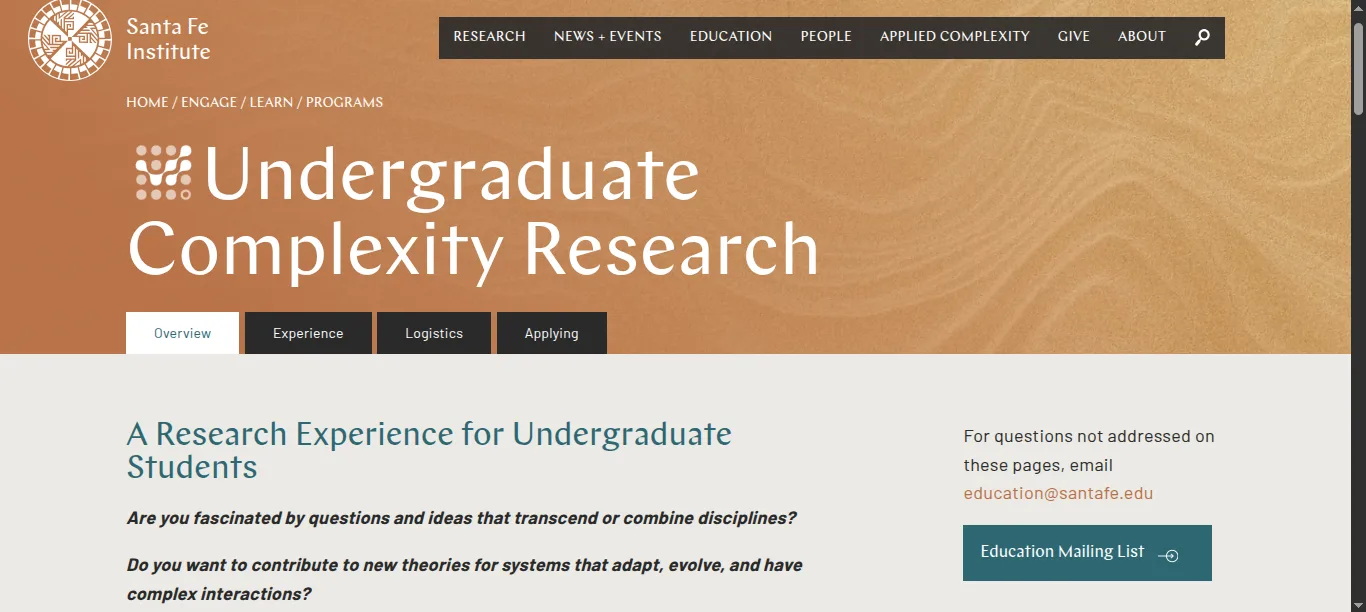
The Santa Fe Institute's Undergraduate Complexity Research (UCR) programme is a ten-week, in-person summer research programme in Santa Fe, New Mexico. The 2027 edition runs from 30 May to 7 August 2027, and the application deadline is 13 January 2027 at 4 p.m. Mountain Standard Time. Participants receive a $7,000 stipend, free housing and meals during the residential stay, and travel support.
The short answer
UCR is not a conventional laboratory internship. Students work with one or more SFI researchers on an original project in complexity science, and the project is defined after arrival, during the first weeks of the programme. The 2027 cohort will live at the Institute of American Indian Arts campus and work at SFI's Cowan campus. The programme is open to current undergraduates from two-year and four-year institutions, including transfer students, and prior research experience is not required.
Quick Facts
| Item | What the official page says as of 12 November 2026 |
|---|---|
| Host | Santa Fe Institute |
| Location | Santa Fe, New Mexico, United States |
| Opportunity type | Undergraduate research programme in complexity science |
| Duration | Ten weeks, 30 May to 7 August 2027 |
| Housing | Private room with en-suite bathroom at the IAIA campus |
| Eligibility | Current undergraduate returning for at least one term after August |
| Funding | $7,000 stipend, housing, meals, travel support |
| Application status | Open |
| Deadline | 13 January 2027, 4 p.m. MST |
| Official portal | SFI UCR page |
What UCR is
The Santa Fe Institute is an independent research institute focused on complex systems. Its UCR programme is an immersive ten-week experience in complexity science research. Each student works closely with one or more SFI researchers to develop and pursue an original research project.
The programme's own description is deliberately broad. It invites students who are interested in "using mathematical, computational, and interdisciplinary approaches to explore questions that don't fit neatly within one field" and who want to "discover new theories for systems that adapt, evolve, and have complex interactions". That is the intellectual centre of the programme: problems that cross disciplines, not a single lab technique.
The first weeks are structured around exploration. Students meet researchers, explore potential directions, and refine their ideas into projects that can make meaningful progress over the summer. The programme says the project ideas in the application are not commitments; they help the selection committee understand your interests and approach. The actual project is developed with a mentor after you arrive.
The programme is small and residential. Students live at the Institute of American Indian Arts campus, about a half-hour drive from SFI, in private rooms with private bathrooms. Weekday group transport between the housing and the SFI campus is provided. The page describes the IAIA campus as a high-desert setting with mountain views, walking trails, and artwork.
The UCR co-directors are Chris Kempes, a professor at SFI whose work spans ecology, astrobiology, and human institutions, and Melanie Mitchell, the James B. Alley Jr. Professor at SFI, whose research focuses on conceptual abstraction, analogy-making, and visual recognition in AI systems. Both are listed with profiles on the programme page.
Complexity science and research areas
Complexity science is easier to describe by its questions than by a departmental label. UCR projects can sit in the physical, natural, and social sciences and mathematics. The programme's goals include exploring new ideas through an independent transdisciplinary project, developing an understanding of complex systems through discussions and seminars, and building technical and professional skills such as science communication and robust research methods.
The page does not publish a fixed list of project topics. That is consistent with the programme's design: the project emerges from the student's interests and the mentor's current work. The page does say that strong quantitative skills and/or experience with a programming language are "favorably considered". It does not require a particular major, a particular language, or a particular level of mathematical preparation.
The Experience page describes the weekly rhythm. Students devote most of the workweek to their individual projects. They meet weekly with programme directors and education staff, and attend tutorials on topics such as effective reading of scientific literature, science communication across audiences, and being a well-rounded researcher. They also attend seminars by resident and external faculty, postdoctoral fellows, and invited researchers.
Each student gives two presentations: a "flash talk" outlining the chosen project and a research presentation during the final week. That structure forces early clarity. A flash talk in the first part of the programme is not a polished conference talk; it is a way to make the project legible to a non-specialist audience.
The page lists the mentors as resident SFI faculty and postdocs from a transdisciplinary network. Students also interact with visiting faculty. The programme explicitly asks candidates to wait until arrival before contacting SFI researchers, and says all admissions decisions are based on the application materials alone.
The 2027 dates and current status
The 2027 programme begins on Sunday 30 May 2027 and ends on Saturday 7 August 2027. It is a full-time, work-day commitment for the entire ten weeks. Participants are expected to arrive on 30 May and depart on 7 August. Late arrivals are not allowed.
The application deadline is 13 January 2027 at 4 p.m. MST. Applications opened in November 2026. The FAQ says applicants who submit a complete application by the deadline will receive an email update about their status in March 2027. Late or incomplete applications will not be reviewed and no status notifications will be sent.
The page does not publish a decision date beyond "March 2027". It says selected finalists will be invited to short individual interviews via Zoom after the initial review. All applicants, including those not selected as finalists, receive an email update in March.
The 2027 dates are confirmed on the programme page. The page does not state whether the programme will run in 2028, or whether the dates, stipend, or housing arrangement will change in a future cycle.
Eligibility
The eligibility rules are more precise than the short label "undergraduate" suggests.
Current undergraduate status. An "undergraduate student" is someone actively enrolled, part-time or full-time, in a degree programme leading to an associate's or bachelor's degree, who intends to continue that undergraduate enrolment for at least one additional academic term after the programme ends in August.
Institutional type. Students from two-year and four-year institutions are eligible. Transfer students are eligible, including during the summer between schools. Students in integrated or dual-degree programmes, such as a combined BS/MS, may be eligible if they are still in the undergraduate portion and will return to undergraduate enrolment for at least one more term after the summer.
Priority. Although undergraduates at all stages may apply, priority is typically given to students entering their junior or senior year of a four-year programme.
Exclusions. Students who will fully complete their undergraduate degree before the programme ends, or who will not return to any further undergraduate enrolment after August, are not eligible. High school graduates who have not yet started college-level coursework are not eligible. Individuals who have already completed an undergraduate degree and are no longer enrolled as undergraduates are not eligible.
The programme does not require prior research experience. It says strong applicants can teach themselves new material, follow through on ideas, communicate effectively, work well in teams, and think logically and creatively about research questions.
International applicants. The programme welcomes applications from anyone whose citizenship or residency makes them eligible to work in the United States. Eligibility is set by US federal regulations. International students at US institutions typically participate under F-1 status through Curricular Practical Training, arranged with their home university and international student office. Students enrolled outside the US may receive visa assistance, including SFI sponsorship of a short-term J-1 visa. SFI does not sponsor H-1B visas. The page says SFI will not provide individual guidance except for final-round candidates after review and interviews in February and March.
Funding and costs
The funding package is unusually complete for a US summer programme:
| Item | What SFI provides |
|---|---|
| Stipend | $7,000 over the ten-week programme |
| Housing | Private room with private bathroom at the IAIA campus |
| Meals | Provided at no cost during the residential stay |
| Travel | Reimbursement to and from Santa Fe, within programme limits |
| Local transport | Weekday van transport between IAIA housing and the SFI campus |
The travel support has conditions. SFI reimburses economy fares within allowable limits and carriers. Students who drive instead of flying are eligible for mileage reimbursement up to the reimbursement limit, which is provided after acceptance. Routine gas and local personal driving during the programme are not reimbursed. Ground transport to and from airports can be reimbursed, but meals and other purchases during travel are not.
Personal transport in and around Santa Fe outside programme travel is not provided or reimbursed. Students who arrive early or stay late for a holiday must arrange and pay for their own accommodation, meals, and transport; programme housing is not available outside the programme dates.
The page does not state whether the stipend is taxable, whether it is paid in instalments, or whether it affects financial aid at your home institution. Those are questions for SFI and your own financial aid office. The page also does not publish a total programme budget or a per-student travel cap.
How to apply
Applications are submitted through SurveyMonkey Apply. The programme says it only accepts applications through that portal. A complete application includes:
- Biographical information. Completed directly in the application portal.
- A current academic CV or résumé. This should show your education, coursework, work experience, and any projects or research.
- Research statements. Written responses to two prompts, including a short project proposal. The page describes this as a one-page research statement outlining research ideas that interest you.
- An unofficial transcript. From each college or university you have attended. Official transcripts are not required at the application stage.
- One letter of recommendation. From a professor, mentor, or advisor who knows your work.
The research statement is not a commitment to a project. The page says it serves two purposes: to show what you are excited about, and to show how you think. It asks you to describe a clear question or target, a plausible path forward, and why that path fits the question. It explicitly says you do not need to know which dataset you would use, which statistical test is best, or the exact name of an algorithm.
The transcript rules are practical. It should list all completed and in-progress courses with grades. If it is not in English, include a cover-page translation. If fall-term grades are not available, provide a list from your institution of the courses you enrolled in and will complete. Updated grades or additional documents cannot be added after the deadline.
The recommendation letter can hold up an application. The page advises contacting your recommender as soon as you begin the application. Materials submitted after the deadline cannot be added or considered.
Selection and what makes a credible application
The page does not publish a scoring rubric or a selection rate. It describes a holistic review of the application materials, followed by short Zoom interviews for finalists. All applicants receive an update in March.
The strongest applications show a question the applicant actually cares about, a plausible way to approach it, and evidence that the applicant can work independently. The programme is explicit that it does not expect prior research experience or deep technical detail. It wants specificity in reasoning, not jargon.
A credible research statement might describe a question such as how a particular kind of network changes under stress, or how a collective behaviour emerges from individual decisions, and then explain what data or model the applicant would use and why. It does not need to be the project the applicant will eventually do. It needs to show that the applicant can connect a question to a method.
The "priority to juniors and seniors" line is not an exclusion, but it shapes the cohort. Younger students should make the case that they have the mathematical or computational preparation to benefit from the programme. The page says strong quantitative skills and programming experience are favourably considered, so those are worth making visible in the CV and statement.
The programme's advice not to contact SFI researchers is worth following. The selection committee reviews applications without those approaches, and the mentor matching happens after admission. A cold email is more likely to be seen as ignoring the instructions than as initiative.
What is confirmed and what is not yet announced
Confirmed for 2027: the 30 May to 7 August dates, the 13 January deadline at 4 p.m. MST, the $7,000 stipend, the IAIA housing, the meals, the travel support, the eligibility rules, the application documents, and the March notification.
Not announced: the number of applicants, the number of places, the selection rate, the names of the 2027 mentors, the project topics, whether the programme will run in 2028, and whether the stipend or dates will change. The page also does not publish a minimum GPA or a required major.
The programme is funded by the National Science Foundation's BIO REU programme (Award No. 2349052) and by the McKinnon Family Foundation, the Darla Moore Foundation, the Bengier Foundation, Eugene and Jean Stark, and an anonymous donor. That funding supports the stipend, housing, meals, and travel.
Sources
- Santa Fe Institute, "Undergraduate Complexity Research", accessed 12 November 2026
- Santa Fe Institute, UCR "Applying" page, accessed 12 November 2026
- Santa Fe Institute, UCR "Experience" page, accessed 12 November 2026
- Santa Fe Institute, UCR "Logistics" page, accessed 12 November 2026
- Santa Fe Institute, UCR FAQ, accessed 12 November 2026
Keep exploring
Compare this programme with other verified undergraduate research routes in the opportunity finder. The Caltech SURF 2027 guide covers a discipline-specific US summer fellowship, and the Santa Fe Institute listing shows how complexity science sits alongside laboratory programmes. The research programmes directory groups listings by type.
Frequently asked questions
- Is the SFI Undergraduate Complexity Research programme open for 2027?
- Yes. Applications for the 2027 UCR programme opened in November 2026 and close on 13 January 2027 at 4 p.m. Mountain Standard Time. The programme runs from 30 May to 7 August 2027.
- How much does UCR pay?
- Participants receive a $7,000 stipend over the ten-week programme. Housing and meals are provided at no cost during the residential stay, and travel support to and from Santa Fe is provided within the programme's limits.
- Who is eligible for UCR?
- Applicants must be current undergraduates enrolled part-time or full-time in an associate's or bachelor's degree programme and must intend to continue undergraduate enrolment for at least one additional academic term after the programme ends in August. Students from two-year and four-year institutions, including transfer students, are eligible.
- Do I need prior research experience?
- No. The programme says prior research experience is not required. It looks for curiosity, the ability to teach yourself new material, effective communication, teamwork, and logical and creative thinking about research questions.
- Do I need to find a mentor before applying?
- No. Mentors and projects are selected after participants arrive, guided by the SFI Education Team and the UCR directors. The programme asks applicants not to contact SFI researchers in connection with their application.
- Can international students apply to UCR?
- Yes, but applicants must be eligible to work in the United States. International students at US institutions typically participate under F-1 status through CPT. Students enrolled outside the US may receive visa assistance, including SFI sponsorship of a short-term J-1 visa. SFI does not sponsor H-1B visas.
- Is UCR in person?
- Yes. The programme is a full-time, in-person commitment for the entire ten weeks. Participants arrive on Sunday 30 May 2027 and depart on Saturday 7 August 2027. Late arrivals are not allowed because the first two weeks are used for orientation and project definition.
- What is the difference between UCR and a traditional summer research internship?
- UCR is explicitly interdisciplinary. Students work with SFI researchers on questions that cross the physical, natural, social and mathematical sciences, and the project is developed after arrival rather than fixed by a host laboratory in advance.
Official application link
Check the official SFI UCR page
The 2027 application closes on 13 January 2027 at 4 p.m. MST. The programme requires arrival on 30 May 2027 and full in-person participation.
Open official page

