
Academic guides · Guide
WHOI Summer Student Fellowship: Guide and Funding
StatusClosed
WHOI's Summer Student Fellowship places 25 to 30 undergraduates in ocean research for 10 to 12 weeks, with a $721 weekly stipend and housing. Summer 2026 is closed.
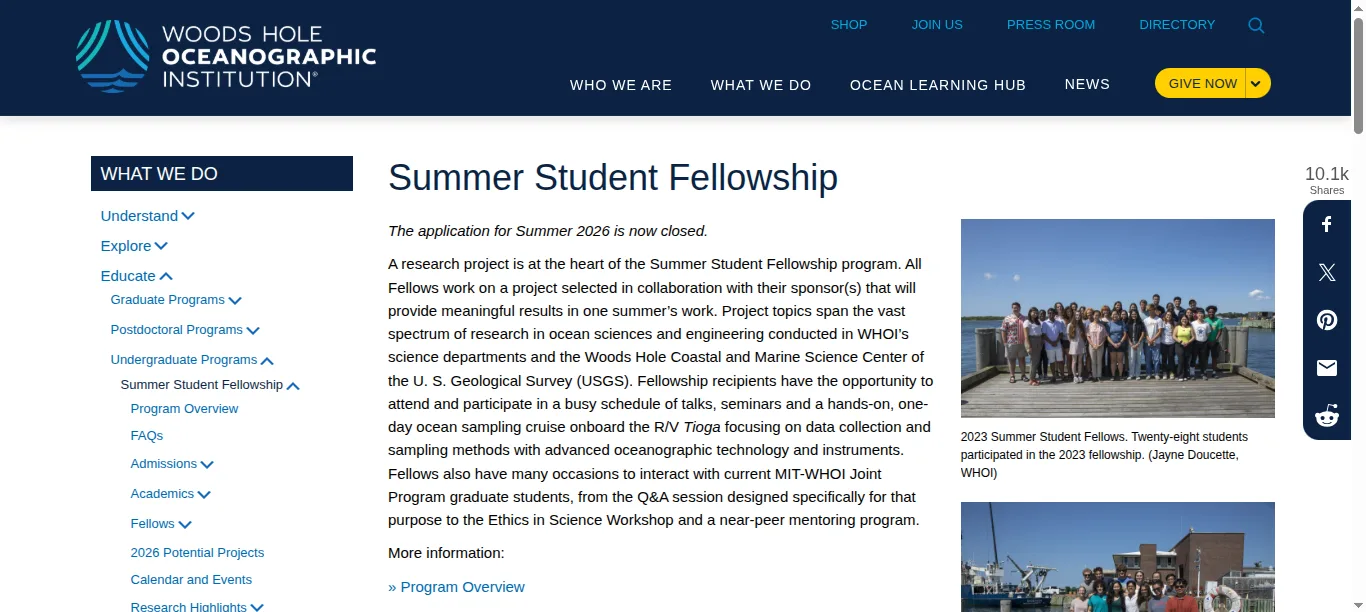
The WHOI Summer Student Fellowship is a ten- to twelve-week paid summer research programme at the Woods Hole Oceanographic Institution in Woods Hole, Massachusetts. The Summer 2026 application is closed. WHOI says applications are accepted each year from early December through early February; the 2026 deadline was 1 February 2026 at 11:59 p.m. EST, and no 2027 deadline has been published. The 2026 package paid $721 per week, a $720 travel allowance, and institution housing.
The short answer
This is a research fellowship, not a taught summer school. Fellows join a WHOI scientist's group, agree on a project that can produce meaningful results in one summer, and spend most of the placement on that project. The programme adds a lecture series, an ethics workshop, a one-day cruise on the R/V Tioga, and required presentations. About 25 to 30 students are selected each summer. Eligibility is restricted to undergraduates who will have completed their junior year by the start of the fellowship and who will not graduate before it begins. The current cycle is closed and the next call has not been announced.
Quick Facts
| Item | What the official pages say as of 12 November 2026 |
|---|---|
| Host | Woods Hole Oceanographic Institution, with NSF REU support |
| Location | Woods Hole, Massachusetts, United States |
| Opportunity type | Summer research fellowship |
| Duration | Ten to twelve weeks; arrival between late May and mid-June |
| Fellows | 25 to 30 per summer |
| Eligibility | Completed junior year; not graduating before the start; science, engineering or marine policy |
| Funding | $721 per week for 2026, $720 travel allowance, institution housing |
| Application status | Summer 2026 closed; 2027 not announced |
| Deadline | 1 February 2026, 11:59 p.m. EST (historical); annual window early December to early February |
| Official portal | WHOI Summer Student Fellowship |
What the fellowship is
The Woods Hole Oceanographic Institution is an independent, non-profit ocean research organisation based on Cape Cod. Its Summer Student Fellowship is one of its undergraduate research routes and is supported by the National Science Foundation's Research Experience for Undergraduates programme, through Award OCE-2447320, as well as by friends of the institution.
A research project sits at the centre of the fellowship. Each fellow works on a project selected in collaboration with a sponsor, and the programme says the project should provide meaningful results in one summer's work. Projects can sit in WHOI's science departments or at the Woods Hole Coastal and Marine Science Center of the US Geological Survey, which is located on WHOI's Quissett campus.
The fellowship is structured beyond the project. Fellows attend the Summer Lecture Series, which introduces the range of oceanographic research at WHOI, and the Ethics in Science Workshop, where scenarios are discussed in small groups and with the whole cohort. They take part in a one-day ocean sampling cruise on the R/V Tioga, focused on data collection and sampling methods with oceanographic instruments. They also meet current MIT-WHOI Joint Program graduate students at a dedicated question-and-answer session and through a near-peer mentoring programme.
Every fellow gives a mid-summer oral progress report and makes a public oral or poster presentation at the end of the summer. A written report describing the research is also required. The programme says fellows are encouraged to attend the wider schedule of seminars and events in the Woods Hole scientific community.
The fellowship does not carry formal academic credit toward a degree. WHOI says some fellows have received credit from their own college or university, but arranging that is the student's responsibility.
Research areas and projects
The programme is open to students in science, engineering, and marine policy, and it expects at least a tentative interest in ocean sciences, oceanographic engineering, or marine policy. The admissions page lists biology, chemistry, engineering, geology, geophysics, mathematics, meteorology, physics, oceanography, and marine policy as examples rather than a closed list.
Projects are hosted across WHOI's research departments: Applied Ocean Physics and Engineering, Biology, Geology and Geophysics, Marine Chemistry and Geochemistry, the Marine Policy Center, and Physical Oceanography. The USGS Woods Hole Coastal and Marine Science Center also hosts fellows, and its research focuses on the geology and processes of coastal and marine systems.
The page does not publish a single fixed project catalogue for a future year. It publishes a potential projects list for the current cycle, and the 2026 list remains linked from the programme pages. That list is the best guide to the kind of work available, but it is a snapshot of one year, not a promise of 2027 topics.
Projects are typically suggested by the advisor and agreed jointly by the student and advisor. That means the fellow is not expected to arrive with a fully specified project. The application research statement is used to understand interests and to propose a sponsor match, not to lock in a project.
Fieldwork varies by project. WHOI says the opportunity to do field work depends on the project, so a laboratory-based or computational project may involve little time at sea. Applicants who want a particular kind of fieldwork should say so in the research statement and discuss it with the advisor.
Eligibility and requirements
The eligibility rules are more specific than the phrase "undergraduate" suggests.
Year of study. Applicants must be undergraduate students who will have completed their junior year at a college or university by the start of the fellowship period. The programme is designed for students to take part in the last summer of their undergraduate years.
Graduation rule. Students who will graduate before the fellowship begins are not eligible. A final-year student whose graduation ceremony falls before the start date cannot use the fellowship as a post-graduation placement.
Three-year and five-year degrees. Students in a three-year bachelor's programme, such as those in the United Kingdom, must be in their second year. Students in a five-year combined bachelor's/master's programme must be in the third year of the programme.
Field. Applicants may be studying any field of science or engineering, including the subjects listed above, and marine policy. They must have at least a tentative interest in ocean sciences, oceanographic engineering, or marine policy.
Nationality and institution. The page does not restrict nationality or require study at a US institution. International students may apply. The practical test is visa eligibility and the ability to participate for the full period.
The page does not publish a minimum GPA, an age limit, a language-test score, or a requirement for prior research experience. It does not say that a master's student is eligible; the stated pool is undergraduates who have not yet completed a bachelor's degree.
Funding, stipend and housing
The 2026 financial package had three parts:
| Item | 2026 amount or arrangement |
|---|---|
| Weekly stipend | $721 per week |
| Duration | Ten to twelve weeks |
| Travel allowance | $720 |
| Housing | Institution housing, typically a shared room in a shared unit with two single beds |
| Meals | Not provided; housing has a fully equipped kitchen |
| Academic credit | Not offered formally |
At $721 per week, a ten-week fellowship comes to $7,210 and a twelve-week fellowship to $8,652 before the travel allowance. Those figures are arithmetic from the published weekly rate, not additional awards. The page does not state whether the stipend is paid weekly, biweekly, or in another schedule.
Housing is provided in kind. WHOI says its housing is typically a shared room in a shared unit, with two single beds per room, and that fellows are strongly encouraged to live in institution housing. Housing preferences must be made clear before the programme starts. There is no meal plan, but the housing has a fully equipped kitchen, and a weekly shuttle to a grocery store is provided.
International fellows should budget for the 14% US federal income tax that WHOI says is deducted from stipend payments, travel allowances, and the fair-market value of WHOI housing. The tax is withheld through payroll. The page does not state the tax treatment for US citizens or permanent residents.
The page does not state that flights, visa fees, health insurance, or local transport are covered beyond the $720 travel allowance. Fellows should budget for return travel to Massachusetts, visa costs, insurance, food, and personal expenses. The travel allowance is a contribution toward round-trip travel, not a guarantee that it covers the full fare.
How to apply
The application is submitted through WHOI's online platform. All documents are uploaded there, and recommenders receive a unique link to submit their letters.
- Check your eligibility. Confirm that you will have completed your junior year by the start of the fellowship and that you will not graduate before it begins. If you are in a three-year or five-year programme, check the year rule above.
- Prepare a current CV or résumé. It should show your educational background and work experience. Research experience, coursework projects, and technical skills are relevant even if they are not oceanographic.
- Upload an unofficial transcript as a PDF. An official transcript is required only from applicants who receive a fellowship.
- Arrange two letters of recommendation. They should come from professors or others familiar with your academic credentials. You may name one additional recommender, for a maximum of three. The page warns that some email clients, including Outlook, may send application-system messages to junk folders, so ask your recommenders to check.
- Answer the five essay questions. Each answer is limited to 200 words. The prompts ask what skills and knowledge you hope to develop at WHOI and how that will benefit your education and career; for an example of prior research or project work where you used learned skills to solve a problem; which areas of marine research interest you and why, with reference to a specific lab or general area; what qualities you will bring to a supportive programme environment, with specific examples; and something about yourself that the committee should know.
- Submit before the deadline. The 2026 deadline was 1 February 2026 at 11:59 p.m. EST. The page says applications are accepted each year from early December through early February. No 2027 date has been published.
- Wait for the decision. WHOI says decisions are made in mid-March. All students offered a position at the REU site have until 15 March or later to accept or reject the offer. Applicants who are asked to decide earlier should contact the NSF Division of Ocean Sciences REU Program Director.
Contacting a potential advisor is optional. WHOI says it is not required but encourages applicants to make contact with an assistant, associate, or senior scientist, or a member of the senior technical staff, who may be willing to host a fellow. Department pages list researchers and their interests, and the USGS centre also has potential sponsors.
Questions go to education@whoi.edu. The programme warns that application-system email can be filtered, so check spam and junk folders for the registration PIN and recommendation confirmations.
Timeline and current status
The 2026 cycle followed the pattern below:
| Stage | 2026 timing |
|---|---|
| Application window | Early December 2025 to 1 February 2026 |
| Deadline | 1 February 2026, 11:59 p.m. EST |
| Decisions | Mid-March 2026 |
| Offer response | 15 March 2026 or later |
| Arrival | Late May to mid-June 2026, depending on advisor availability |
| Duration | Ten to twelve weeks |
As of 12 November 2026, the main programme page says: "The application for Summer 2026 is now closed." The admissions page repeats the notice. The FAQ still lists 1 February 2026 as the deadline, which confirms that the published dates describe the past cycle rather than a future one.
WHOI's general statement is that applications are accepted each year starting in early December through early February. That is a description of the annual rhythm, not an announcement of 2027 dates. The programme has not published a 2027 deadline, start date, stipend rate, travel allowance, project list, or number of places.
The 2026 page also says participation will be dependent on any visa or travel restrictions. That language reflects the conditions under which the page was written and should be checked against current guidance if you are applying from outside the United States.
Selection and what makes a credible application
WHOI describes selection as a holistic review of the applicant's previous academic and scientific background, interests, and promise as a future ocean scientist or ocean engineer. It says important consideration is given to matching each fellow with an appropriate advisor on the scientific or senior technical staff. Decisions are made in mid-March.
The programme does not publish a scoring rubric or a selection rate. It does say the selection committee considers the research statement, coursework history, and academic background when proposing a sponsor match. That makes the research statement more than a generic essay: it is the document used to decide which scientist's group might suit you.
A credible application has three features. First, the research statement names specific interests. A general statement about loving the ocean is less useful than a statement about a question, a system, or a technique, with a reference to a WHOI department or lab where that work happens. Second, the CV shows what you have actually done, including coursework projects, programming, field experience, or laboratory work. Third, the recommendation letters speak to your ability to work independently and to learn new material, not only to your exam grades.
The five 200-word essays are short, so each one needs a concrete example. The prompt about solving a problem with learned skills is an invitation to describe a project rather than to list skills. The prompt about contributing to a supportive environment is an invitation to describe a specific experience, not to assert that you are a team player.
Contacting an advisor before applying can help, but it is not a substitute for a strong application. WHOI says contact is encouraged, not required. A short, specific email that refers to the scientist's recent work and explains what you could contribute is more useful than a mass mailing.
What is confirmed and what is not yet announced
Confirmed for 2026: the ten- to twelve-week duration, the late-May-to-mid-June arrival window, the 25 to 30 places, the $721 weekly stipend, the $720 travel allowance, the institution housing, the eligibility rules, the five essay prompts, the two-letter requirement, the 1 February deadline, and the mid-March decision date.
Not announced for 2027: the application opening and closing dates, the programme dates, the stipend rate, the travel allowance, the number of places, the project list, and whether the programme will run on the same terms. The page does not state whether the 14% tax treatment, the J-1 visa support, or the housing arrangement will change.
The programme also does not publish a minimum GPA, a required major, a language-test score, or a selection rate. Those gaps should be treated as unknown rather than as evidence that no standard exists.
Sources
- Woods Hole Oceanographic Institution, "Summer Student Fellowship", accessed 12 November 2026
- Woods Hole Oceanographic Institution, "Program Overview", accessed 12 November 2026
- Woods Hole Oceanographic Institution, "Admissions", accessed 12 November 2026
- Woods Hole Oceanographic Institution, "FAQs", accessed 12 November 2026
- Woods Hole Oceanographic Institution, "References", accessed 12 November 2026
- Woods Hole Oceanographic Institution, "2026 Potential Projects", accessed 12 November 2026
Keep exploring
Compare this fellowship with other verified laboratory placements in the opportunity finder. The OIST Research Internship guide covers a Japanese marine-science route, and the UTSIP Kashiwa guide covers a seven-week laboratory internship at the University of Tokyo. The research programmes directory groups listings by type.
Frequently asked questions
- Is the WHOI Summer Student Fellowship open for applications?
- No. The Woods Hole Oceanographic Institution says the application for Summer 2026 is now closed. WHOI accepts applications each year from early December through early February, but no 2027 deadline, programme dates, stipend rate, or project list has been published as of 12 November 2026.
- Who is eligible for the WHOI Summer Student Fellowship?
- Applicants must be undergraduates who will have completed their junior year at a college or university by the start of the fellowship, and they must not graduate before the fellowship begins. They should be studying science, engineering, or marine policy and have at least a tentative interest in ocean sciences. Students in a three-year UK-style bachelor's must be in second year; students in a five-year combined bachelor's/master's must be in third year.
- How much does the WHOI Summer Student Fellowship pay?
- The 2026 fellowship paid a weekly stipend of $721 for the ten- to twelve-week programme, plus a travel allowance of $720 and institution housing. Housing is typically a shared room in a shared unit with two single beds. The page does not state whether the stipend or travel allowance will change for 2027.
- Do I need to find an advisor before applying?
- No. WHOI says contacting a potential advisor is not required, although applicants are encouraged to make contact with a WHOI scientist or senior technical staff member. The programme matches each fellow with an advisor after selection, based on the research statement, coursework, and academic background.
- Can international students apply?
- Yes. International students may apply, and WHOI's Foreign National Advisor helps successful applicants with J-1 visa paperwork. Students already in the United States on an F-1 visa must discuss Curricular Practical Training or Optional Practical Training with their institution's international office. International fellows pay a 14% US federal income tax on the stipend, travel allowance, and fair-market value of WHOI housing.
- What documents are required?
- The application requires an online form, a current CV or résumé, an unofficial transcript as a PDF, two letters of recommendation from professors or others familiar with the applicant's academic credentials, and answers to five short essay questions of up to 200 words each. Applicants may name one additional recommender, for a maximum of three.
- Is academic credit available?
- No. WHOI does not offer formal academic credit toward degree requirements for the Summer Student Fellowship. The page says some students have received credit from their own college or university, but arranging that is the fellow's responsibility.
- How many fellows are selected each summer?
- WHOI says the number varies each year and ranges between 25 and 30 fellows per summer. The page does not publish the number of applicants or a selection rate.
Official application link
Check the official WHOI fellowship page
The Summer 2026 application is closed. WHOI says applications are accepted each year from early December through early February; no 2027 deadline has been published.
Open official page

