
Academic guides · Guide
ECB Student Research Traineeship: Grant, Eligibility, and How to Apply
StatusOpen
The ECB's research traineeship places students in its Frankfurt research directorate. Applications open in the first quarter each year, with a €1,170 monthly grant.
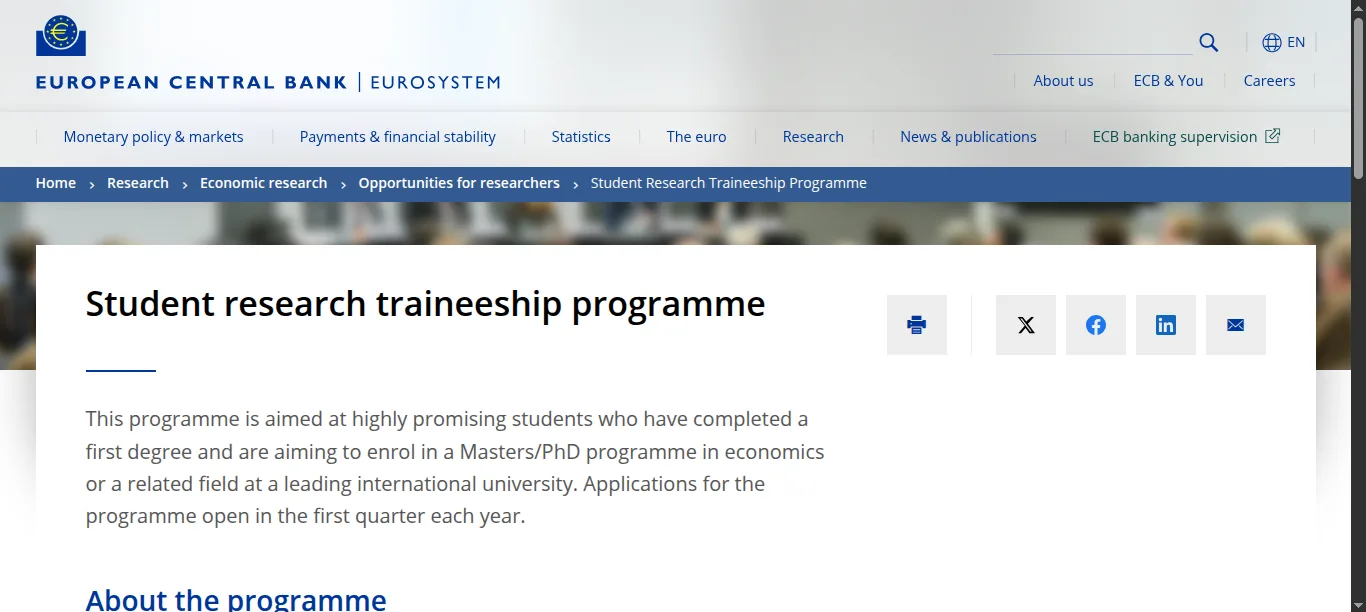
The European Central Bank's Student Research Traineeship Programme places students in the ECB's Directorate General Research in Frankfurt, where they work with economists on research projects, policy notes and reports. Applications open in the first quarter of each year. The programme page does not publish a grant or a duration; those details come from the ECB's general traineeship page, which sets a monthly grant of €1,170 and a contract of three to six months, extendable once to twelve months.
Quick Facts
| Item | Detail |
|---|---|
| Host | European Central Bank (ECB) |
| Location | Frankfurt am Main, Germany |
| Opportunity type | Research traineeship in Directorate General Research (DG/R) |
| Duration | Three to six months, extendable once to twelve months, per the ECB's general traineeship page |
| Eligibility | Completed first degree and aiming for a Masters/PhD in economics or a related field; general traineeship rules also apply |
| Funding | €1,170 per month; €2,120 for trainees with at least two years of PhD study in a qualifying vacancy |
| Application status | Applications open in the first quarter of each year; no 2027 date published |
| Deadline | Not stated on the programme page; individual vacancy notices set closing dates |
| Official portal | ECB Student Research Traineeship Programme |
What the programme is
The ECB runs the euro area's monetary policy, manages foreign reserves, oversees payment systems and produces economic research. Its Directorate General Research is the unit that carries out much of that research and publishes it in international academic journals. The Student Research Traineeship Programme is a route into that directorate for students who are preparing for graduate study.
The ECB describes the programme as aimed at "highly promising students who have completed a first degree and are aiming to enrol in a Masters/PhD programme in economics or a related field at a leading international university." That sentence sets the audience precisely: this is not a general internship for any undergraduate, and it is not a PhD placement for students already deep into a doctorate. It sits in the gap between a first degree and graduate school.
Participants cooperate closely with economists in DG/R and are involved in all stages of research projects. They also support economists in preparing policy-related notes and reports for the ECB's Executive Board. The ECB frames the value in terms of analytical skills, insight into research and policy-making, and ideas for future graduate study.
The programme page is short. It describes the purpose and the tasks, but it does not publish a grant, a duration, a deadline or a detailed eligibility list. Those details sit on the ECB's general traineeship page, which governs trainees registered in the programme. This guide separates the two sources because they answer different questions.
What trainees actually do
The programme page lists four broad areas of work. Trainees generally contribute to one or more of them alongside DG/R staff:
- Databases. Constructing and maintaining databases of monetary, financial and economic data.
- Data presentation and analysis. Presenting data together with basic economic and econometric analysis.
- Programming. Writing mathematical and statistical procedures for research projects.
- Software and hardware support. Supporting and maintaining software tools and hardware installations in DG/R.
That list is more technical than a typical economics internship description. It implies comfort with data work, statistical software and possibly programming, and it suggests that the trainee is expected to be useful quickly rather than to observe from the side. The phrase "basic economic and econometric analysis" sets a floor, not a ceiling: a student who has completed an econometrics course and used statistical software is better placed than one who has only studied theory.
The ECB also says participants are involved in all stages of research projects and may support policy notes and reports for the Executive Board. That is unusual access for a short placement. It also means the work can be confidential and deadline-driven, and that reliability matters as much as technical skill.
Eligibility: two layers of rules
There are two sets of requirements, and applicants need to satisfy both.
The programme's own audience. The research traineeship is aimed at students who have completed a first degree and intend to enrol in a Masters or PhD in economics or a related field at a leading international university. The page does not define "leading international university", does not list preferred degree subjects beyond economics and related fields, and does not state a minimum grade.
The ECB's general traineeship rules. The general page says students, including PhD students, or recent graduates can apply, and lists these conditions:
- at least 18 years old;
- a national of an EU Member State or of an acceding country;
- at least a first-cycle qualification (a bachelor's degree);
- fluent in English and in another official language of the EU;
- no more than 12 months of professional experience following the most recent qualification;
- no more than six months of previous traineeship experience;
- no previous ECB traineeship or employment at the ECB.
The nationality rule is the hardest constraint for non-EU applicants. The research programme page does not advertise an exception, and the general page states the rule plainly. Students from outside the EU who want to work at the ECB should check whether they qualify through nationality or through a different recruitment route before investing time in an application.
The experience limits also catch people out. A candidate who has worked full-time for two years after graduating is outside the 12-month window. A candidate who has already completed a six-month traineeship elsewhere is at the limit. These are general rules, but the research programme page does not override them.
Funding, grant and accommodation
The research programme page does not state a grant. The general traineeship page does:
- €1,170 per month as of 1 December 2023.
- €2,120 per month for trainees who have completed at least two years of PhD study and who apply for a vacancy requiring that level of qualification.
The grant is a fixed monthly amount, not a salary scale. The page does not state whether it is taxable, whether it is adjusted for Frankfurt living costs, or whether travel to and from Frankfurt is reimbursed. Those details are not on the pages reviewed.
Accommodation is covered in a specific circumstance. If the distance from your place of recruitment to the ECB exceeds 50 km and you decide to relocate temporarily, the ECB pays for accommodation for the duration of your stay. You can stay in one of the residences with which the ECB has an arrangement, or receive a lump sum for temporary private accommodation and find your own place. If you already live within 50 km, the accommodation support does not apply.
The ECB does not publish a housing allowance figure, a relocation grant or a meals allowance. Frankfurt is an expensive city, and the grant is modest relative to market rents. Applicants should budget carefully and ask the ECB about any costs the page does not cover.
Duration and conditions
The general page says the contract runs for three to six months unless the vacancy notice states otherwise. It can be prolonged once, up to a total of twelve months. The programme is described as a way of getting to know the ECB and contributing to its tasks; it does not automatically lead to a contract, though trainees can apply for junior positions.
The research programme page does not state a duration. That means the length of a research traineeship depends on the vacancy notice. A three-month placement and a twelve-month placement are both possible under the general rules, and the specific notice should be the deciding document.
Trainees are subject to the rules governing the ECB traineeship programme. The general page does not publish holiday entitlement, working hours or remote-work rules for trainees. Those are likely covered in the contract or the vacancy notice, and applicants should ask if they matter for planning.
How to apply
- Check the timing. Applications for the research programme open in the first quarter of each year. The page does not give a month or a closing date, so monitor the ECB's vacancy pages from January onwards.
- Create one candidate profile. Applications go through the ECB's online recruitment system. The ECB says to create only one profile, which can be used for any current or future vacancy, and warns that multiple applications for the same position through different profiles will lead to exclusion.
- Fill in the application form thoroughly. The ECB says any attached CV will not be taken into consideration unless the vacancy notice says otherwise. The online form is the document that matters, so put your education, experience, skills and motivation into the form itself rather than relying on an attachment.
- Write a specific motivation statement. The ECB says it always asks why you are applying, and that the selection committee uses the answer to understand your motivation and whether the role fits what you are looking for. It also says not to repeat information that belongs in the education or work-experience sections.
- Submit in English, before the closing date. The ECB asks for applications in English, free of spelling and grammatical errors, and submitted well in advance of the deadline. Selection starts on the closing date, so a late application is not considered with the batch.
- Prepare for a Microsoft Teams interview. The ECB says traineeship interviews take place via MS Teams. Expect questions on your technical skills, your research interests and your motivation for the ECB.
- Wait for the outcome. Selection usually takes around three months, longer if there is a very large number of applications. You will be told whether you have an offer, are on a reserve list, or were unsuccessful.
The ECB does not publish a document checklist specific to the research traineeship. The general application guidance and the vacancy notice are the authoritative sources. Do not assume that a research proposal is required; the programme page does not ask for one.
Two things belong in the form even though the ECB does not prescribe a template. First, the graduate-school link: the programme is aimed at students preparing for a Masters or PhD in economics or a related field, so state what you plan to study and why time in DG/R fits that plan. Second, the technical evidence: the task list points to databases, econometric analysis, programming and software support, so describe the datasets you have built, the models you have estimated, the code you have written or the research you have supported. A general statement of interest in monetary policy is weaker than a concrete example of work you have done.
Timeline and current status
As of 12 November 2026, the ECB's research traineeship page is live but does not advertise a 2027 cycle. It says applications open in the first quarter of each year, which points to January–March 2027 for the next intake. That is a statement of the annual pattern, not a published date.
The general traineeship page describes a rolling vacancy system rather than a single annual programme. Vacancies have closing dates, selection begins after the closing date, and the process usually takes about three months. That means the practical deadline for any specific traineeship is the closing date in its vacancy notice, not a programme-wide date.
The ECB does not publish a start date, a number of places or an acceptance rate for the research traineeship. Applicants should treat the first quarter of 2027 as the window to watch and should check the recruitment system regularly rather than waiting for an announcement.
Selection and what makes a credible application
The ECB does not publish selection criteria for the research traineeship. The general page describes the process but not the rubric. The programme page's task list is the best guide to what the panel will value.
Technical evidence comes first. The work involves databases, econometric analysis, programming and software support. A candidate who can point to a dataset they built, a model they estimated, a script they wrote or a research project they supported is more credible than one who describes an interest in monetary policy in general terms. The phrase "basic economic and econometric analysis" suggests that the panel expects a working knowledge, not a specialist's expertise.
The second criterion is fit with DG/R. The directorate produces research published in international journals and policy notes for the Executive Board. A candidate who understands the difference between an academic paper and a policy note, and who can explain why both matter, is better prepared than one who has only read textbooks.
The third is the graduate-school trajectory. The programme is explicitly for students aiming at a Masters or PhD at a leading international university. A clear, specific plan — a particular field, a particular reason, a particular set of skills to acquire — is more persuasive than a general ambition to study economics.
The fourth is reliability and discretion. Trainees may support Executive Board material. The ECB does not say this explicitly, but the combination of short contracts, confidential policy work and a central bank setting makes it a reasonable inference. Applications that show responsible handling of data or sensitive material are stronger.
Living and working in Frankfurt
The ECB is in Frankfurt am Main, Germany's financial centre. The general traineeship page does not describe the office, the working language or the daily schedule. It does say that accommodation support applies if your place of recruitment is more than 50 km away and you relocate temporarily.
Frankfurt has a large international population and an expensive rental market. The €1,170 monthly grant is below what a full-time professional would earn, and the ECB does not publish a housing supplement beyond the accommodation arrangement described above. Applicants should model the cost of rent, health insurance, transport and food before accepting an offer, and should ask the ECB what the accommodation options actually cost.
The working language of the ECB is English, but the eligibility rules require fluency in English and another official EU language. That requirement is about the institution's multilingual environment, not about the research team's day-to-day work.
What is confirmed and what is not yet announced
Confirmed on the ECB's official pages as of 12 November 2026:
- the research traineeship is based in Directorate General Research in Frankfurt;
- it is aimed at students who have completed a first degree and intend to enrol in a Masters or PhD in economics or a related field at a leading international university;
- applications open in the first quarter of each year;
- the work covers databases, data presentation and econometric analysis, programming, and software and hardware support;
- the general traineeship grant is €1,170 per month, or €2,120 for trainees with at least two years of PhD study in a qualifying vacancy;
- the general contract is three to six months, extendable once to twelve months;
- the general eligibility rules include EU or acceding-country nationality, a bachelor's degree, language fluency and limits on prior experience;
- accommodation is paid if the distance from the place of recruitment exceeds 50 km and the trainee relocates;
- selection usually takes around three months and interviews are held via Microsoft Teams.
Not stated on the official pages reviewed:
- a 2027 application opening date or deadline;
- a grant figure specific to the research traineeship;
- a duration specific to the research traineeship;
- the number of places, the acceptance rate or the start date;
- whether the grant is taxable or whether travel to Frankfurt is reimbursed;
- a document checklist for the research programme;
- holiday entitlement, working hours or remote-work rules for trainees.
Sources
- European Central Bank, "Student research traineeship programme," accessed 12 November 2026
- European Central Bank, "Traineeship," accessed 12 November 2026
- European Central Bank, "How to apply," accessed 12 November 2026
- European Central Bank, "Opportunities for researchers," accessed 12 November 2026
- Feynman Research Labs, "ECB Student Research Traineeship" listing
Keep exploring
The Stanford CISAC fellowship guide covers a longer residential research award in the United States, and the CERN doctoral studentship guide explains a funded PhD route in Europe. The research programmes directory groups opportunities by type and country.
Frequently asked questions
- What is the ECB Student Research Traineeship?
- It is a traineeship in the European Central Bank's Directorate General Research in Frankfurt. Participants work with ECB economists on research projects, policy notes and reports, and the programme is aimed at students who have completed a first degree and intend to enrol in a Masters or PhD in economics or a related field at a leading international university.
- When do applications open?
- The ECB says applications for the Student Research Traineeship Programme open in the first quarter of each year. The programme page does not publish a specific 2027 opening date or deadline.
- How much does the ECB traineeship pay?
- The ECB's general traineeship page states a trainee grant of €1,170 per month as of 1 December 2023. It rises to €2,120 per month for trainees who have completed at least two years of PhD study and who apply for a vacancy requiring that level of qualification. The research programme page itself does not state the grant.
- How long is the traineeship?
- The ECB's general traineeship page says the contract runs for three to six months unless the vacancy notice states otherwise, and it can be extended once up to a total of twelve months. The research programme page does not state a duration.
- Who is eligible for an ECB traineeship?
- The general traineeship rules require applicants to be at least 18, to be a national of an EU Member State or an acceding country, to have completed at least a bachelor's degree, and to be fluent in English and another official EU language. Applicants must have no more than 12 months of professional experience after their most recent qualification, no more than six months of previous traineeships, and no previous ECB traineeship or employment.
- Is accommodation provided?
- The ECB says that if the distance from your place of recruitment to the ECB exceeds 50 km and you temporarily relocate, it will pay for accommodation for the duration of your stay. You can stay in one of the ECB's partner residences or receive a lump sum for temporary private accommodation.
- Do I need to be an EU citizen?
- Yes, under the general traineeship rules you must be a national of an EU Member State or of an acceding country. The research programme page does not state a separate nationality rule, so the general rule applies.
- How does the selection process work?
- Applications go through the ECB's online recruitment system. Selection starts on the vacancy closing date and usually takes around three months. Shortlisted candidates are invited to interviews conducted via Microsoft Teams, and outcomes are sent by email.
Official application link
Check the ECB's official research traineeship page
Applications open in the first quarter of each year, but the ECB has not published a 2027 date. Check the vacancy notices in the ECB recruitment system.
Open official page

