
Academic guides · Guide
Stanford CISAC Fellowships 2027–2028: Deadline, Eligibility, and Stipend
StatusOpen
Stanford CISAC's 2027–28 fellowship applications close on 2 December 2026. A verified guide to the eight fellowships, PhD eligibility, stipends, and materials.
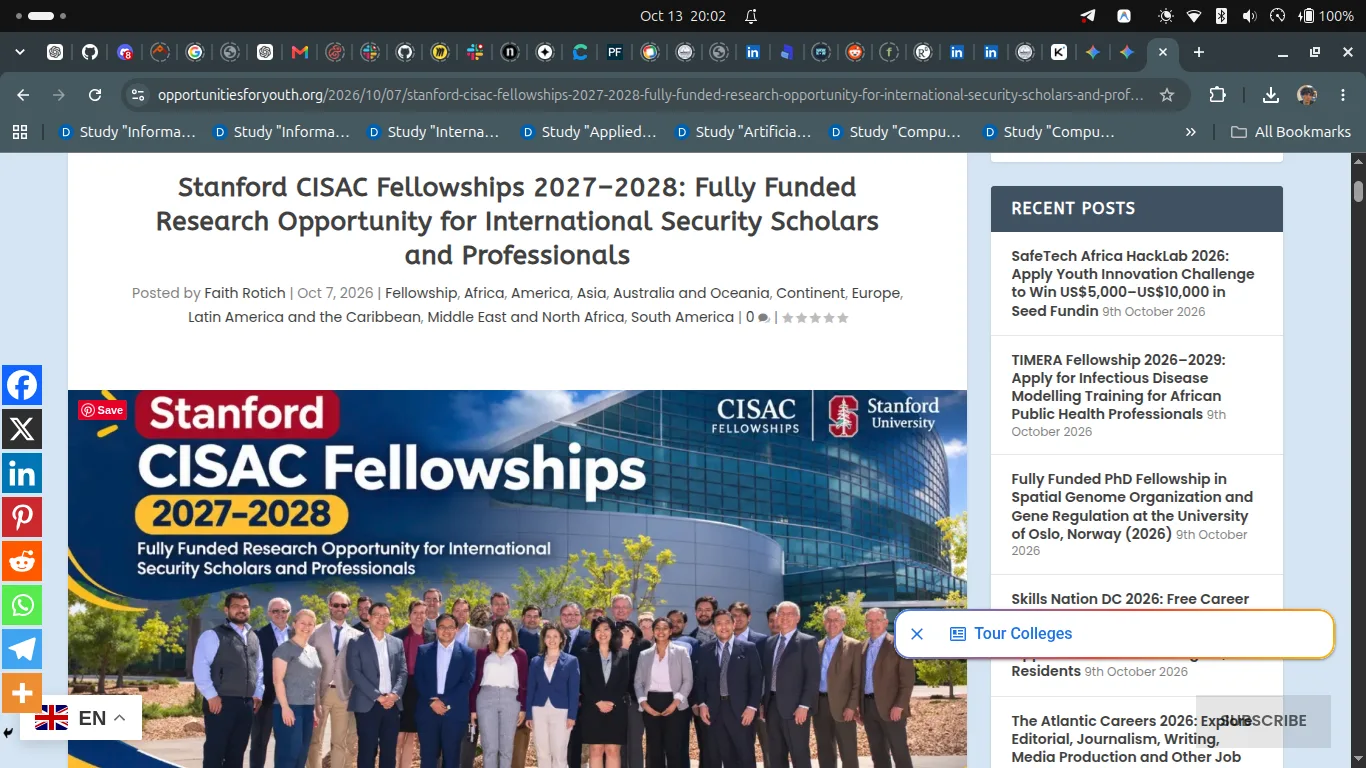
Stanford University's Center for International Security and Cooperation (CISAC) has opened its fellowship application for the 2027–2028 academic year, and it closes on 2 December 2026. The programme supports nine to twelve months of residential research at Stanford on international security, with eight named fellowships covering nuclear security, AI and military competition, Indo-Pacific security, India–US relations and other areas. The core eligibility rule is a current PhD enrolment, with a DPhil accepted as equivalent; pre-doctoral applicants outside their final year are rarely accepted because they compete in the same pool as post-docs.
Quick Facts
| Item | Detail |
|---|---|
| Host | Center for International Security and Cooperation (CISAC), Freeman Spogli Institute, Stanford University |
| Location | Encina Hall, 616 Jane Stanford Way, Stanford, California, USA |
| Opportunity type | Residential research fellowship (pre-doctoral, post-doctoral, junior faculty and professionals) |
| Duration | Nine to twelve months; renewable in certain circumstances |
| Eligibility | Currently enrolled PhD students (DPhil accepted); post-docs must have completed the PhD; pre-docs should be in their final year |
| Funding | Pre-doc stipend comparable to Stanford Graduate Fellowships plus non-matriculated tuition where required; post-doc stipend commensurate with experience; medical insurance; no housing |
| Application status | Open for 2027–2028 |
| Deadline | 2 December 2026 |
| Official portal | CISAC Fellowships, with applications through SlideRoom |
What CISAC is
CISAC is a research centre within Stanford's Freeman Spogli Institute for International Studies. It describes its purpose as supporting rigorous scholarship and lively intellectual exchange to help build a safer world, and its fellowships as a portfolio of in-residence awards for scholars working on international security.
The centre's research spans nuclear weapons policy and non-proliferation, nuclear energy, digital security including cyber and artificial intelligence, biosecurity and global health, insurgency and terrorism, civil conflict, national security strategy and global governance. It explicitly welcomes applicants from the United States and abroad, and says it considers applications without regard to citizenship.
CISAC is not a teaching programme and it is not a conventional post-doctoral appointment attached to a single grant. Fellows spend the academic year researching and writing, attending seminars, and collaborating with Stanford faculty and other fellows. The centre says natural scientists can work on the scientific and technical aspects of security topics in collaboration with faculty.
The eight fellowships
CISAC lists eight current fellowship opportunities. Applicants are considered for every fellowship for which they are deemed eligible, whether or not they apply to a specific one.
| Fellowship | Focus |
|---|---|
| Artificial Intelligence and Laws of Armed Conflict | One-year post-doctoral policy fellowship on whether humans or machines better comply with the laws of armed conflict, using scenarios, surveys and wargames |
| Artificial Intelligence in Strategic Stability and Military Competition | One-year post-doctoral fellowship on AI in nuclear command and control and nuclear force posture, including wargaming and expert interviews |
| Indo-Pacific Security | Two-year post-doctoral fellowship on US strategy and China, including nuclear strategy, alliance politics and deterrence, with teaching and lab management |
| Geopolitics of Artificial Intelligence | One-year post-doctoral fellowship on the US–China AI competition, export controls, AI sovereignty and trustworthy technology diffusion |
| India–US Security Studies | Support for early-career scholars working on Indian foreign and defence policy, US–India–China relations and South Asian security |
| International Security | Broad fellowship on security topics from nuclear policy to cyber, biosecurity, conflict and global governance |
| Natural Sciences or Engineering International Security | For scientists and engineers applying technical expertise to security policy and science communication |
| Nuclear Security | Research on nuclear weapons policy, nuclear terrorism and materials, and nuclear energy and non-proliferation |
The project-specific fellowships name their supervisors and describe the work in unusual detail. The AI and Laws of Armed Conflict fellowship, for example, involves developing scenarios and surveys, designing wargames, working with multiple AI agents, and analysing quantitative data. The AI in Strategic Stability fellowship involves cataloguing budget documents, facilitating experimental wargames and summarising expert interviews. That level of specificity is useful: it tells applicants what evidence of skill to provide.
What fellows actually do
CISAC publishes a detailed list of programme requirements. Fellows are expected to be fully present and engaged at the centre during their assignment, not to treat the fellowship as a remote affiliation.
Within the first month, each fellow completes an Individual Development Plan and reviews it with a mentor. Fellows meet their faculty mentor at least once a month to refine the research topic, discuss progress and receive career guidance. They attend and engage with the weekly research seminar and coordinate one panel. They participate in fellowship dinners with seminar speakers and host one dinner, which CISAC pays for. They take part in the Fellows' Policy Workshop, typically two to three sessions a month.
The output expectations are concrete. Fellows must make tangible progress on their proposed project, completing several dissertation or book chapters and/or at least one article for a peer-reviewed journal. They must write a short op-ed or other media piece offering public insight from their research; blog posts are not eligible. They submit brief quarterly reports describing research, writing and presentation activity. They produce at least one policy-focused document for a mock congressional testimony or National Security Council simulation. They may also participate as a head of state in the winter-quarter simulation for the course "International Security in a Changing World" if selected.
That list is worth reading before applying. CISAC is not offering a quiet year to write in isolation. It is offering a structured policy engagement programme with public-facing and workshop obligations alongside the research.
Eligibility: who should apply
The basic rule is that the fellowship is open to anyone currently enrolled in a PhD programme. CISAC accepts a DPhil as a PhD equivalent. It adds an important caveat: it is rare for pre-doctoral applicants who are not in the final year of their programme to be accepted, because pre-docs are evaluated in the same pool as post-docs. To be competitive, applicants should be as far along in the PhD as possible.
Applicants who expect to have completed the PhD by the time the fellowship begins should apply as post-doctoral applicants. The offer, stipend and title are contingent on finishing before the start date, and the offer can be rescinded if the PhD is not complete. Applicants who expect to finish during the fellowship year should apply as pre-doctoral fellows; some fellowships allow conversion to post-doctoral status if all requirements are met by 1 December, but applicants must confirm this with CISAC.
Junior faculty and professionals can apply. The transcript requirement is relaxed for them: pre- and post-doctoral applicants must include a transcript, while junior faculty and professionals may include one but are not required to. Non-stipendiary applicants, who have their own funding, are considered in the same pool as those requesting a stipend.
There is no nationality restriction. CISAC says candidates do not have to be US citizens and that it sponsors fellows for visas through Stanford's Bechtel International Center. It also warns that some visa types from some countries are currently very difficult to obtain and that it will work through the specific situation with accepted fellows.
Funding, stipend and benefits
CISAC does not publish a stipend figure. Instead it describes the basis for each category:
- Pre-doctoral fellows receive stipends comparable to those awarded by the Stanford Graduate Fellowships programme. CISAC also pays non-matriculated student tuition for pre-doctoral fellows as required by Stanford University.
- Post-doctoral fellows receive stipends commensurate with experience and with consideration of Stanford's established minimums.
- Junior faculty and professionals receive stipends commensurate with experience.
Medical insurance is provided for fellows without personal coverage. Pre-doctoral fellows are enrolled in Stanford's student medical insurance plan, Cardinal Care. Post-doctoral fellows attend a mandatory benefits orientation on arrival and receive health benefits. All fellows can buy additional coverage for dependants.
Housing is not provided. CISAC says it cannot provide housing but refers fellows to Stanford's housing information. That is a significant cost to plan for, because Stanford is in one of the most expensive housing markets in the United States. The stipend is intended to support the fellow, not to cover a family's full living costs, and the page does not publish a housing allowance.
How to apply
- Choose the fellowship or fellowships that fit. You can indicate a preference, but CISAC's selection committee considers you for every fellowship for which you are eligible. Read the project descriptions and decide which ones your record actually supports.
- Prepare the online form. The application is submitted through SlideRoom, linked from the CISAC fellowship page. You create an account, select the CISAC fellowship programme and complete the required fields.
- Assemble the documents. The required materials are a completed application form, a CV, a graduate transcript, a research prospectus or dissertation description of no more than 1,500 words excluding footnotes and endnotes, a research abstract of no more than 200 words, a writing sample of no more than 50 pages, and three confidential letters of recommendation.
- Handle the transcript correctly. Unofficial transcripts are acceptable at application stage, and CISAC may ask for official transcripts later. All documents must be in English. Junior faculty and professionals who are not required to submit a transcript should upload a document stating that transcripts are not required for their fellowship level.
- Brief your recommenders early. Letters are submitted through SlideRoom. Recommendation services such as Interfolio cannot use the online system, so letters sent through Interfolio must be emailed to cisacfellowship@stanford.edu. Emailed letters are accepted only from the recommender, not from the applicant.
- Submit by 2 December 2026. All materials, including recommendations, are due by the deadline. Recommenders have up to five days afterwards to submit their letters, but CISAC says applicants are responsible for ensuring everything arrives.
- Do not send extras. CISAC asks applicants not to submit supplemental materials such as books, lengthy manuscripts or more than the required number of recommendations.
The writing sample does not need to be published, but if it has multiple authors the applicant should be the primary author. The prospectus should describe the work you would undertake at CISAC, and it can be an introduction or relevant portion of the dissertation.
Timeline and current status
The 2027–2028 application is open now. The deadline is 2 December 2026. Decisions are released in mid-February. Fellowships run for nine to twelve months and may be renewable in certain circumstances.
The application page reviewed for this guide was live on 12 November 2026 and showed the 2027–2028 cycle. That is unusually early relative to the start of the academic year, and it means the effective preparation window is short: applicants have roughly three weeks from the date of this guide to the deadline.
CISAC does not publish an interview stage, a shortlist date or a fixed number of awards. It says the number of fellowships granted each year varies with available funding and the applicant pool. Applicants should therefore treat mid-February as the only confirmed decision point.
Selection and what makes a credible application
CISAC does not publish a scoring rubric. Its materials nevertheless point to several criteria.
The first is scholarly progress. Pre-docs compete with post-docs, so a pre-doctoral applicant needs a dissertation that is far enough along to support a credible prospectus and a writing sample. The requirement to complete several chapters or an article during the fellowship implies that applicants are expected to arrive with a project that can produce publishable work within a year.
The second is fit with a specific fellowship. The project-specific awards name supervisors and describe the tasks. An applicant who has designed wargames, analysed large-N behavioural data, worked with AI agents, or researched nuclear command and control can show that fit directly. A generic international security proposal is weaker than one that speaks to a named project.
The third is policy engagement. CISAC requires an op-ed, a mock congressional testimony or NSC simulation document, and quarterly reports. It is selecting for people who can translate research into policy-relevant outputs, not only for people who can write journal articles. Evidence of public writing, briefing experience or policy work belongs in the application.
The fourth is residency. Fellows must be present at Stanford and engaged in the weekly seminar and workshop programme. Applicants who cannot relocate for nine to twelve months should not apply.
Practical considerations
Stanford's campus is in Palo Alto, California. CISAC is housed in Encina Hall at 616 Jane Stanford Way. The fellowship does not provide housing, and the page does not publish a relocation allowance, a travel budget or a dependants' allowance beyond the option to buy additional insurance coverage.
International fellows need a visa. CISAC works with Stanford's Bechtel International Center and says it will discuss the specific situation with accepted candidates. The warning that some visa types from some countries are difficult to obtain is worth taking seriously: an offer is not a guarantee that a visa will be issued in time.
The fellowship is also not a degree programme. Pre-doctoral fellows remain enrolled at their home institution, and CISAC pays non-matriculated student tuition where Stanford requires it. Applicants should confirm with their own university how a year at CISAC would affect their enrolment status, funding and dissertation timeline.
What is confirmed and what is not yet announced
Confirmed on CISAC's official pages as of 12 November 2026:
- the 2027–2028 application is open and closes on 2 December 2026;
- the fellowship runs nine to twelve months and may be renewable in certain circumstances;
- eight named fellowships are available, and applicants are considered for all eligible awards;
- eligibility is current PhD enrolment, with DPhil equivalence and rare exceptions for non-final-year pre-docs;
- the required materials are the form, CV, transcript, prospectus (1,500 words maximum), abstract (200 words maximum), writing sample (50 pages maximum) and three confidential letters;
- decisions are released in mid-February;
- pre-doc stipends are comparable to Stanford Graduate Fellowships, post-doc stipends are commensurate with experience, and medical insurance is provided;
- housing is not provided;
- international applicants are eligible and visa sponsorship is available through the Bechtel International Center.
Not stated on the official pages reviewed:
- the actual stipend amounts for any category;
- the number of fellowships awarded or the acceptance rate;
- whether the 2027–2028 cycle will include every listed fellowship at the same funding level;
- the exact start and end dates of the fellowship year;
- whether interviews are held;
- the value of any tuition payment for pre-doctoral fellows.
Sources
- Stanford CISAC, "CISAC Fellowships," accessed 12 November 2026
- Stanford CISAC, "CISAC Fellowship Program," accessed 12 November 2026
- Stanford CISAC, "Frequently Asked Questions," accessed 12 November 2026
- Feynman Research Labs, "Stanford CISAC Fellowships 2027–2028" listing
Keep exploring
The ECB Student Research Traineeship guide covers a shorter research placement at a central bank, and the CERN doctoral studentship guide explains a PhD route in physics. The research programmes directory groups fellowships and internships by type and country.
Frequently asked questions
- When is the CISAC fellowship deadline for 2027–2028?
- The application for the 2027–2028 academic year is open and will close on 2 December 2026. All materials, including recommendation letters, must be submitted by that date; recommenders have up to five days afterwards to submit their letters.
- Who is eligible for a CISAC fellowship?
- The fellowship is open to anyone currently enrolled in a PhD programme, and CISAC accepts a DPhil as a PhD equivalent. It is rare for pre-doctoral applicants who are not in their final year to be accepted, because pre-docs are evaluated in the same pool as post-docs. Postdoctoral applicants must have completed the PhD before starting.
- How much does a CISAC fellowship pay?
- CISAC does not publish a figure. Pre-doctoral fellows receive stipends comparable to Stanford Graduate Fellowships, and CISAC also pays non-matriculated student tuition where Stanford requires it. Postdoctoral stipends are commensurate with experience and Stanford minimums, and junior faculty and professional stipends are commensurate with experience.
- Is housing provided?
- No. CISAC says it cannot provide housing, but it refers fellows to Stanford's housing information. Medical insurance is provided for fellows without personal coverage: pre-docs are enrolled in Cardinal Care and post-docs receive health benefits.
- Can international applicants apply, and is a visa available?
- Yes. CISAC says candidates do not have to be US citizens and that it sponsors fellows for visas with guidance from Stanford's Bechtel International Center. It notes that some visa types from some countries are currently very difficult to obtain.
- How long is a CISAC fellowship?
- Fellowships range from nine to twelve months and may be renewable in certain circumstances. Fellows are expected to be in residence at Stanford and fully engaged in CISAC's programme.
- How many fellowships does CISAC award each year?
- CISAC says the number varies with available funding and the applicant pool. It does not publish a fixed number of places.
- Do I need a Stanford mentor to apply?
- No. CISAC assigns every fellow a Stanford or CISAC faculty mentor. Applicants may have an outside mentor, but if selected they will also be assigned a Stanford/CISAC mentor.
Official application link
Check Stanford CISAC's official fellowship page
The 2027–2028 application closes on 2 December 2026. The portal is linked from CISAC's fellowship page and uses SlideRoom.
Open official page

