
Academic guides · Guide
ETH Postdoctoral Fellowships: 2027 Application Guide and Eligibility
StatusOpen
ETH Zurich's postdoctoral fellowship funds two years of research in any discipline, with a CHF 24,000 research and travel budget. Deadlines fall on 1 March and 1 September.
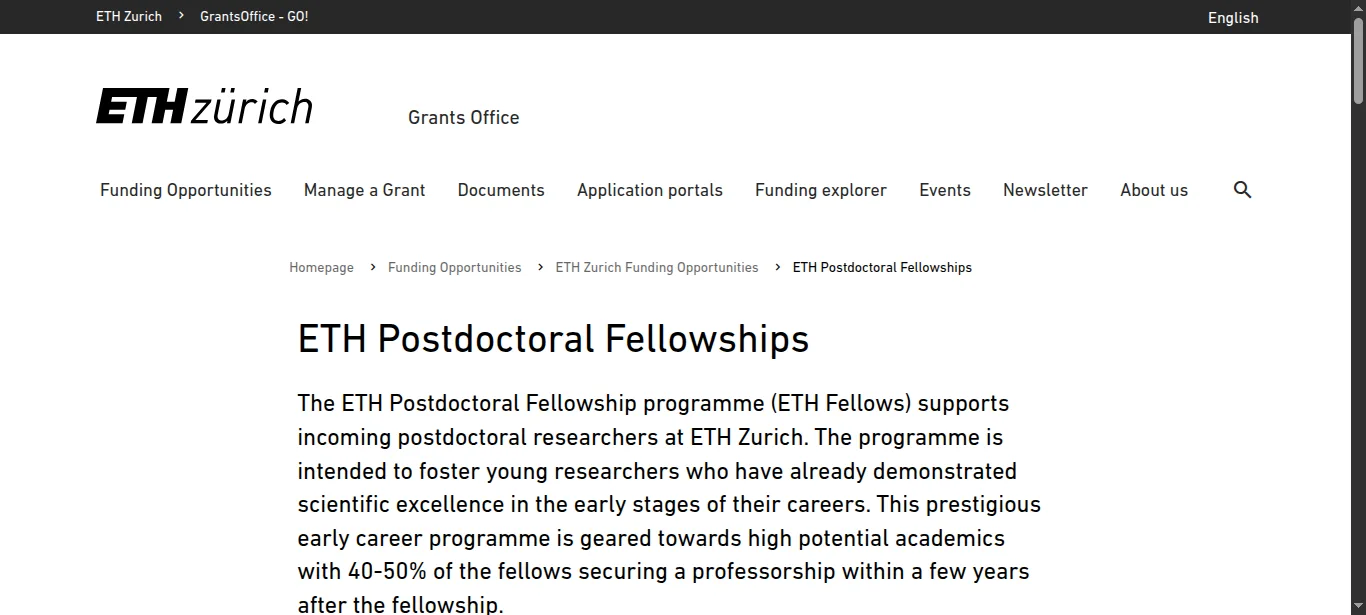
ETH Zurich's Postdoctoral Fellowships fund incoming postdoctoral researchers for two years in any discipline at ETH Zurich. The next deadline is 1 March 2027 at 17:00 Swiss time; the second 2027 deadline is 1 September 2027. ETH awards about 25 fellowships a year in two rounds of 12 to 13, and each fellowship covers a full ETH postdoc salary plus CHF 24,000 for research and travel over the two years. The 2027 interview dates have not yet been published.
Quick Facts
| Item | Detail |
|---|---|
| Host | ETH Zurich, Switzerland |
| Opportunity type | Postdoctoral fellowship |
| Duration | Two years, non-extendable |
| Eligibility | PhD completed or within six months; PhD no more than two years before the deadline; at least one peer-reviewed publication or thesis prize; mobility rules |
| Funding | 100% ETH standard postdoc salary, including social security; CHF 18,000 research costs plus CHF 6,000 travel costs, CHF 24,000 in total over two years |
| Application status | Open; next deadline 1 March 2027 |
| Deadline | 1 March 2027 and 1 September 2027, 17:00 Swiss time |
| Official portal | ETH Grants Office and eResearch |
What the ETH Fellowship is
The ETH Postdoctoral Fellowship is run by the ETH Zurich Grants Office. It is an internal funding scheme for incoming postdoctoral researchers, not a prize for work already completed. ETH describes it as a way to bring early-career researchers to Zurich, and the fellowship is embedded in a host professor's group for its full two-year duration.
The scheme is unusual in two respects. First, it covers the fellow's salary rather than offering a fixed stipend or a top-up. ETH's fellowship FAQ says the fellowship covers the salary of fellows at the first- and second-year postdoc standard rate, including social security contributions. Second, the fellowship comes with a separate research and travel budget that cannot be used for salary, and the salary budget cannot be used for research costs.
ETH awards approximately 25 fellowships each year, split into two rounds of about 12 to 13. Roughly twice as many candidates are invited to interview as receive an award. The fellowship lasts two years and cannot be extended. A fellow must begin within eight months of the decision, on the first day of a month.
What the fellowship pays for
The funding has three parts. The salary is the largest: a 100% ETH standard postdoc salary at the rate for the first and second year, including social security contributions. The research budget is CHF 18,000, and the travel budget is CHF 6,000. Together they provide CHF 24,000 across the two years, or an average of CHF 12,000 per year.
ETH's FAQ is explicit that the research and travel budget may not be used to cover salary costs, and the salary may not be used for research or travel. The salary may be adjusted in line with the general ETH domain remuneration policy set by the ETH Board. The exact salary figure is not stated on the programme page reviewed for this guide; ETH publishes the postdoc salary table separately, and the amount depends on the year the fellowship is awarded.
The fellowship does not advertise a housing allowance, a relocation grant, or a family allowance. Applicants should treat the salary, the CHF 18,000 research budget, and the CHF 6,000 travel budget as the confirmed package, and ask the Grants Office about anything else before relying on it.
What the fellowship does not cover
ETH does not advertise a housing allowance, a relocation grant, a family allowance, or a separate travel budget for dependants. The CHF 6,000 travel budget is for the fellow's travel, and the CHF 18,000 research budget is for research costs; neither can be converted into salary. Applicants with families or costly relocation should ask the Grants Office and the host about local costs before accepting an award. The salary is set at the ETH standard rate, so it is not negotiable in the way a private-sector offer might be.
Research areas and host arrangements
The fellowship is open to all disciplines at ETH Zurich. There is no published list of priority topics, and the applicant defines the project with the host professor. That makes the host relationship the centre of the application: the host must guarantee an ETH position for the full fellowship period, and the position must be at least 50% of full-time.
The host requirement has practical consequences. A professor who cannot guarantee funding or space for two years cannot support the application. Assistant professors must contact the Grants Office before applying, because their position may not yet provide the required guarantee. ETH also limits each professor to one candidate per round, so a professor who supports one applicant cannot support another in the same round.
The host provides an invitation letter as part of the application. The project description is written using ETH's templates, and the host is expected to help shape a project that fits the group and can be completed within the fellowship. Applicants should discuss the project's scope, the host's role, and the research budget before submitting.
Who is eligible
The eligibility rules are specific, and several of them are easy to misread.
Must-have conditions:
- You must have completed a PhD, or be within six months of completing it.
- The PhD must not have been awarded more than two years before the application deadline.
- You need at least one peer-reviewed publication or a thesis prize.
- You must not have spent more than 12 months in Switzerland in the three years before the deadline.
- You must not have spent more than six months at ETH Zurich, EPFL, an ETH-domain institute, or the University of Zurich in the same three-year period.
- Holders of ETH Zurich or University of Zurich doctorates are not eligible.
- You need a host professor who can guarantee an ETH position for at least 50% of the fellowship period.
- Only one candidate per professor may apply in each round.
The two mobility rules work together. The 12-month rule limits total time in Switzerland; the six-month rule limits time at ETH and its close institutional neighbours. A candidate who has spent a year in Switzerland but only three months at ETH may still satisfy both rules, while a candidate who has spent seven months at ETH fails the second rule even if the total time in Switzerland is short.
The publication requirement can be met by a peer-reviewed publication or a thesis prize. ETH does not state a minimum number of papers, a journal ranking, or a citation threshold. The requirement is a threshold, not a scoring formula, and the review considers the quality of the research record as a whole.
ETH does not state a nationality restriction, an age limit, or a language requirement on the pages reviewed for this guide. The working language of the host group may vary, and applicants should confirm practical arrangements with the host.
How to apply
- Check your eligibility before contacting anyone. Confirm the PhD date, the publication or thesis prize, and the time spent in Switzerland and at ETH-affiliated institutions. A candidate who fails a mobility rule cannot fix it with a strong project.
- Find a host professor and agree the project. The host must guarantee an ETH position for at least 50% of the fellowship period. Assistant professors should contact the Grants Office first. Remember that each professor may support only one candidate per round.
- Prepare the project description using ETH's templates. The templates are part of the application materials linked from the Grants Office page. The project should be specific enough for the host and reviewers to judge, and realistic within two years.
- Prepare a CV of no more than four pages. ETH sets a four-page limit. The CV should make the PhD date, publications, and research experience easy to find.
- Arrange two external reference letters. The referees must send their letters directly to the Grants Office by email, at least ten days before the deadline. They should not be uploaded by the applicant.
- Obtain the host invitation letter. The letter confirms the host's support and the guaranteed position.
- Submit through eResearch by 17:00 Swiss time on the deadline. There is no cover letter, and ETH does not accept resubmissions. If the deadline falls on a weekend, it moves to the following Monday.
The absence of a cover letter and the no-resubmission rule make the application less forgiving than schemes that allow repeated attempts. The project description, CV, references, and host letter all need to be complete on the first submission.
Timeline and current status
The scheme runs two rounds a year, with deadlines on 1 March and 1 September at 17:00 Swiss time. After submission, ETH says candidates are invited to interview within two months. The interview is online and lasts about 15 minutes. Decisions are communicated about four months after the deadline, and successful fellows must start within eight months of the decision, on the first day of a month.
For the 2027 cycle, the next deadline is 1 March 2027. ETH says the interview dates for 2027 will be updated at the end of 2026 or the beginning of 2027, so applicants should check the official page rather than relying on dates from an earlier year. The second 2027 deadline is 1 September 2027.
The programme page does not publish a separate deadline for reference letters beyond the requirement that they arrive at least ten days before the application deadline. Applicants should treat the ten-day margin as a hard operational deadline and ask referees well in advance.
Selection and what makes a credible application
ETH's FAQ states a success rate of 15 to 20%, and about twice as many candidates are interviewed as are funded. The selection is not a lottery: the project, the host, the research record, and the references all carry weight.
A credible application usually has four features. The project is specific and technically grounded, not a general statement of interest in the host's field. The host's letter explains why the project fits the group and what the fellow will do. The CV shows independent research output, including the peer-reviewed publication or thesis prize that meets the eligibility threshold. The references come from people who know the work and can comment on the applicant's ability to carry out the proposed project.
The 15-minute online interview is short. Applicants should be able to explain the project, its significance, and their role in it without relying on slides. Because the interview follows an initial review, the project description and references do most of the work before the conversation begins.
The one-candidate-per-professor rule means timing matters. A professor who is supporting another applicant in the same round cannot support a second candidate, even if both are strong. Applicants should ask the host early whether they are the designated candidate for the round.
Common mistakes to avoid
- Treating the deadline as midnight. It is 17:00 Swiss time. A submission that arrives later in the evening is late.
- Applying without confirming the host's guaranteed position. The host must guarantee an ETH position for at least 50% of the fellowship period, and assistant professors must contact the Grants Office first.
- Ignoring the six-month ETH rule because the 12-month Switzerland rule is satisfied. The two mobility tests are separate.
- Sending reference letters through the applicant. Referees must email the Grants Office directly, at least ten days before the deadline.
- Planning a start date more than eight months after the decision. The fellowship must begin within that window, on the first day of a month.
- Submitting a CV longer than four pages. The four-page limit is explicit.
- Assuming resubmission is allowed. ETH states that resubmission is not possible, so the first application must be complete.
What is confirmed and what is not yet announced
Confirmed: the two annual deadlines and the 17:00 Swiss time cutoff; the two-year, non-extendable duration; the 100% salary plus CHF 18,000 research and CHF 6,000 travel budgets; the eligibility rules on PhD timing, publications, mobility, and ETH/UZH doctorates; the host requirement and the one-candidate-per-professor limit; the online interview of about 15 minutes; the four-month decision window; and the eight-month start window.
Not yet announced: the 2027 interview dates, which ETH says will be published at the end of 2026 or the beginning of 2027; the exact salary figure, which is published separately and was not stated on the page reviewed; and any changes to the 2027 guidelines beyond the current published version.
Applicants should check the ETH Fellowships page and the guidelines PDF before submitting. The programme can update its rules, and the page is the authoritative source for dates and amounts.
Sources
- ETH Zurich Grants Office, "ETH Fellowships," accessed 12 November 2026
- ETH Zurich, "ETH Fellows Guidelines," PDF, accessed 12 November 2026
- ETH Zurich, "Frequently Asked Questions for the ETH Zurich Postdoctoral Fellowship Programme," August 2026, accessed 12 November 2026
- Feynman Research Labs, "ETH Postdoctoral Fellowships" listing
Keep exploring
Compare this call with other verified postdoctoral schemes in the opportunity finder. The EMBL EIPOD-LinC guide covers a different European postdoc model, and the ICTP postdoctoral fellowships guide explains a research-institute route in Italy. The research programmes directory groups listings by type.
Frequently asked questions
- What is the ETH Postdoctoral Fellowship?
- It is a two-year, non-extendable fellowship for incoming postdoctoral researchers in any discipline at ETH Zurich. ETH awards about 25 fellowships a year, in two rounds of 12 to 13, and the fellowship covers a full ETH postdoc salary plus CHF 24,000 for research and travel over the two years.
- When is the ETH Fellowship deadline?
- There are two deadlines each year: 1 March and 1 September, both at 17:00 Swiss time. If a deadline falls on a weekend, it moves to the following Monday. The next deadline is 1 March 2027.
- How much does an ETH Fellowship pay?
- The fellowship covers a 100% ETH standard postdoc salary, including social security contributions, at the first- and second-year rate. It also provides CHF 18,000 for research costs and CHF 6,000 for travel, a total of CHF 24,000 across the two years. The exact salary figure is published separately by ETH and was not stated on the page reviewed for this guide.
- Who is eligible for an ETH Fellowship?
- Applicants must have completed a PhD or be within six months of completing it, and the PhD must not have been awarded more than two years before the deadline. They need at least one peer-reviewed publication or a thesis prize, must not have spent more than 12 months in Switzerland in the previous three years, and must not have spent more than six months at ETH Zurich, EPFL, an ETH-domain institute, or the University of Zurich in that period. ETH and University of Zurich doctorates are not eligible.
- Do I need a host professor for the ETH Fellowship?
- Yes. A host professor must guarantee an ETH position for at least 50% of the fellowship period and provide an invitation letter. Assistant professors must contact the ETH Grants Office before applying. Only one candidate per professor may apply in each round.
- Can I apply if I did my PhD at ETH Zurich?
- No. Holders of ETH Zurich or University of Zurich doctorates are not eligible for the ETH Postdoctoral Fellowship. The scheme is designed for incoming researchers who have not recently been based at ETH, EPFL, an ETH-domain institute, or the University of Zurich.
- How competitive is the ETH Postdoctoral Fellowship?
- ETH's FAQ states a success rate of 15 to 20%. About 25 fellowships are awarded each year across two rounds, and roughly twice as many candidates are invited to interview as receive an award.
- When can a fellowship start?
- A fellow must start within eight months of the decision, on the first day of a month. The fellowship itself lasts two years and cannot be extended.
Official application link
Check the official ETH Zurich Grants Office page
The next deadline is 1 March 2027 at 17:00 Swiss time. ETH says the 2027 interview dates will be published at the end of 2026 or the beginning of 2027.
Open official page

