
Academic guides · Guide
ETH Robotics Summer School (RoboX) 2027: Application Guide
StatusClosed
RoboX is a one-week robotics summer school in Geneva, not a paid research placement. Applications for 2027 open on 8 February and close on 19 March; the fee is CHF 200.
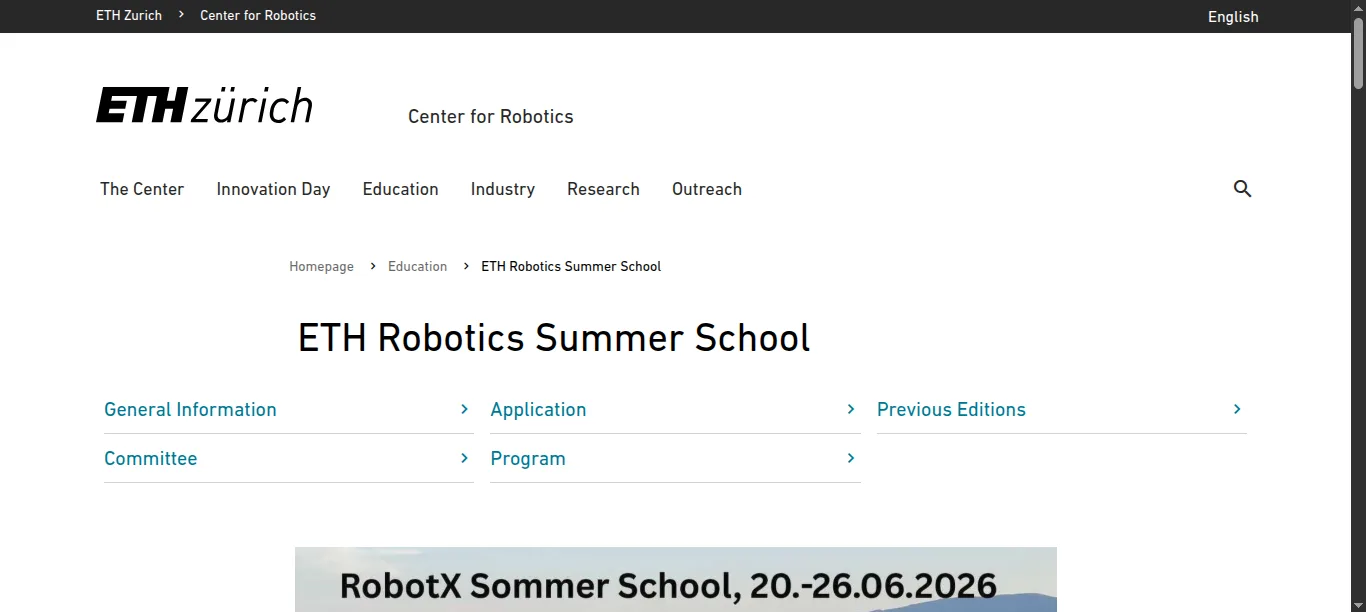
RoboX is a one-week robotics summer school run by ETH Zurich's Center for Robotics, held in Geneva from 12 to 16 July 2027. It is a training school with a CHF 200 participation fee, not a paid research placement. Applications open on 8 February 2027 and close on 19 March 2027, and the acceptance list is published on 16 April 2027.
Quick Facts
| Item | Detail |
|---|---|
| Host | ETH Zurich Center for Robotics |
| Location | Geneva, Switzerland; the 2026 venue was Caserne Epeisses in Avully |
| Opportunity type | One-week robotics summer school |
| Duration | Five days, 12 to 16 July 2027 |
| Eligibility | Master's students and first-year PhD students |
| Funding | No salary; CHF 200 participation fee; financial support available on justified request |
| Application status | Opens 8 February 2027 |
| Deadline | 19 March 2027 |
| Official portal | robotx.ethz.ch |
What RoboX is
RoboX is the ETH Robotics Summer School. ETH's Center for Robotics runs it, and the programme is built around autonomous rough-terrain ground robots. Participants attend lectures, work hands-on with robots, and take part in a search-and-rescue competition. The school runs alongside the ARCHE exercise, and the fee includes entrance to that exercise.
The format is intensive and practical rather than a research internship. There is no host group, no individual research project, and no salary. Participants are selected for a one-week cohort of no more than 50 people. The value of the programme is the combination of lectures, hands-on sessions, and a team competition in a short period, not a long placement in a laboratory.
The 2027 dates are 12 to 16 July. The main page also displays the line "Geneva, Switzerland, 10th June – 16th July 2027", which is longer than the five-day school. The most likely explanation is that the June date refers to the ARCHE exercise rather than the school itself, but the page does not say so explicitly. Applicants should confirm the dates they are expected to attend before booking travel.
How RoboX differs from a research internship
A research internship usually places one student in a group for several weeks or months, with an individual project and a supervisor. RoboX is a cohort school: everyone follows the same programme, works in teams, and completes a competition in five days. There is no individual research output, no thesis, and no salary.
That distinction matters when comparing offers. Applicants who want a long laboratory placement, a publication, or a paid research experience should look at a research internship rather than RoboX. Applicants who want a concentrated introduction to autonomous robots, with lectures and hands-on work in a small cohort, are the intended audience. The CHF 200 fee reflects the school format: it covers teaching, materials, meals, accommodation, and the social programme, but it does not pay participants.
The school is also shorter and more structured than a research placement. The week is organised around taught topics and a team competition, so participants see a broad set of robotics problems rather than one narrow research question. That breadth is the main reason to choose RoboX over a longer, narrower internship.
What you study
The programme covers the core skills needed to make a ground robot navigate rough terrain autonomously. The published topics are:
- State estimation. Estimating the robot's position and orientation from sensor data, including the uncertainty in those estimates.
- SLAM. Simultaneous localisation and mapping, where the robot builds a map while locating itself within it.
- Path planning and exploration. Choosing routes and deciding where to go when the environment is not fully known.
- Camera modelling and geometry. Understanding how images relate to the three-dimensional world and how camera models are used in robotics.
These topics are taught through lectures and hands-on sessions. The hands-on work is the centre of the programme: participants work with robots rather than only listening to presentations. The search-and-rescue competition at the end gives the week a concrete goal and forces teams to integrate perception, estimation, planning, and control under time pressure.
The 2026 programme page lists a check-in on 20 June and a start on 21 June, which reflects the previous edition rather than the 2027 schedule. The 2027 lecture list and detailed timetable have not been published. The topic list above is the programme's published content, and applicants should expect the 2027 edition to follow the same broad areas.
Who can apply
RoboX is aimed at Master's students and first-year PhD students. The application page states that selection is based on the curriculum, the motivation letter, and diversity. Applicants submit a CV and a one-page motivation letter. A code repository or a video is optional.
The official pages do not state a formal prerequisite in robotics, a minimum grade average, or a required programming language. That does not mean the school is introductory: the topics assume some familiarity with robotics, computer vision, or programming. Applicants without prior robotics coursework can still apply, but they should use the motivation letter to explain how their background prepares them for the hands-on work.
The cohort is capped at 50 participants. The cap makes the motivation letter more important than it might be for a large open-enrolment school. A generic statement of enthusiasm is less useful than a specific account of what you have built, what you want to learn, and why this programme fits that goal.
ETH does not state a nationality restriction or a language requirement on the pages reviewed for this guide. The programme is taught at ETH Zurich's robotics centre, and applicants should confirm the working language and any practical requirements with the organisers if they are unsure.
Costs and financial support
The participation fee is CHF 200 in total. It covers course materials, coffee breaks, meals, accommodation, the social dinner, and entrance to the ARCHE exercise. Travel costs are the participant's responsibility.
The fee is payable within 14 days of acceptance and is non-refundable. That makes the acceptance decision a financial commitment, not a provisional place. Applicants who are unsure whether they can attend should resolve the travel and funding questions before accepting.
Financial support is available on justified request. The official page does not publish a separate application form, a deadline, or a set of criteria for that support. Applicants who need it should contact the organisers before or alongside their application and explain the circumstances. Do not assume that support will cover the full cost of travel or that it will be granted automatically.
The fee is low relative to many international summer schools, but it is not the full cost of attending. Participants should budget for travel to Geneva, local transport, insurance, and any spending money. The page does not state whether insurance is included, so participants should check their own cover.
The fee also does not cover visa fees. The official page does not state whether the organisers provide visa support or invitation letters. Applicants who need a Schengen visa should allow time for the process and ask the organisers what documentation they can provide after acceptance.
How to apply
- Check the eligibility and the dates. RoboX is for Master's students and first-year PhD students, and the 2027 school runs from 12 to 16 July. Confirm that you can attend the full week before applying.
- Prepare a CV. The CV should make your academic background, relevant coursework, and any robotics or programming projects easy to find.
- Write a one-page motivation letter. Explain why you want to attend, what you have worked on, and what you hope to take away. The selection considers the motivation letter alongside the curriculum and diversity.
- Add an optional code repository or video. This is not required, but it can show practical work more directly than a CV. A short video of a robot or a software project is a useful supplement if it is relevant.
- Apply between 8 February and 19 March 2027. Use the official application page. The page does not state a time of day for the deadline, so submit before the final day.
- Check the acceptance list on 16 April 2027. Accepted participants must pay the CHF 200 fee within 14 days.
- Arrange travel and accommodation. Accommodation is included in the fee, but travel is not. Confirm the venue and the arrival arrangements with the organisers before booking.
Practical preparation
Before the school, participants should review the mathematical and programming background the topics assume. State estimation and SLAM rely on probability, linear algebra, and geometry; camera modelling relies on projective geometry; path planning relies on algorithms and data structures. The programme does not publish a reading list or a pre-course assignment, so preparation is self-directed.
It also helps to arrive with a clear sense of what you want to build or test. The search-and-rescue competition rewards teams that can integrate components quickly, and participants who have already used a robotics framework or a simulation environment can contribute sooner. The official page does not require a particular framework, language, or tool, so the most useful preparation is general rather than tool-specific.
Practical arrangements matter too. Accommodation is included, but travel is not, and insurance is not stated. Attendees should confirm the venue, the arrival time, and what they need to bring before booking travel. Geneva is expensive, so a budget for meals outside the provided ones and local transport is sensible.
Timeline and current status
The 2027 cycle has a clear sequence. Applications open on 8 February 2027, close on 19 March 2027, and the acceptance list is published on 16 April 2027. The school itself runs from 12 to 16 July 2027.
The main page is current for 2027, but some sub-pages are not. The programme page still describes the 2026 schedule, including a check-in on 20 June and a start on 21 June. The general information page also refers to the 2026 school. Applicants should treat the 2027 dates on the main and application pages as the current information and wait for the 2027 programme page to be updated before relying on a detailed timetable.
The venue needs the same care. The 2026 page names Caserne Epeisses in Avully, near Geneva, as the venue. The 2027 page says Geneva but does not publish a different venue. Applicants should confirm the exact location before booking accommodation or travel.
Selection and what makes a credible application
The selection criteria are curriculum, motivation letter, and diversity. That is a broad set, and the programme does not publish weightings. A credible application usually does three things well.
First, it shows relevant preparation. That can be coursework in robotics, computer vision, control, or programming, or a project in which you built or programmed something that moved or perceived the world. The CV should make that preparation visible without requiring the reader to infer it.
Second, the motivation letter should be specific to RoboX. A letter that could be sent to any summer school is weaker than one that names the topics you want to work on, explains why the hands-on format suits you, and connects your background to the search-and-rescue competition.
Third, the optional code repository or video should be relevant and easy to assess. A short README, a clear demonstration, or a link to a working project is more useful than a large repository with no explanation.
The cohort cap of 50 means the programme can be selective, but the published criteria are not a ranking formula. Applicants should present a coherent case rather than trying to guess a hidden threshold.
The programme does not publish an acceptance rate. The cap of 50 places and the three selection criteria are the only published guidance. A strong application is therefore one that makes the curriculum and motivation easy to assess, rather than one that tries to infer a hidden ranking.
What is confirmed and what is not yet announced
Confirmed: the 2027 application window of 8 February to 19 March; the acceptance date of 16 April; the school dates of 12 to 16 July; the Geneva location; the maximum of 50 participants; the eligibility for Master's and first-year PhD students; the CHF 200 fee and its inclusions; the selection criteria; and the core topic list.
Not yet announced: the detailed 2027 timetable and lecture list; the exact 2027 venue; whether the fee will remain CHF 200 for 2027; whether the "10th June – 16th July 2027" line refers to the ARCHE exercise or to a longer programme; and the specific terms of financial support.
The application page is the best place to confirm the current status. The lectures page lists the teaching topics but, like the programme page, still reflects the 2026 edition.
Sources
- ETH Zurich Center for Robotics, "ETH Robotics Summer School," accessed 12 November 2026
- ETH Zurich Center for Robotics, "Application," accessed 12 November 2026
- ETH Zurich Center for Robotics, "Programme," accessed 12 November 2026
- ETH Zurich Center for Robotics, "General Information," accessed 12 November 2026
- ETH Zurich Center for Robotics, "Lectures and Tutorials," accessed 12 November 2026
- Feynman Research Labs, "ETH Robotics Summer School (RoboX)" listing
Keep exploring
Compare RoboX with other verified robotics and engineering programmes in the opportunity finder. The Caltech SURF guide covers a paid undergraduate research route, and the EPFL summer research guide explains a different Swiss summer programme. The research programmes directory groups listings by type.
Frequently asked questions
- What is RoboX?
- RoboX is the ETH Robotics Summer School run by ETH Zurich's Center for Robotics. The 2027 edition is scheduled for 12 to 16 July 2027 in Geneva, Switzerland. It combines lectures and hands-on work on autonomous rough-terrain ground robots, including a search-and-rescue competition.
- Is RoboX a paid internship or research placement?
- No. RoboX is a one-week training summer school with a CHF 200 participation fee. It does not advertise a salary or a research placement. Participants pay the fee and their own travel costs, although financial support is available on justified request.
- Who can apply to RoboX?
- RoboX is open to Master's students and first-year PhD students. Selection is based on curriculum, the motivation letter, and diversity. Applicants submit a CV and a one-page motivation letter, with an optional code repository or video.
- What does the CHF 200 fee cover?
- The fee covers course materials, coffee breaks, meals, accommodation, the social dinner, and entrance to the ARCHE exercise. Travel costs are not included. Payment is due within 14 days of acceptance and is non-refundable.
- When are RoboX 2027 applications open?
- The application window is 8 February to 19 March 2027. The acceptance list is published on 16 April 2027, and the summer school runs from 12 to 16 July 2027.
- Do I need previous robotics experience for RoboX?
- The official pages do not state a formal robotics prerequisite. Selection considers the curriculum, the motivation letter, and diversity, and the programme covers state estimation, SLAM, path planning, and camera geometry. Applicants should show relevant coursework or projects in their materials.
- Is the RoboX fee refundable?
- No. The fee is non-refundable, and payment must be made within 14 days of acceptance. Applicants who need financial support should make a justified request to the organisers.
- Where is RoboX held?
- The 2027 school is listed as taking place in Geneva, Switzerland. The 2026 page names Caserne Epeisses in Avully as the venue; the 2027 page has not published a different venue.
Official application link
Check the official ETH RoboX application page
Applications open on 8 February 2027 and close on 19 March 2027. The detailed 2027 schedule and venue should be confirmed on the official page before booking travel.
Open official page

