
Academic guides · Guide
GIST IERI International Internship: Current Status and Application Guide
StatusOpen
GIST's IERI has not published an internship call since Fall 2023. This guide explains the programme, the 2023 terms, and what to check before applying.
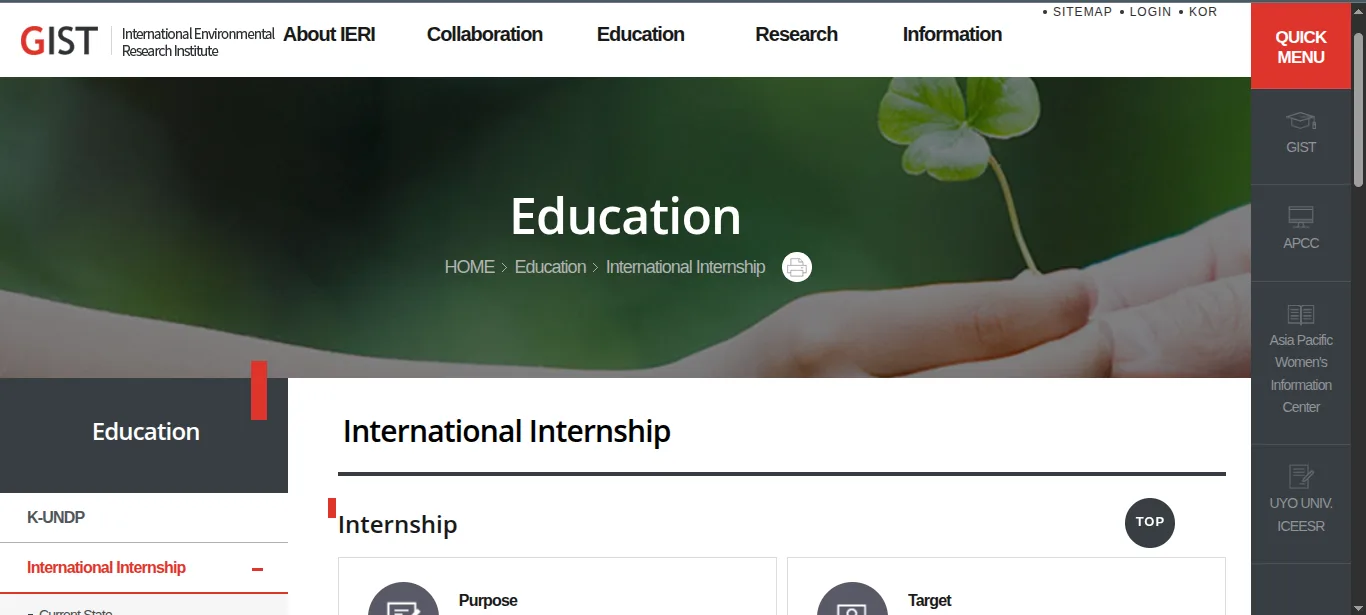
The GIST International Environmental Research Institute (IERI) internship is a training placement at Gwangju Institute of Science and Technology in South Korea for graduate students and researchers from developing countries. No 2026 or 2027 call is open: the last published announcement was for the Fall 2023 semester, and the official pages have not announced a successor. The programme's general page describes a six-month internship, but the 2023 call ran for four months.
Quick Facts
| Item | Detail |
|---|---|
| Host | International Environmental Research Institute (IERI), Gwangju Institute of Science and Technology (GIST), South Korea |
| Opportunity type | International training internship |
| Duration | Six months on the general page; four months in the Fall 2023 call |
| Eligibility | Current postgraduate or final-year bachelor's students in environment or climate-related fields; excellent English; MS Office |
| Funding | Fall 2023 call: round-trip air ticket, shared dormitory, insurance, and about KRW 425,000 per month |
| Application status | No open call; last published cycle was Fall 2023 |
| Deadline | None open |
| Official portal | ieri.gist.ac.kr |
What IERI is
IERI is the International Environmental Research Institute at GIST in Gwangju, South Korea. It was founded in 2001 as a research institute for the United Nations University at GIST, and it has been a member of the CTCN since August 2016. Its work focuses on climate change and the environment, including capacity building in developing countries.
That mission explains the shape of the internship. It is not a general research internship for any student who wants laboratory experience. It is a training programme for people from developing countries who are studying or working on environmental and climate issues, and it combines practical support for the institute with assigned laboratory tasks. The programme's stated purpose is educational training for government officials and researchers from developing countries.
The institute's pages are partly a historical record. The "Current State" list for the internship has entries that stop in 2018, and the notice board's most recent internship announcement is the Fall 2023 call. The general internship page still describes the programme's intended structure, but it has not been updated to reflect a current cycle.
What the institute works on
IERI's research and collaboration pages give the internship its context. The institute works on climate change and environmental research, and its collaboration menu lists the CTCN, the IFOCA forum, the Ongdalsaem Project, and workshops. Its education menu lists the K-UNDP programme and the international internship. The common thread is capacity building: training people and institutions, particularly in developing countries, to understand and manage environmental problems.
That matters for applicants because the internship is not a standalone laboratory job. The 2023 call asked the intern to support the Director's office as well as the assigned laboratory. An intern who understands the institute's mission, and can explain how their background fits it, is better prepared than one who has only read the eligibility list.
The institute's pages do not publish a detailed research portfolio for the internship, and the 2023 call did not name the laboratories that hosted interns. Applicants should not assume a particular project or supervisor. The call's tasks were described at a general level, and the specific assignment would have been made after selection.
What the internship involves
The general page describes the internship as educational training for government officials and researchers in developing countries. The target group is graduate students and researchers who hold a bachelor's degree in a developing country. The programme is intended to build capacity in environmental and climate work, not to provide a general introduction to research.
The 2023 call listed the intern's tasks. They included support for the Director's office, tasks assigned by the host laboratory, a final report, and a presentation. The internship was full-time, with at least 40 hours per week. That combination suggests a structured placement rather than a short visit: the intern contributes to the institute's work, completes a written output, and presents it.
The 2023 call also described the living arrangements. The intern received a shared dormitory room in a single-gender building, with two people per room. The call offered insurance and a round-trip air ticket. The monthly stipend was about KRW 425,000. These details are specific to 2023 and should not be read as current offers.
The 2023 Fall call in detail
The Fall 2023 announcement is the most recent complete description of the programme. Its closing date was 30 June 2023. The internship ran for four months, from September to December 2023. It was full-time, with at least 40 hours per week.
The call offered a monthly stipend of about KRW 425,000, a shared dormitory room, insurance, and a round-trip air ticket. The intern's tasks included support for the Director's office, assigned laboratory tasks, a final report, and a presentation. The call was aimed at current postgraduate students or final-year bachelor's students in environment or climate-related fields, with excellent English and MS Office skills.
Applicants submitted an application form, a CV, a cover letter, and original or notarised transcripts and an enrolment or degree certificate. The application went by email to ieri.internship@gmail.com, with the subject line "[IERI] International Internship Program_your name". The call did not publish a separate online portal.
The 2023 terms are useful for understanding what a future call might look like, but they are not a promise. Stipend amounts, duration, and document requirements can change. Anyone considering the programme should wait for a new announcement rather than sending an application to the 2023 address.
How the programme is supposed to work
The general internship page describes a different rhythm from the 2023 call. It says the internship lasts six months. For the spring intake, applications are due at the end of December in the previous fiscal year, selection takes place in mid-January, and the internship starts in early March. For the fall intake, applications are due at the end of June, selection takes place in mid-July, and the internship starts at the end of August.
That description is a template, not a current calendar. The 2023 Fall call ran for four months, not six, and its closing date was 30 June 2023. The general page has not been reconciled with the 2023 announcement, and no later call has tested whether the six-month description still applies.
The practical lesson is to treat the general page as background and the notice board as the source of truth. A call is real when there is a dated announcement with a closing date, a start date, and a set of documents. The general page's spring and fall rhythm is useful for knowing when to look, but it is not evidence that a call will open.
Eligibility and documents
The 2023 call's eligibility rules were narrow. Applicants had to be current postgraduate students or final-year bachelor's students in environment or climate-related fields. They needed excellent English and MS Office skills. The call did not state a nationality list, a minimum GPA, or an age limit on the pages reviewed for this guide.
The documents were a application form, a CV, a cover letter, and original or notarised transcripts and an enrolment or degree certificate. The call asked for the documents by email, with a specific subject line. Applicants who did not follow the subject line may have had their messages missed.
A future call could change the documents or the eligibility rules. The 2023 list is a starting point for preparation, not a guarantee. Applicants can prepare a CV, a short cover letter, and scanned transcripts now, but they should check the new call before sending anything.
Timeline and current status
No 2026 or 2027 call is open. The last published internship announcement was the Fall 2023 call, which closed on 30 June 2023 and ran from September to December 2023. The "Current State" list on the IERI site has entries that stop in 2018, and the notice board does not show a later internship announcement.
The institute has not published a statement that the programme is discontinued. That leaves three possibilities: the programme is paused, it has been replaced by another channel, or it is running without a public call. The official pages do not resolve the question. Applicants should describe the status as "no open call" rather than "closed permanently".
The general page's spring and fall rhythm suggests when a call might appear: the end of December for a spring start, and the end of June for a fall start. Those are the programme's stated application periods, not announced dates for 2027. Anyone monitoring the programme should check the internship page and the notice board at those points, and should not assume that a call will open.
How to monitor the programme
The first place to check is the International Internship page. The second is the notice board, where the Fall 2023 announcement was posted. A current call should have a dated announcement, a closing date, a start date, and a list of documents. Without those, there is no call to apply to.
The general page's rhythm gives two windows to watch: the end of December for a spring intake and the end of June for a fall intake. Those are the programme's stated application periods, not guarantees. A monitoring routine can be simple: check both pages at the start and middle of those months, and again in the weeks after, in case an announcement is posted late.
Applicants should not send a speculative application to the 2023 email address. The address may still be active, but a message without a current call is unlikely to be processed as an application. If there is a contact form or a current institute address on the official site, a short enquiry about the programme's status is more appropriate than a full application.
Selection and what makes a credible application
The 2023 call did not publish selection criteria beyond the eligibility rules. It did not state a shortlisting process, an interview, or a scoring system. That makes it difficult to say what made a successful application, and applicants should be cautious about advice that claims to know.
What can be said is that the programme's purpose shapes the application. It is a capacity-building internship for people from developing countries working on environment and climate issues. A credible application would explain the applicant's environmental or climate background, their English and office skills, and how the internship fits their work or studies. A generic statement of interest in Korea or in research would be weaker than a specific account of the applicant's environmental work.
The 2023 documents were simple: an application form, a CV, a cover letter, transcripts, and proof of enrolment or degree. The cover letter carried most of the explanatory weight. Applicants should use it to connect their background to the institute's mission, not to repeat the CV.
If a new call appears, the exact subject line and email address matter. The 2023 call asked for "[IERI] International Internship Program_your name" in the subject. A future call may use a different address or a portal, so applicants should follow the new instructions rather than copying the old ones.
What is confirmed and what is not yet announced
Confirmed: IERI's location at GIST in Gwangju; its founding in 2001 and its CTCN membership since August 2016; the general page's description of a six-month internship with spring and fall intakes; the Fall 2023 call's four-month duration, closing date, stipend, dormitory arrangement, insurance, air ticket, tasks, eligibility rules, documents, and email instructions; and the absence of a later published internship announcement.
Not announced: whether the programme will run in 2027 or later; the current duration and stipend; whether the six-month description still applies; the next call's dates, documents, and selection process; and whether the programme has been discontinued or replaced.
The discrepancy between the general page's six months and the 2023 call's four months is unresolved. Applicants should not assume either figure for a future cycle. The International Internship page and the notice board are the places to check for a new announcement.
Sources
- GIST International Environmental Research Institute, "International Internship," accessed 12 November 2026
- GIST IERI, "Current State" internship list, accessed 12 November 2026
- GIST IERI, notice board, accessed 12 November 2026
- GIST IERI, Fall 2023 internship announcement, accessed 12 November 2026
- Feynman Research Labs, "GIST International Internship" listing
Keep exploring
Compare this programme with other verified environmental and research internships in the opportunity finder. The WHOI summer student fellowship guide covers a paid marine research programme, and the HZB International Summer Student Programme guide explains a materials and energy research route in Berlin. The research programmes directory groups listings by type.
Frequently asked questions
- Is the GIST IERI internship open in 2026 or 2027?
- No. The last published internship announcement on the IERI site was for the Fall 2023 semester, and no 2026 or 2027 call is open. The institute has not announced a successor cycle on the pages reviewed for this guide.
- What is the GIST IERI International Internship?
- It is a training internship at the International Environmental Research Institute at Gwangju Institute of Science and Technology in South Korea. It is aimed at graduate students and researchers from developing countries working on climate and environmental issues, and it combines support for the Director's office with assigned laboratory tasks, a final report, and a presentation.
- How long is the IERI internship?
- The general IERI page describes a six-month internship. The last published call, for Fall 2023, ran for four months from September to December 2023. The difference means applicants should not treat six months as a current duration.
- What funding did the 2023 IERI internship offer?
- The Fall 2023 announcement offered a round-trip air ticket, a shared dormitory room, insurance, and a monthly stipend of about KRW 425,000. These are 2023 terms, not current terms, and the institute has not published updated amounts.
- Who was eligible for the 2023 IERI internship?
- The 2023 call was open to current postgraduate students or final-year bachelor's students in environment or climate-related fields, with excellent English and MS Office skills. Applicants also had to submit transcripts and proof of enrolment or degree.
- How do I apply to the IERI internship?
- The 2023 call asked applicants to email an application form, CV, cover letter, and original or notarised transcripts and enrolment or degree certificate to ieri.internship@gmail.com, with the subject line '[IERI] International Internship Program_your name'. No current application channel is open.
- Has the IERI internship been discontinued?
- The official pages do not say that the programme has been discontinued. They also do not show a call after Fall 2023. The safest description is that no call is currently open and the programme's status is unconfirmed.
- Where is IERI based?
- IERI is based at Gwangju Institute of Science and Technology (GIST) in Gwangju, South Korea. It was founded in 2001 and focuses on climate change and environmental research, including capacity building in developing countries.
Official application link
Check the official GIST IERI internship page
No 2026 or 2027 call is open. The last published announcement was for Fall 2023, and the official page has not announced a successor cycle.
Open official page

