
Academic guides · Guide
HZB International Summer Student Programme (ISSP): 2026 Guide and 2027 Status
StatusClosed
HZB's ISSP is an 8-week summer research programme in Berlin with a €1,900 stipend (external) or €1,000 (Berlin/Potsdam students), plus 75–80% travel subsidy. The 2026 deadline was 14 December 2025; the 2027 call is not yet announced.
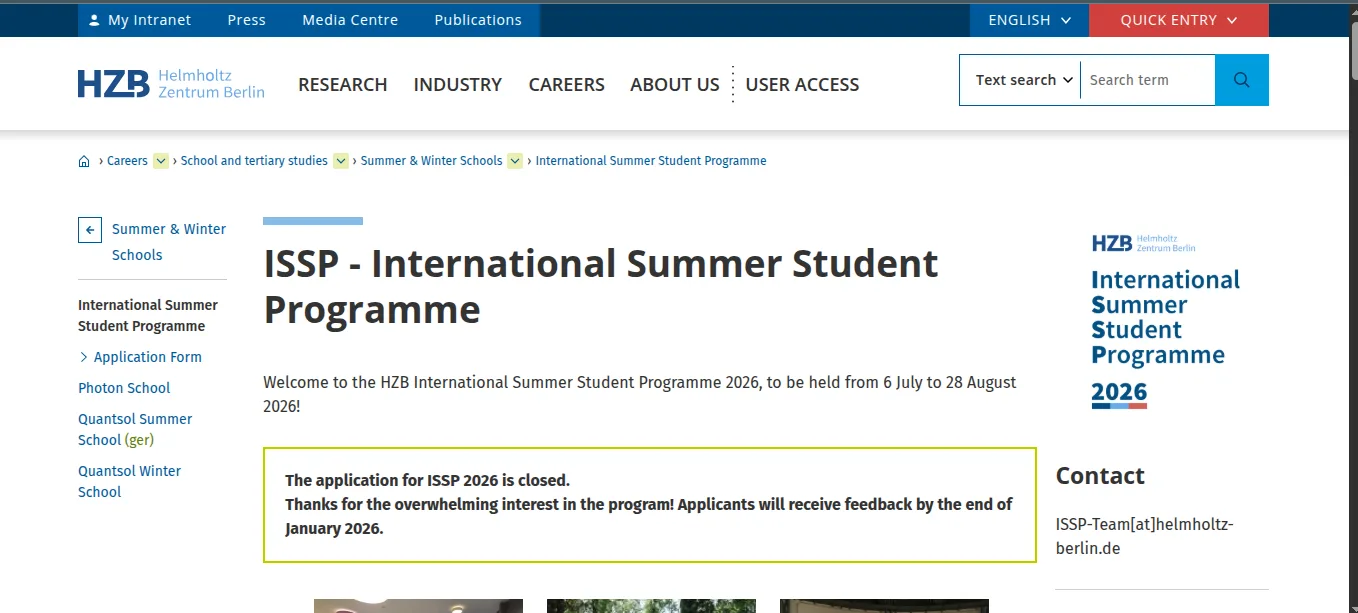
The Helmholtz-Zentrum Berlin (HZB) International Summer Student Programme (ISSP) is an 8-week summer research placement in Berlin, Germany. The 2026 programme ran from 6 July to 28 August 2026, with applications closing on 14 December 2025. Participants receive a €1,900 gross stipend (€1,000 for Berlin/Potsdam university students) plus a travel subsidy (75% up to €200 for EU/UK, 80% up to €800 for non-EU). The 2027 call has not been announced as of 12 November 2026.
The ISSP is aimed at undergraduate students who want to experience research in a large-scale scientific facility. HZB's BESSY II synchrotron produces intense X-ray light used to probe materials, making the centre particularly relevant for students interested in physics, chemistry, materials science, and energy research. Participants work on an independent project rather than assisting with routine tasks, giving them a realistic view of what a research career involves.
Quick Facts
| Item | What HZB publishes |
|---|---|
| Host | Helmholtz-Zentrum Berlin für Materialien und Energie (HZB) |
| Location | Berlin, Germany (Wannsee and Adlershof campuses) |
| Opportunity type | Summer research programme for undergraduates |
| Duration | 8 weeks, 6 July – 28 August 2026 (2026 dates) |
| Cohort size | 20 undergraduate students per year |
| Stipend | €1,900 gross (external); €1,000 gross (Berlin/Potsdam students) |
| Travel subsidy | 75% up to €200 (EU/UK); 80% up to €800 (non-EU) |
| Working hours | 40 hours/week |
| Eligibility | Undergrad (Bachelor/Master, not PhD); ≥2 years full-time study; enrolled during stay; Physics, Chemistry, Material Science, Structural Biology, Math, Engineering, Life/Environmental Sciences or related |
| Application status | 2026 closed (deadline 14 Dec 2025); 2027 not announced |
| Official portal | HZB ISSP page |
What the HZB ISSP is
HZB operates the BESSY II synchrotron radiation source and conducts research in materials and energy for a climate-neutral future. HZB is a member of the Helmholtz Association, Germany's largest scientific organisation, and receives the majority of its funding from the German federal government and the State of Berlin. Its research centres on materials and energy technologies needed for the energy transition, including solar energy, battery research, quantum materials, and accelerator-based science. The centre's goal is to develop new materials and methods for a sustainable energy supply, and the ISSP gives students a chance to contribute to that mission during their placement.
The ISSP places 20 undergraduate students each year in research groups at HZB's two Berlin campuses (Wannsee and Adlershof) for an 8-week independent research project. Participants work on their own project under the supervision of HZB scientists, gaining hands-on experience in a real research environment rather than taking taught classes.
HZB's campuses and facilities
- Wannsee campus — home to BESSY II, the synchrotron radiation source used for materials research, and to HZB's institute for solar fuels and materials
- Adlershof campus — hosts HZB's institutes for thin-film photovoltaics, battery research, and quantum materials, co-located with other research institutes in the Adlershof science and technology park
The framework programme
In addition to the research project, the ISSP includes a framework programme designed to give participants a broad view of HZB's research and of scientific careers:
- Visits to BESSY II, solar energy labs, and the proton therapy cyclotron
- Excursions to research institutions in and around Berlin
- Workshops on topics such as science communication and entrepreneurship
- A closing event with a scientific poster presentation, where participants present their project results
Participation for the entire 8-week duration is mandatory. Students who cannot commit to the full period should not apply, as the project work and framework programme are designed to run continuously over the summer.
Research fields covered by the ISSP
The programme covers these research fields:
- Photon Science — using synchrotron light to study materials at the atomic and molecular scale
- Photovoltaics — thin-film solar cells and solar energy technologies
- Solar Cells / Catalysis — materials and processes for converting sunlight into chemical energy
- Electrochemical Energy Storage — batteries and other energy storage technologies
- Quantum and Functional Materials — materials with novel electronic, magnetic, or optical properties
- Accelerator research — particle accelerator technology and accelerator-based science
Eligibility
Must-have:
- Undergraduate student (Bachelor or Master — not PhD candidate)
- Physics, Chemistry, Material Science, Structural Biology, Mathematics, Engineering, Life or Environmental Sciences, or related disciplines
- Completed at least two years of full-time university study in major discipline by programme start
- Enrolled at university during the entire stay (6 July – 28 August 2026)
- Good knowledge of English (German an advantage)
- Letter of reference included with application
Non-EU students additionally need:
- Declaration of Certificate of Enrolment (ZAV) — mandatory form for German authorities, must be signed and stamped by university
HZB explicitly welcomes diverse applications and aims to improve women's representation in science.
What the eligibility criteria mean in practice
- At least two years of full-time university study means applicants should have completed roughly the equivalent of four semesters by the time the programme begins in July. This excludes first-year undergraduates.
- Enrolled during the stay means you must remain registered at your university throughout July and August 2026; recent graduates who have already completed their degree are not eligible.
- Good knowledge of English is required because the programme, research groups, and framework activities are conducted in English. German is an advantage but not required.
- Letter of reference must come from someone who knows you well as a student and can assess your professional conduct — typically a university lecturer or supervisor.
- ZAV form (for non-EU students) is a Declaration of Certificate of Enrolment that must be signed and stamped by your university. It is a mandatory form for German authorities and is required in addition to the other application documents.
Stipend and costs
| Item | Amount |
|---|---|
| Subsistence allowance (external) | €1,900 gross for 8 weeks |
| Subsistence allowance (Berlin/Potsdam students) | €1,000 gross for 8 weeks |
| Travel subsidy (EU/UK) | 75% of expenses, up to €200 |
| Travel subsidy (non-EU) | 80% of expenses, up to €800 |
| Working hours | 40 hours/week |
| Contract | 8-week internship contract |
Not provided by HZB:
- Accommodation (students arrange independently; HZB provides platform list)
- Health insurance (students must provide proof)
Accommodation and living in Berlin
HZB does not provide on-campus accommodation. Students are responsible for arranging their own housing in Berlin for the 8-week period. HZB provides a list of useful housing platforms to help students search, but does not place students in accommodation or reserve rooms. Given the short duration and the summer period, students should begin their housing search as soon as they are accepted, as Berlin's rental market is competitive.
Students must also provide proof of health insurance before the stay. EU students may be able to use a European Health Insurance Card (EHIC), while non-EU students will need to arrange appropriate German health insurance coverage.
Cost of living considerations
The €1,900 gross subsistence allowance (€1,000 for Berlin/Potsdam students) is intended to cover living costs for the 8-week period. Students should budget for:
- Rent and utilities in Berlin (shared flats or short-term lets)
- Food and groceries
- Public transport (BVG tickets for buses, trams, U-Bahn and S-Bahn)
- Personal expenses
The travel subsidy (75% up to €200 for EU/UK; 80% up to €800 for non-EU) helps cover the cost of travelling to and from Berlin but does not cover local transport during the stay.
How to apply
Applications are submitted via the HZB ISSP online application form (link on the page when open).
Required documents (English or German, unprotected files):
- Academic CV — tabular, chronological, ≤2 pages
- Certificate of enrolment — valid until end of August 2026 (current certificate accepted if 2026 not yet available)
- Transcripts and degree certificate (if applicable) — most recent marks overview
- Copy of passport or identity card
- Letter of reference — from someone who knows you well as a student and can assess professional conduct
- Declaration of Certificate of Enrolment (ZAV) — for non-EU students only; signed and stamped by university
Deadline: 14 December 2025 (for 2026 cycle). Late/incomplete applications not considered.
Applications are only accepted during the open application window; when the call is closed, the online application form is not available. Prospective applicants for a future cycle should monitor the HZB ISSP page for the announcement of the next call and the opening of the application form.
Tips for a strong application
- Ensure all documents are in English or German and are unprotected (not password-protected PDFs)
- Keep the CV to two pages or fewer, in tabular chronological format
- Choose a referee who can comment specifically on your suitability for laboratory or research work
- Non-EU applicants should arrange the ZAV form well before the deadline, as it requires a university stamp and signature
Selection process
HZB supervisors submit research projects alongside student applications. Once projects and applications are in, the relevant supervisors review the applicant pool and select candidates for their projects. The process is competitive; the HZB page notes "overwhelming interest" for the 2026 cycle, meaning more qualified applicants applied than there were places.
Applicants for 2026 received feedback by the end of January 2026.
What the selection process involves
- Project submission — HZB supervisors propose research projects that summer students could work on
- Application review — supervisors review applications and select candidates whose interests and background match their projects
- Offer and acceptance — selected candidates are offered a place and must confirm their participation
- Feedback — applicants are notified of the outcome; for 2026, feedback was provided by the end of January
Because selection is done by individual supervisors rather than a central committee, a strong application demonstrates a clear fit between the applicant's interests and a specific HZB research group's work.
Timeline and current status
| Cycle | Dates | Status |
|---|---|---|
| 2026 | 6 Jul – 28 Aug 2026 | Completed; application closed 14 Dec 2025 |
| 2027 | Not announced | No call published as of 12 Nov 2026 |
The programme runs annually. Based on the consistent annual schedule, a 2027 call is expected, but no dates are confirmed. Applicants should not assume that 2027 will follow the 2026 dates, stipend, or deadline exactly; all such details will be set out in the 2027 call when it is published.
What is confirmed and what is not yet announced
| Confirmed (from 2026) | Not confirmed for 2027 |
|---|---|
| Programme exists, runs annually | 2027 dates |
| 8 weeks, July–August | 2027 application opening |
| 20 students/year | 2027 deadline |
| €1,900/€1,000 stipend | 2027 stipend amount |
| 75–80% travel subsidy | 2027 travel subsidy |
| Research fields listed | 2027 research fields |
| No accommodation provided | — |
| No health insurance provided | — |
| Contact: ISSP-Team@helmholtz-berlin.de | — |
| Two campuses: Wannsee and Adlershof | Specific 2027 host groups/projects |
| Mandatory full 8-week participation | 2027 application opening date |
Sources and verification
- HZB International Summer Student Programme — official ISSP page, accessed 12 November 2026
- HZB Summer & Winter Schools overview — programme listing
- Archive screenshot:
2026-11-05_HZB_Summer_Student_Programme_Page_01.png
Keep exploring
- DESY Summer Student Programme 2027 — 7.5-week Hamburg/Zeuthen programme with €28.50/day
- GSI/FAIR Summer Student Program — Darmstadt summer student programme
- EMBL Trainees and Interns — short-term opportunities across six EMBL sites
Frequently asked questions
- Is the HZB International Summer Student Programme 2027 open for applications?
- No. The 2026 programme ran 6 July – 28 August 2026 and its application closed on 14 December 2025. As of 12 November 2026, no 2027 call has been announced.
- How much does the HZB ISSP pay?
- €1,900 gross for external participants; €1,000 gross for students of universities in Berlin and Potsdam, for the 8-week contract duration. Plus 75% of travel expenses up to €200 for EU/UK countries, or 80% up to €800 for non-EU countries.
- Who is eligible for the HZB ISSP?
- Undergraduate students (Bachelor or Master, not PhD candidates) in Physics, Chemistry, Material Science, Structural Biology, Mathematics, Engineering, Life or Environmental Sciences or related disciplines. Must have completed at least two years of full-time university study by the programme start, be enrolled during the stay (6 July – 28 August 2026), have good English (German an advantage), and provide a letter of reference. Non-EU students need a Declaration of Certificate of Enrolment (ZAV) form signed and stamped by their university.
- What are the HZB ISSP 2026 dates?
- 6 July to 28 August 2026 (8 weeks). Participation for the entire duration is mandatory.
- Does HZB provide accommodation for ISSP students?
- No. HZB does not have capacity to provide on-campus accommodation. Students must arrange housing themselves; HZB provides a list of useful platforms.
- Is health insurance provided?
- No. Students must provide proof of health insurance themselves.
- What research areas does the HZB ISSP cover?
- Photon Science, Photovoltaics, Solar Cells/Catalysis, Electrochemical Energy Storage, Quantum and Functional Materials, and Accelerator research. Students work on their own project with HZB scientists at the Wannsee or Adlershof campuses.
- What is the application deadline for HZB ISSP?
- The 2026 deadline was 14 December 2025. The 2027 deadline has not been announced.
Official application link
Check the official HZB ISSP page
The 2026 round is closed (deadline 14 December 2025). The 2027 call has not been announced. Contact ISSP-Team@helmholtz-berlin.de for updates.
Open official page

