
Academic guides · Guide
GSI/FAIR Summer Student Program 2027: Application Guide
StatusClosed
GSI/FAIR's eight-week summer programme runs 26 July to 16 September 2027. Applications reopen in December 2026, with deadlines in January and February 2027.
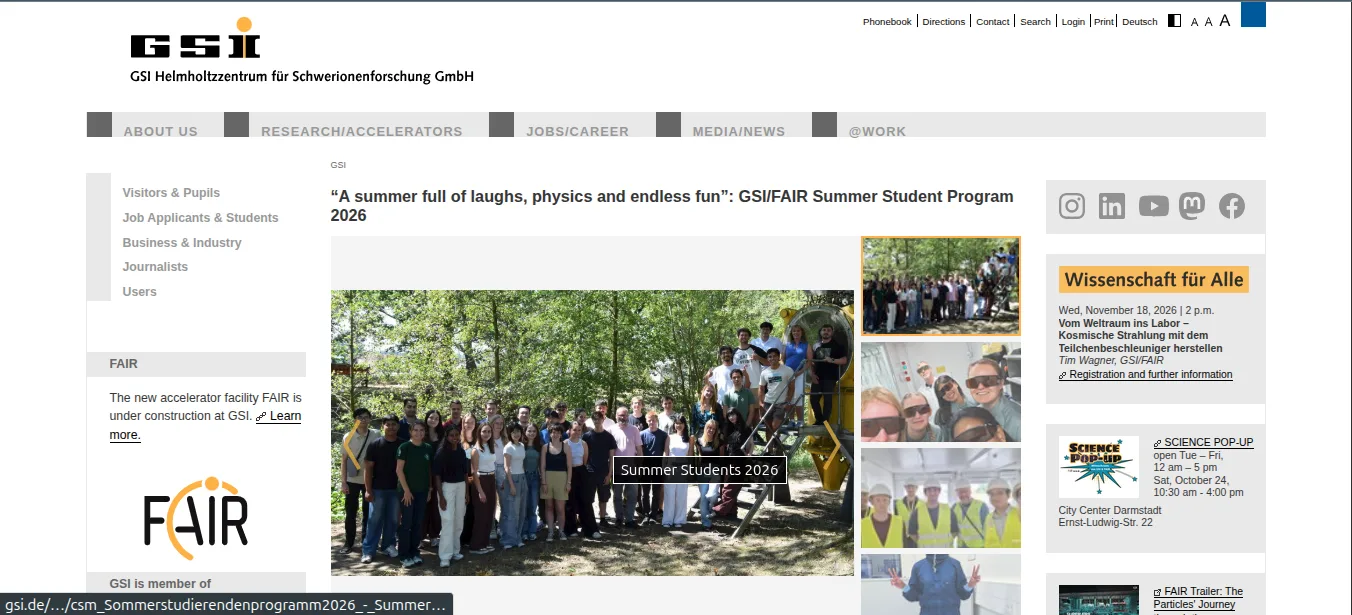
The GSI/FAIR International Summer Student Program is an eight-week research internship at the GSI Helmholtzzentrum für Schwerionenforschung and the FAIR accelerator facility in Darmstadt, Germany. The 2027 programme runs from 26 July to 16 September 2027. The application portal is currently closed and will reopen in December 2026; the published deadlines are 31 January, 13 February, and 15 February 2027.
Quick Facts
| Item | Detail |
|---|---|
| Host | GSI Helmholtzzentrum für Schwerionenforschung and FAIR, Darmstadt, Germany |
| Opportunity type | Summer research internship |
| Duration | Eight weeks, 26 July to 16 September 2027 |
| Eligibility | Advanced undergraduate or Master's students with at least three years of study; last-year Bachelor or Master; physics or related natural science or engineering; PhD students excluded |
| Funding | Free lodging in a nearby hotel, weekly allowance at the German student standard, travel support up to EUR 500 |
| Application status | Closed; reopens December 2026 |
| Deadline | 31 January 2027 (form), 13 February 2027 (reports and CV), 15 February 2027 (non-EEA documents) |
| Official portal | theory.gsi.de/stud-pro |
What the programme is
The International Summer Student Program is organised by GSI and its graduate school, HGS-HIRe. It has been part of the HGS-HIRe programme since spring 2010. GSI describes it as an opportunity for advanced undergraduates and Master's students to experience research at a major accelerator laboratory.
The core of the programme is an individual project. Each participant works with a tutor on a research question, in the way a student might work on a small Bachelor project. At the end, the participant writes a four-page report and gives a short seminar presentation. The programme also includes introductory lectures and soft-skill tutorials, so the internship is not only laboratory work.
The full eight weeks are mandatory. GSI states that participants must attend the entire period, which matters when planning travel, exams, or other commitments. The programme is based in Darmstadt, and the 2027 dates are 26 July to 16 September.
What you would work on
GSI lists a broad set of fields for the programme: physics, accelerator physics, biophysics, medical physics, biology, medicine, including tumour therapy, materials and nanotechnology, computer science and IT, electrical engineering and microelectronics, and mechanical engineering. The range reflects the laboratory's work, which spans accelerator operations, detector development, biophysics, and materials research.
The 2026 lecture programme gives a sense of the topics. It included accelerators from source to target, biophysics and cancer therapy with heavy ions, nuclear structure and astrophysics, plasma physics with intense laser and ion beams, atomic physics, tracking and vertex detectors, compressed nuclear matter, hadron spectroscopy, computing, the ROOT data-analysis framework, and scientific writing with LaTeX. It also included visits and student report sessions.
The 2027 lecture timetable and project list have not been published. Applicants should treat the 2026 topics as an indication of the programme's breadth, not as a promise that a particular lecture or project will be offered in 2027. Project availability depends on the tutors who participate in the year.
What the research environment is like
GSI is an accelerator laboratory, and FAIR is the new accelerator facility being built alongside it. Participants are not visiting a static museum: they join active research groups and work with tutors who are involved in the laboratory's projects. The programme's lectures and visits are designed to show how the different parts of the laboratory fit together, from ion sources and accelerators to detectors and data analysis.
The 2026 programme included visits to the medical and biophysics caves and the FAIR viewing platform, alongside lectures and report sessions. Those visits give a sense of the scale of the facilities and the range of work that goes on at the site. The 2027 visits have not been published, but the programme's structure is likely to include similar elements.
The programme is also part of HGS-HIRe, GSI's graduate school. That connection means participants are working in an environment that includes doctoral researchers and senior scientists, not only a summer cohort. The weekly allowance and hotel accommodation are designed to make the eight-week stay practical for students who are coming from outside Darmstadt.
Who is eligible
The eligibility rules are specific. Applicants must be advanced undergraduate or Master's students who have completed at least three years of study by the start of the summer programme. They must be in their last-year Bachelor or Master studies in physics or a related natural science or engineering discipline.
The programme is open to students from Europe or from GSI/FAIR partner countries. Students from non-European universities can apply only if their site is a GSI/FAIR collaboration partner and at least one of their reviewers is a member of a GSI-FAIR collaboration. That rule is narrower than a general "international students welcome" statement, and applicants should check their institution's status before preparing an application.
PhD students are excluded. The programme is for undergraduates and Master's students, and the project is pitched at that level. Applicants who have already started a doctorate should look at other GSI programmes rather than this one.
The full eight-week period is also a requirement. GSI says the full duration is mandatory, so applicants should confirm that they can attend from 26 July to 16 September 2027 before applying.
Funding and practical arrangements
GSI provides free lodging in a nearby hotel, in two- or three-bed rooms. It also provides a weekly allowance at the German student standard. The exact weekly amount is not stated on the page reviewed for this guide, so applicants should not budget from a guessed figure.
Travel support is available up to EUR 500. That is a cap, not a guarantee that all travel costs will be covered. Participants should keep receipts and follow GSI's instructions for claiming the support.
The programme does not state on the reviewed pages whether health insurance is included, whether local transport is covered, or whether meals are provided beyond the allowance. Participants should ask GSI about those details and budget for everyday costs.
GSI does not publish a total value for the package on the reviewed pages. The lodging, allowance, and travel support are separate components, and the allowance is described by reference to the German student standard rather than a fixed monthly figure. Applicants who need a precise budget should ask GSI for the current weekly rate before committing to the programme.
Visa arrangements depend on nationality. Participants with EEA nationality or residence generally do not need a visa. Non-EEA participants may need a Schengen visa, and the 90-day rule applies. GSI publishes visa information and provides documents for the process. Applicants should start early, because visa appointments and processing can take longer than expected.
How to apply
- Check the eligibility and the collaboration rule. Confirm that you are in your last-year Bachelor or Master studies, that you have completed at least three years of study, and that your university is in a GSI/FAIR partner country or is a collaboration partner with a reviewer who is a GSI-FAIR collaboration member.
- Prepare your CV and transcript. The application requires a current CV, which can be brief, and a transcript. The documents are submitted through the online system.
- Arrange two confidential reports. Two university professors, lecturers, or thesis supervisors must submit reports online. The application form generates a message you can send to your reviewers with the submission link.
- Submit the online application by 31 January 2027. The form is the first deadline. After submission, note your Application ID and the confirmation key that GSI sends by email. Both are required for further processing.
- Make sure the reports and CV arrive by 13 February 2027. The confidential reports and the CV or transcript have a separate deadline.
- Submit non-EEA documents by 15 February 2027. Non-EEA applicants need to provide a passport, enrolment certificate, declaration, and consent by this date.
- Wait for the results in the second half of April. GSI says results are announced in April.
The application is document-heavy, and the three deadlines are staggered. A common failure is to submit the form on time but leave the reports or the non-EEA documents until later. Applicants should treat all three dates as real deadlines and give their reviewers several weeks' notice.
Timeline and current status
The 2027 programme runs from 26 July to 16 September 2027. The application portal is closed and will reopen in December 2026 for the next year's programme. The published deadlines are 31 January 2027 for the online form, 13 February 2027 for the confidential reports and CV or transcript, and 15 February 2027 for non-EEA documents.
Results are announced in the second half of April. That gives successful applicants roughly three months to arrange travel, visas, and any other logistics before the programme starts in late July.
The 2027 lecture timetable and project list are not yet published. The programme page describes the overall structure, and the 2026 lecture programme shows the kinds of topics that have been offered. Applicants should check the official page again after the portal reopens for the 2027 project list.
Selection and what makes a credible application
GSI does not publish a detailed scoring rubric, a minimum GPA, or a publication requirement. The application is assessed on the documents: the form, the CV and transcript, and the two confidential reports. The collaboration rule for non-European applicants is a gate, not a score.
A credible application makes the academic preparation easy to see. The CV should list relevant coursework, laboratory experience, programming or instrumentation skills, and any research projects. The transcript shows the level of preparation. The two reports should come from people who have taught or supervised the applicant and can comment on their ability to work independently.
The project itself is assigned after selection, so applicants do not need to propose a specific research question in the application. What matters is fit with the programme's fields and the applicant's ability to contribute to a short project. Applicants who can explain why they want laboratory experience at an accelerator facility, and what they bring to it, are better placed than those who send a generic statement.
The full-duration requirement is also part of selection in practice. Applicants who cannot attend the entire eight weeks should not apply, because GSI states that the full period is mandatory.
Common mistakes to avoid
- Missing the staggered deadlines. The form, the reports and CV, and the non-EEA documents have three separate dates. Submitting the form is not the end of the application.
- Losing the Application ID or confirmation key. GSI says both are required for further processing. Note them immediately after submitting the form.
- Assuming a non-European university is eligible. The collaboration-partner rule and the reviewer requirement are specific. Check before preparing an application.
- Applying as a PhD student. The programme is for advanced undergraduates and Master's students; PhD students are excluded.
- Planning to arrive late or leave early. The full eight weeks are mandatory.
- Treating the EUR 500 travel support as a guaranteed full reimbursement. It is a cap, and participants should keep receipts and follow GSI's instructions.
- Sending the confidential reports yourself. The reports are submitted online by the reviewers, not by the applicant.
What is confirmed and what is not yet announced
Confirmed: the 2027 programme dates of 26 July to 16 September; the eight-week duration; the eligibility rules, including the three-year study requirement, the last-year Bachelor or Master condition, the exclusion of PhD students, and the collaboration rule for non-European universities; the funding structure of free lodging, a weekly allowance, and travel support up to EUR 500; the three deadlines; the results timing in the second half of April; and the requirement to attend the full period.
Not yet announced: the 2027 lecture timetable; the 2027 project list; the exact weekly allowance; whether the travel support will remain at EUR 500; and whether health insurance or local transport will be provided.
The applicant information page and the FAQ are the best places to confirm the documents and deadlines. The GSI careers page lists the programme alongside other student opportunities.
Sources
- GSI/FAIR, "International Summer Student Program," accessed 12 November 2026
- GSI/FAIR, "Information for Applicants," accessed 12 November 2026
- GSI/FAIR, "Visa Formalities," accessed 12 November 2026
- GSI/FAIR, "Frequently Asked Questions," accessed 12 November 2026
- GSI, "Offers for Students," accessed 12 November 2026
- Feynman Research Labs, "GSI/FAIR Summer Student Program" listing
Keep exploring
Compare this programme with other verified physics and accelerator opportunities in the opportunity finder. The CERN doctoral studentship guide covers a longer research route at an accelerator laboratory, and the DESY summer student programme guide explains another German summer research option. The research programmes directory groups listings by type.
Frequently asked questions
- What is the GSI/FAIR Summer Student Program?
- It is an eight-week research internship at the GSI Helmholtzzentrum für Schwerionenforschung and the FAIR accelerator facility in Darmstadt, Germany. Students work on their own project with a tutor, write a four-page report, give a seminar presentation, and attend introductory lectures.
- When is the 2027 GSI/FAIR summer programme?
- The 2027 programme runs from 26 July to 16 September 2027. The full period is mandatory, so participants cannot arrive late or leave early.
- When can I apply for the 2027 GSI/FAIR programme?
- The application portal is currently closed and will reopen in December 2026. The published deadlines are 31 January 2027 for the online form, 13 February 2027 for confidential reports and CV or transcript, and 15 February 2027 for non-EEA documents.
- Who is eligible for the GSI/FAIR Summer Student Program?
- Applicants must be advanced undergraduate or Master's students with at least three years of study completed by the summer, in their last-year Bachelor or Master studies in physics or a related natural science or engineering discipline. PhD students are excluded. Students from non-European universities can apply only if their site is a GSI/FAIR collaboration partner and at least one reviewer is a member of a GSI-FAIR collaboration.
- What funding does the GSI/FAIR programme provide?
- GSI provides free lodging in a nearby hotel in two- or three-bed rooms, a weekly allowance at the German student standard, and travel support of up to EUR 500. The exact weekly allowance is not stated on the page reviewed for this guide.
- Do I need a visa for the GSI/FAIR programme?
- Participants with EEA nationality or residence generally do not need a visa. Non-EEA participants may need a Schengen visa, and the 90-day rule applies. GSI provides information and documents for the visa process, but applicants should check the official visa page for their nationality.
- What do participants work on at GSI/FAIR?
- Participants work on their own project with a tutor, in fields that include physics, accelerator physics, biophysics, medical physics, biology, medicine, materials and nanotechnology, computer science, electrical engineering, and mechanical engineering. The project is comparable in scope to a small Bachelor project.
- When are GSI/FAIR results announced?
- GSI says results are announced in the second half of April. The 2027 lecture timetable and project list have not yet been published.
Official application link
Check the official GSI/FAIR Summer Student Program page
The portal is closed and reopens in December 2026. The 2027 programme runs from 26 July to 16 September 2027, with deadlines in January and February.
Open official page

