
Academic guides · Guide
Google Student Researcher 2027 (EMEA): Deadline, Pay, and Eligibility
StatusOpen
Google's 2027 Student Researcher role in EMEA closes on 13 December 2026. A verified guide to the nine locations, degree requirements, pay ranges, and how to apply.
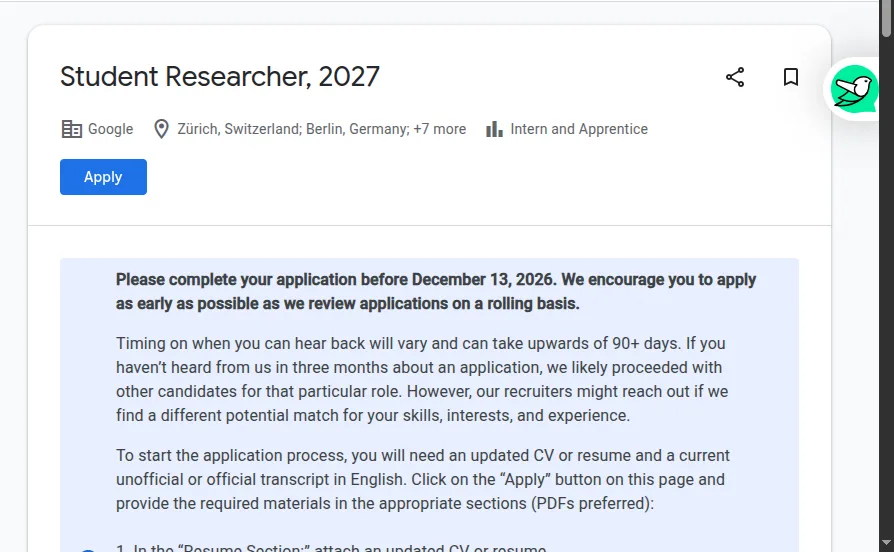
Google's Student Researcher role for 2027 in Europe, the Middle East and Africa is a paid research engagement for students, with applications due before 13 December 2026. The posting covers nine locations — Zürich, Berlin, Munich, Grenoble, Paris, Accra, Amsterdam, Stockholm and London — and places students on research projects across Google's teams, including DeepMind, Google Research and Google Cloud. Applicants must be pursuing a Bachelor's, Master's or PhD and must remain enrolled and located in one of the listed countries for the full engagement.
Quick Facts
| Item | Detail |
|---|---|
| Host | |
| Location | Zürich; Berlin; Munich; Grenoble; Paris; Accra; Amsterdam; Stockholm; London |
| Opportunity type | Paid Student Researcher engagement (research, engineering and science projects) |
| Duration | Variable; part-time to full-time, confirmed with the team |
| Eligibility | Enrolled Bachelor's, Master's or PhD in a listed field; experience in one area of computer science; student status and location maintained |
| Funding | Annual ranges by degree in Germany, France, Sweden and the Netherlands; 0% bonus target; other countries not stated |
| Application status | Open, with rolling review |
| Deadline | 13 December 2026 |
| Official portal | Google Student Researcher 2027 posting |
What the Student Researcher programme is
Google's Student Researcher Program hires students onto research projects aligned with the company's priorities in scientific advancement. The roles sit across research, engineering and science teams, and the work is project-based rather than a fixed rotation. Google describes the projects as exploratory and says they support the creation of breakthrough technologies.
The important distinction is between the Student Researcher role and a conventional research internship. Google says the Student Researcher role offers greater flexibility in weekly time commitment, project duration and onsite or remote options, and that specific arrangements are confirmed at offer stage. A Research Internship is a structured seasonal placement; a Student Researcher engagement can be part-time, can run for a different number of months, and can be shaped around a project.
For 2027, Google says applicants will be considered for Student Researcher positions across all of its research teams, including DeepMind, Google Research, Google Cloud and others. That means you apply once and are matched to a project rather than applying to a named team. It also means the posting is broad: the same application can lead to a machine-learning project, a data-science project or a software-engineering project.
The role is not a route to automatic full-time employment. The posting says participation does not guarantee full-time hiring consideration and directs anyone interested in a permanent role to apply through Google's standard external channels.
The nine locations
The 2027 EMEA posting lists the following locations:
| Country | Location |
|---|---|
| Switzerland | Zürich |
| Germany | Berlin, Munich |
| France | Grenoble, Paris |
| Ghana | Accra |
| Netherlands | Amsterdam |
| Sweden | Stockholm |
| United Kingdom | London |
Applicants can share a preferred location, but the posting makes clear that the role is tied to specific country locations. Google says participants must be located in one of the specific country locations identified for the role for the full duration of the engagement. If you cannot be in one of those countries for the whole project, the role is not open to you.
The list is also a reminder that "EMEA" is not a single market. Pay, visa rules, working hours and holiday entitlement differ by country, and the posting publishes pay for only four of the nine countries. Applicants in Zürich, Accra and London have no published range to work from.
What you would work on
The posting does not list individual projects. Instead it describes the kind of research the programme supports: foundational research in computing, intelligent systems, sustainability, algorithms and AI. The teams involved include Google Research, DeepMind and Google Cloud.
The minimum qualifications give the clearest signal of the technical areas. Google asks for experience in one area of computer science, and gives examples: natural language understanding, human-computer interaction, generative media, computer vision, machine learning, deep learning, algorithmic foundations of optimisation, quantum information science, data science and software engineering.
That list is wide, but it is not generic. A candidate needs a demonstrable specialism, not a general interest in technology. The strongest applications will be able to point to a project, paper, thesis, open-source contribution or internship that shows depth in one of those areas.
Because the role is matched to available projects, the specific work depends on the team. Google says projects vary in duration and time commitment, ranging from part-time to full time. That flexibility is attractive, but it also means you should ask at offer stage what the expected weekly commitment is, how long the project will run, and whether the arrangement is onsite or remote.
Eligibility: must-have and preferred
Google separates minimum from preferred qualifications, and the distinction matters.
Minimum qualifications:
- currently pursuing a Bachelor's, Master's or PhD degree in computer science, linguistics, statistics, biostatistics, applied mathematics, operations research, economics, natural sciences or an equivalent field, or equivalent practical experience;
- experience in one area of computer science, such as those listed above.
Preferred qualifications:
- currently enrolled in a full-time degree programme in EMEA and returning to the programme after the internship;
- experience as a researcher, including internships, full-time roles or lab work;
- experience contributing to research communities, including publishing papers in major conferences or journals;
- experience with one or more general-purpose programming languages such as C/C++, Java, MATLAB, Go or Python.
The preferred list is where most applicants can differentiate themselves. Research experience and publications are not required, but they are named. Programming experience is not framed as a nice-to-have; it is a preferred qualification for a research role, which reflects how much of Google's research involves building and testing systems.
Two further conditions are absolute. Participants must maintain student status for the full duration of the engagement, and they must be located in one of the listed countries. The posting also says individuals applying must hold valid work authorisation or meet local immigration eligibility requirements for their specific work location. Google does not say it sponsors visas for this role, so applicants should check their own right to work in the country before applying.
Pay and compensation
Google publishes annual pay ranges by degree for four countries. The figures are annual, not monthly, and each carries a 0% bonus target.
| Country | Bachelor's | Master's | PhD |
|---|---|---|---|
| Germany | €68,500 | €71,000 | €85,000 |
| France | €53,000 | €54,000 | €66,000 |
| Sweden | kr545,000 | kr560,000 | kr670,000 |
| Netherlands | €68,500 | €71,000 | €86,500 |
The posting does not publish ranges for Switzerland, Ghana or the United Kingdom. It also does not state whether the annual figure is pro-rated for a part-time or short engagement. Google says individual pay is determined by factors including job-related skills, experience and relevant education or training, so the published range is a band, not a guaranteed offer.
The 0% bonus target is explicit. Applicants should not assume a performance bonus on top of the range. The posting also includes standard language about equity grants being discretionary and granted by Alphabet Inc., which is boilerplate rather than a promise of equity for this role.
Because the role can be part-time, the annual range is not a reliable guide to what you would actually earn. A three-month full-time engagement at the Germany bachelor's rate would be roughly a quarter of €68,500 before tax, but Google does not confirm that pro-rating method. Ask for the proposed compensation in writing at offer stage.
How to apply
- Check that the posting is live. The 2027 EMEA posting has a stated deadline of 13 December 2026, but Google reviews applications on a rolling basis and may close the role earlier if projects are filled.
- Prepare a CV or resume. Google asks for an updated CV or resume in the resume section of the application.
- Prepare a transcript. Upload a current or recent unofficial or official transcript in English. Under "Degree Status", select "Now attending" to upload it. PDFs are preferred.
- Choose your location preference. The application lets you share a preferred working location from the listed countries. Be honest about where you can legally work and live for the full engagement.
- Show one area of depth. The minimum qualification is experience in one area of computer science. Make that area obvious in the CV and in any research summary you provide.
- Submit early. Google says it reviews on a rolling basis and encourages early submission. A deadline-day application is technically on time but is competing with a pool that has already been reviewed.
- Wait for a response. Google says timing varies and can take upwards of 90 days. If you have not heard within three months, it likely proceeded with other candidates, though a recruiter may contact you about a different match.
The posting does not ask for a research proposal, a cover letter or reference letters. It asks for a CV and a transcript, and it uses the application form to collect the rest. Do not add documents that are not requested.
Timeline and current status
The 2027 EMEA posting was live on 12 November 2026. The application deadline is 13 December 2026. Review is rolling, and Google warns that the process can take 90 days or more.
There is no published start date. The posting says projects vary in duration and time commitment, and that arrangements are confirmed at offer stage. That is different from a summer internship with a fixed June start. Applicants should be prepared for a start date that depends on the team and the project.
Google does not publish the number of places, the acceptance rate or the number of projects available in each country. The posting is a single application route for multiple teams, and the matching process happens after review.
Selection and what makes a credible application
Google does not publish a scoring rubric for the Student Researcher role. The posting's structure nevertheless shows what the review is likely to weigh.
The first filter is eligibility. Degree level, field, student status, location and work authorisation are binary. An application that fails one of those is unlikely to progress, regardless of the quality of the research record.
The second is evidence of research ability. The preferred qualifications name research experience, publications and lab work. A candidate who has completed a research project, contributed to a paper or built a system that required independent investigation has material to show. A candidate who has only coursework has less, though the minimum qualifications do not require research experience.
The third is technical depth. The minimum qualification asks for experience in one area of computer science, and the examples range from natural language understanding to quantum information science. A CV that lists many languages and frameworks but no depth in a research area is weaker than one that shows a sustained project in one area.
The fourth is fit with Google's current projects. Because the application is pooled across teams, the reviewers are looking for a match between your skills and an available project. That is not fully controllable, but it rewards applicants who make their specialism legible.
What is confirmed and what is not yet announced
Confirmed on Google's official posting as of 12 November 2026:
- the role is Student Researcher, 2027, in EMEA;
- the nine locations are Zürich, Berlin, Munich, Grenoble, Paris, Accra, Amsterdam, Stockholm and London;
- the application deadline is 13 December 2026, with rolling review;
- applicants need a CV and a current or recent unofficial or official transcript in English;
- the minimum qualification is a Bachelor's, Master's or PhD in a listed field plus experience in one area of computer science;
- preferred qualifications include full-time EMEA enrolment, research experience, publications and programming languages;
- participants must maintain student status and be located in a listed country for the full engagement;
- pay ranges are published for Germany, France, Sweden and the Netherlands, with a 0% bonus target;
- responses can take 90 days or more.
Not stated on the official posting:
- pay ranges for Switzerland, Ghana or the United Kingdom;
- whether annual pay is pro-rated for part-time or short engagements;
- the number of places or projects in each country;
- a fixed duration or start date;
- whether Google sponsors visas or work authorisation for this role;
- the exact teams or projects available in 2027.
Sources
- Google Careers, "Student Researcher, 2027," accessed 12 November 2026
- Google Careers, "Student Researcher, BS/MS, Winter-Summer 2027," accessed 12 November 2026
- Google Careers, search results for Student Researcher, accessed 12 November 2026
- Feynman Research Labs, "Google Student Researcher 2027" listing
Keep exploring
The Google Student Researcher BS/MS guide covers the separate US posting for Winter–Summer 2027, which has a much longer window and a different pay range. For a European research placement outside industry, the ECB Student Research Traineeship guide explains a central-bank route, and the research programmes directory groups opportunities by type and country.
Frequently asked questions
- What is the deadline for Google Student Researcher 2027 in EMEA?
- Google asks applicants to complete their application before 13 December 2026. Applications are reviewed on a rolling basis, so Google encourages early submission.
- Which locations are included in the 2027 EMEA posting?
- The posting lists Zürich, Switzerland; Berlin and Munich, Germany; Grenoble and Paris, France; Accra, Ghana; Amsterdam, Netherlands; Stockholm, Sweden; and London, UK.
- Who is eligible for the Google Student Researcher role?
- Applicants must be pursuing a Bachelor's, Master's or PhD in computer science, linguistics, statistics, biostatistics, applied mathematics, operations research, economics, natural sciences or an equivalent field, and have experience in one area of computer science. They must maintain student status and be located in one of the listed countries for the full engagement.
- How much does a Google Student Researcher earn in 2027?
- The posting publishes annual ranges by degree for four countries. In Germany: €68,500 for bachelor's, €71,000 for master's and €85,000 for PhD. France: €53,000, €54,000 and €66,000. Sweden: kr545,000, kr560,000 and kr670,000. Netherlands: €68,500, €71,000 and €86,500. All carry a 0% bonus target.
- Does the posting state pay for Switzerland, Ghana or the UK?
- No. The 2027 EMEA posting publishes ranges for Germany, France, Sweden and the Netherlands only. It does not state pay for Zürich, Accra or London.
- Do I need to be a student to apply?
- Yes. The role is for students enrolled in an accredited Bachelor's, Master's or PhD programme in the EMEA region, and participants must maintain student status for the full duration of the engagement.
- How long does the role last?
- Google says projects vary in duration and time commitment, ranging from part-time to full time. The posting does not specify a fixed length; the arrangement is confirmed with the team.
- How long does Google take to respond?
- Google says timing varies and can take upwards of 90 days. If you have not heard within three months, it likely proceeded with other candidates, though recruiters may contact you about a different match.
Official application link
Open Google's official Student Researcher 2027 posting
The posting closes on 13 December 2026 and applications are reviewed on a rolling basis. Check that the role is still live before applying.
Open official page

