
Academic guides · Guide
Google Student Researcher BS/MS 2027: US Pay, Timeline, and Eligibility
StatusOpen
Google's BS/MS Student Researcher posting for Winter–Summer 2027 stays open until 16 July 2027, but most projects are for PhD students. Here is what BS/MS applicants face.
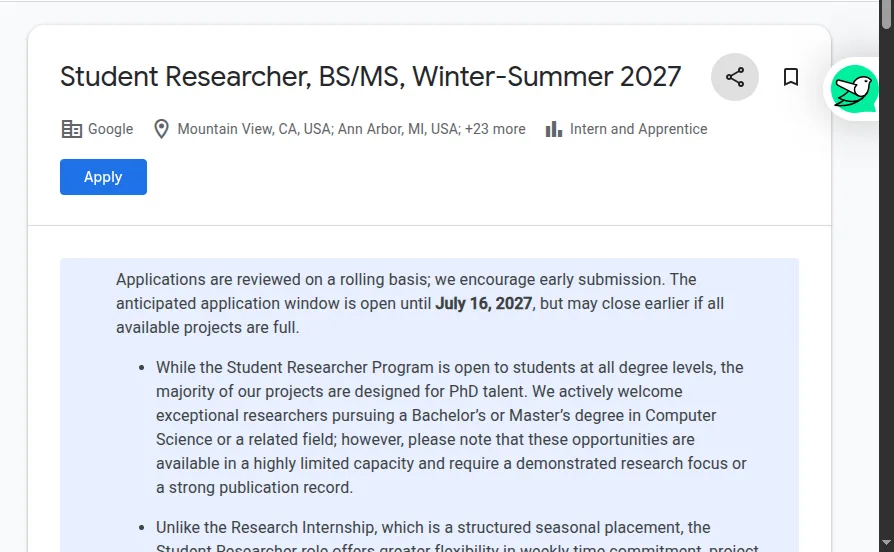
Google's Student Researcher posting for BS/MS students in Winter–Summer 2027 is open until 16 July 2027, but the title is misleading in one important respect: Google says the majority of projects are designed for PhD talent, and bachelor's and master's places are "available in a highly limited capacity." The role pays $98,000 to $131,000 per year in the United States with a 0% bonus target, starts between January and August 2027, and requires applicants to be located in the US for the full engagement.
Quick Facts
| Item | Detail |
|---|---|
| Host | |
| Location | 25 US locations, from Mountain View and Ann Arbor to New York and Washington, D.C.; Playa Vista possible |
| Opportunity type | Paid Student Researcher engagement (research, engineering and science) |
| Duration | Variable; start dates typically January–August 2027 |
| Eligibility | Enrolled Bachelor's or Master's in a listed technical field; experience in one area of computer science; located in the US |
| Funding | $98,000–$131,000 per year in the US; 0% bonus target; pro-rating not stated |
| Application status | Open, rolling review, may close early |
| Deadline | 16 July 2027 (anticipated window) |
| Official portal | Google BS/MS Student Researcher 2027 posting |
What this posting actually is
The Student Researcher Program hires students onto research projects aligned with Google's priorities. The work is project-based, sits across research, engineering and science teams, and is matched after you apply rather than being tied to a named team at the point of application. Google says applicants are considered for positions across all of its research teams, including DeepMind, Google Research and Google Cloud.
The BS/MS label describes the minimum degree level, not a separate programme. The posting says the Student Researcher Program is open to students at all degree levels, then adds the caveat that most projects are designed for PhD talent. Bachelor's and master's students are welcome, but Google describes the opportunities as highly limited and says they require a demonstrated research focus or a strong publication record.
That single paragraph should shape how you read the rest of the posting. A BS/MS student is not applying to a programme with a guaranteed cohort of bachelor's and master's interns. They are applying into a pool where most successful candidates are likely to be doctoral students, and where the evidence bar for a non-PhD candidate is therefore higher.
The posting also says the role is intended for students who will continue their academic studies, and that participation does not guarantee automatic full-time hiring consideration. Anyone who wants a permanent role at Google afterwards must apply through the standard external channels.
The scarcity problem
Most internship postings hide the odds. This one states them. "Highly limited capacity" and "majority of our projects are designed for PhD talent" are unusually direct warnings, and they should change an applicant's strategy in three ways.
First, a BS/MS applicant needs research evidence that can compete with doctoral work. That does not necessarily mean a PhD-level publication, but it does mean something more than coursework: a thesis, a lab project, a conference paper, a preprint, a substantial open-source research contribution or a research internship with a named output.
Second, the application should make the research focus legible immediately. Google asks for a CV that includes the anticipated graduation date and says highlighting publications, specialised lab work or significant research contributions is highly recommended for BS/MS applicants. That is a strong hint that the review is looking for a research identity, not a list of technologies.
Third, the timing matters. The window is long, but review is rolling and projects are approved on an ongoing basis. Applying early puts an application into the pool before places are filled. Applying in July, when the window is about to close, is the weakest position.
Locations
The posting lists 25 US locations:
Mountain View, CA; Ann Arbor, MI; Atlanta, GA; Austin, TX; Boulder, CO; Cambridge, MA; Chicago, IL; Houston, TX; Irvine, CA; Kirkland, WA; Los Angeles, CA; Madison, WI; New York, NY; Palo Alto, CA; Princeton, NJ; Pittsburgh, PA; Raleigh, NC; Durham, NC; Goleta, CA; San Bruno, CA; Seattle, WA; San Francisco, CA; San Jose, CA; Sunnyvale, CA; and Washington, D.C.
It also says the role may be located at Google's Playa Vista, California campus. Applicants can share a preferred location, but the posting is clear that participation requires being located in the United States for the duration of the engagement. Select remote arrangements from within the United States or Canada may be permitted depending on project requirements, and candidates residing in other countries must relocate.
That last point is a hard constraint. This is not a remote-first global role. If you are studying outside the US and cannot relocate, the posting is not aimed at you.
What you would work on
The posting does not list specific projects. It describes the programme as research on real-world, large-scale problems, with projects that vary in duration and location based on team and student requirements. The teams include Google Research, DeepMind and Google Cloud.
The minimum qualifications name the technical areas: natural language understanding, human-computer interaction, computer vision, machine learning, deep learning, algorithmic foundations of optimisation, quantum information science, data science, software engineering and similar areas. The list is broad, but the requirement is depth in one area rather than familiarity with all of them.
Because the role is matched to available projects, the actual work depends on the team. A student matched to a research team may work on model development, evaluation or data analysis; a student matched to an engineering team may build tools or infrastructure for research. The posting says specific work arrangements and timelines are confirmed at offer stage, so applicants should ask what the project is, who the mentor is and what the expected output is before accepting.
Eligibility: minimum and preferred
Minimum qualifications:
- currently enrolled in a Bachelor's or Master's degree in computer science, linguistics, statistics, biostatistics, applied mathematics, operations research, economics, natural sciences or a related technical field;
- experience in one area of computer science, such as those listed above.
Preferred qualifications:
- currently enrolled in a PhD programme in a listed field;
- currently enrolled in a full-time degree programme and returning to it after the internship;
- currently attending a degree programme in the United States;
- experience as a researcher, including internships, full-time roles or lab work;
- experience contributing to research communities, including publishing papers in major conferences or journals;
- experience with one or more general-purpose programming languages such as Python, Java, JavaScript, C or C++.
The preferred list is revealing. A PhD enrolment is preferred even for a posting labelled BS/MS. A US degree programme is preferred. Research experience and publications are preferred. The message is that the strongest BS/MS applicant looks, as far as possible, like a research student with a track record.
The posting also requires participants to be located in the US for the full duration, with limited remote arrangements possible from within the US or Canada. Work authorisation is not discussed in the same detail as the EMEA posting, but applicants should still confirm their right to work in the US before applying.
Pay and benefits
The posting lists a US pay range of $98,000 to $131,000 per year, with a 0% bonus target. The range is annual, and the posting does not state whether it is pro-rated for a part-time or short engagement. Google says individual pay is determined by factors including job-related skills, experience and relevant education or training.
The annual figure is high relative to many internships, but it is not a promise of a full year of work. Student Researcher engagements vary in duration, and a three-month placement at an annualised $98,000 would not pay $98,000. Applicants should ask for the proposed compensation and the expected duration in writing before accepting.
The posting also lists benefits available to eligible US-based interns:
- health, dental and vision insurance;
- sick time of 40 hours per year, increased to 69 hours per year for Seattle, including five discretionary sick days per instance;
- 13 paid holidays per year.
The posting does not list housing support, relocation assistance, a travel allowance or a signing bonus. It also does not state whether the role includes equity; the standard Google language about discretionary equity grants is boilerplate and should not be read as a promise.
How to apply
- Check the posting is live. The anticipated window is open until 16 July 2027, but Google may close it earlier if all projects are full.
- Update your CV with your graduation date. Google requires an anticipated graduation date in MM/YY format. A CV without it is incomplete.
- Attach a transcript. Provide a current unofficial or official transcript in English. PDF is preferred.
- Foreground your research. Google says highlighting publications, specialised lab work or significant research contributions is highly recommended for BS/MS applicants. Put the research near the top, not buried under coursework.
- Show depth in one area of computer science. The minimum qualification is experience in one area, not breadth across many. Name the area and give evidence.
- Choose your location preferences honestly. You must be in the US for the full engagement. Select locations where you can realistically live and work.
- Submit early. Review is continuous and projects are approved on an ongoing basis. Early applications are seen before places fill.
- Prepare for a wait. Google says application review may take several months and that it will contact you directly if your application is selected to advance.
The posting asks for a CV and a transcript. It does not ask for a cover letter, a research proposal or reference letters. The research focus can be conveyed through the CV and the application form.
Timeline and current status
The posting was live on 12 November 2026. The window is expected to remain open until 16 July 2027, but Google says it may close earlier if all available projects are full. Start dates are typically between January and August 2027.
That creates an unusual situation: the application window extends well past the start dates it serves. A candidate who applies in June 2027 is applying for a role that may have started months earlier or may start almost immediately. The practical advice is to apply as early as possible, especially for a BS/MS candidate competing for a small number of places.
Google does not publish the number of BS/MS places, the number of projects, or the acceptance rate. It does not publish a decision timeline beyond saying review may take several months.
Selection: how to compete as a BS/MS applicant
The posting's own language sets the standard. BS/MS opportunities are highly limited and require a demonstrated research focus or a strong publication record. That is the bar.
A demonstrated research focus can take several forms. A senior thesis or master's dissertation with a clear question, method and result is strong evidence. A conference paper, workshop paper or preprint is stronger. A research internship with a named output, such as a report, a dataset or a tool, is useful. A substantial contribution to an open-source research project can also count if it shows independent technical work.
A strong publication record is the alternative route. Google does not define "strong", but the preferred qualifications mention papers in major conferences or journals. A first-author paper at a recognised venue is the clearest signal; a co-authored paper or a workshop paper is weaker but still relevant.
Beyond research evidence, the application should show technical ability. Programming experience is a preferred qualification, and research projects in computer science usually require it. A CV that lists languages without projects is less convincing than one that shows what you built and why.
Finally, the location constraint is part of selection. A candidate who cannot be in the US for the full engagement is not eligible, regardless of research record. Make that clear in the application rather than leaving the reviewer to guess.
What is confirmed and what is not yet announced
Confirmed on Google's official posting as of 12 November 2026:
- the role is Student Researcher, BS/MS, Winter–Summer 2027, in the United States;
- the anticipated application window is open until 16 July 2027, with rolling review and possible early closure;
- the posting lists 25 US locations and says Playa Vista may also be possible;
- participants must be located in the US for the full engagement, with limited remote arrangements possible from within the US or Canada;
- start dates are typically between January and August 2027;
- the minimum qualification is enrolment in a Bachelor's or Master's in a listed technical field plus experience in one area of computer science;
- preferred qualifications include PhD enrolment, a US degree programme, research experience, publications and programming;
- most projects are designed for PhD talent, and BS/MS places are highly limited;
- the US pay range is $98,000–$131,000 per year with a 0% bonus target;
- benefits include health, dental and vision insurance, sick time and 13 paid holidays.
Not stated on the official posting:
- the number of BS/MS places or projects;
- whether the annual pay range is pro-rated for part-time or short engagements;
- the exact duration of a typical engagement;
- whether housing, relocation or travel support is provided;
- whether equity is included;
- the specific teams or projects available;
- a fixed decision date.
Sources
- Google Careers, "Student Researcher, BS/MS, Winter-Summer 2027," accessed 12 November 2026
- Google Careers, "Student Researcher, 2027," accessed 12 November 2026
- Google Careers, search results for Student Researcher, accessed 12 November 2026
- Feynman Research Labs, "Google Student Researcher BS/MS 2027" listing
Keep exploring
The Google Student Researcher 2027 EMEA guide covers the separate European posting, which closes on 13 December 2026 and publishes pay for four countries. If you are weighing a research internship against a graduate programme, the Stanford CISAC fellowship guide shows how a longer residential fellowship is structured, and the research programmes directory groups opportunities by type and country.
Frequently asked questions
- What is the application window for Google's BS/MS Student Researcher 2027?
- Google says the anticipated window is open until 16 July 2027, but it may close earlier if all available projects are full. Applications are reviewed on a rolling basis and Google encourages early submission.
- Is the BS/MS Student Researcher role only for bachelor's and master's students?
- No. The posting is open to students at all degree levels, but Google says the majority of projects are designed for PhD talent. Bachelor's and master's opportunities are available in a highly limited capacity and require a demonstrated research focus or a strong publication record.
- How much does the BS/MS Student Researcher role pay?
- The US posting lists a range of $98,000 to $131,000 per year with a 0% bonus target. The posting does not state whether the figure is pro-rated for a part-time or short engagement.
- Where are the 2027 BS/MS locations?
- The posting lists 25 US locations, including Mountain View, Ann Arbor, Atlanta, Austin, Boulder, Cambridge, Chicago, Houston, Irvine, Kirkland, Los Angeles, Madison, New York, Palo Alto, Princeton, Pittsburgh, Raleigh, Durham, Goleta, San Bruno, Seattle, San Francisco, San Jose, Sunnyvale and Washington, D.C. It says the role may also be located at the Playa Vista campus.
- Do I have to be in the United States?
- Yes. Google says participants must be located in the United States for the duration of the engagement. Select remote arrangements from within the United States or Canada may be permitted depending on project requirements, and candidates in other countries must relocate.
- When do the 2027 roles start?
- Google says start dates are typically between January and August 2027.
- What documents do I need?
- An updated CV or resume that includes your anticipated graduation date in MM/YY format, and a current unofficial or official transcript in English, with PDF preferred. Google says highlighting publications, specialised lab work or significant research contributions is highly recommended for BS/MS applicants.
- Do I need publications to apply?
- They are not a minimum qualification, but Google says BS/MS opportunities require a demonstrated research focus or a strong publication record because the number of places is highly limited. Research experience and publications are also listed as preferred qualifications.
Official application link
Open Google's official BS/MS Student Researcher posting
The window runs until 16 July 2027 but may close earlier if projects fill. Check that the posting is still live before applying.
Open official page

