
Academic guides · Guide
RIPS 2026 Los Angeles: IPAM Industrial Maths Research Guide
StatusClosed
RIPS-LA 2026 placed undergraduate teams on industry-sponsored maths projects at UCLA from 22 June to 21 August. That round is closed; RIPS 2027 runs 21 June to 20 August 2027.
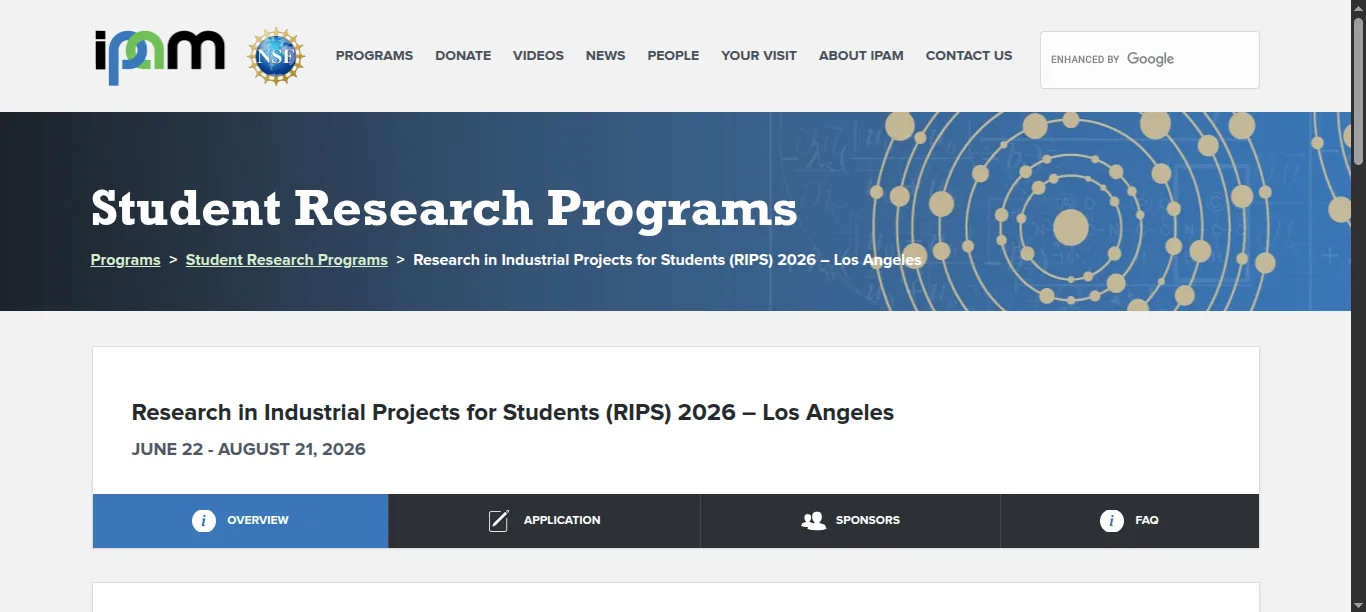
RIPS-LA 2026 was the Los Angeles edition of IPAM's Research in Industrial Projects for Students, a nine-week summer programme in which undergraduate teams solve problems proposed by industry or public-sector sponsors. It ran from 22 June to 21 August 2026 on the UCLA campus, and that round is now closed: the deadline was 10 February 2026, and IPAM's application tab states that applications are closed. IPAM has already published a RIPS 2027 Los Angeles page for 21 June to 20 August 2027, but gives the next deadline only as February 2027.
Quick Facts
| Item | Detail |
|---|---|
| Host | Institute for Pure and Applied Mathematics (IPAM), University of California, Los Angeles |
| Location | UCLA campus, Los Angeles, California |
| Opportunity type | Team-based research placement on industry-sponsored mathematics projects |
| Duration | 22 June – 21 August 2026 (nine weeks); RIPS 2027 runs 21 June – 20 August 2027 |
| Eligibility | Age 18+; enrolled in or just completed a bachelor's degree; international students only if studying in the US |
| Funding | Stipend, travel allowance, housing in UCLA residence halls and most meals; stipend amount not stated |
| Application status | Closed for 2026; RIPS 2027 page published with a February 2027 deadline |
| Deadline | 10 February 2026 (closed); February 2027 for the next round, exact date not given |
| Official portal | https://www.ipam.ucla.edu/programs/student-research-programs/research-in-industrial-projects-for-students-rips-2027-los-angeles/ |
What RIPS is
IPAM is a National Science Foundation institute for pure and applied mathematics based at UCLA. It runs several versions of RIPS: Los Angeles and Singapore for undergraduates, and GRIPS in Berlin and Sendai for graduate students. The Los Angeles edition is the oldest and the one this guide covers.
RIPS is not a conventional academic summer research placement. Each team works on a problem supplied by a company or public-sector sponsor, with support from two mentors: an academic mentor, often a UCLA mathematics postdoc, and an industry mentor from the sponsoring organisation. The team researches the problem, writes a formal final report for the sponsor, and presents results orally at the end of the programme.
IPAM describes RIPS as a cross between an REU — a US Research Experiences for Undergraduates placement — and an internship. The distinction is structural: the projects come from outside academia, so the work is judged by whether it answers a sponsor's question rather than by whether it advances a research field. IPAM notes that some teams later publish their results or present them at national conferences, but that is not the programme's purpose.
Students live, work and socialise together for the summer. IPAM provides an office with a computer and meeting space, technical support, daily tea time and occasional guest lectures. Participants stay in university housing within walking distance of IPAM and eat most meals on campus.
How the nine weeks are structured
IPAM says the last two weeks of the programme are devoted to the final report and presentation, culminating in "Projects Day" and a site visit to the sponsor's office, laboratory or facility. That leaves roughly seven weeks for the research itself, including a midterm presentation.
One student on each team serves as project manager. The role includes leading team discussions, coordinating individual efforts, monitoring progress against milestones, and communicating with the industry sponsor and the RIPS director. The director and the academic mentor choose the project manager during the first week, so it is not an application-time role.
There are no classes. IPAM is explicit that the focus is entirely on the research projects and on presenting the results. That makes RIPS different from a summer school with a research component: there is no taught curriculum to fall back on, and the team is expected to find the methods its problem requires.
The programme is also explicitly careers-oriented. IPAM lists four things participants gain: experience applying mathematics to a real-world industrial problem, team working experience, exposure to careers in mathematics, science and technology, and report-writing and public-presentation skills. The industry mentor is the main route to understanding the sponsoring company's work.
What you would work on
IPAM does not publish a project catalogue in advance. For 2026 it said it expected nine projects, while noting that the sponsors and projects were not yet finalised. The 2027 page repeats the expectation of nine projects and the same caveat.
What is published is the shape of the work rather than its content. Projects are proposed by sponsors from industry or the public sector, and each team researches the problem and presents results in writing and orally. IPAM says most projects have a significant computational component, which is why experience in computer science, data analysis or numerical computation is described as valuable.
The mathematical range is correspondingly broad. IPAM says the backgrounds of successful applicants vary considerably, and that most have taken some upper-division mathematics and some computer programming classes. Because students work in teams, IPAM says a gap in one member's background can be covered by another member, and the courses an applicant has taken are used to decide which project suits them.
Applicants should not expect to choose a project from a list. The matching is done by IPAM using the application materials, and the sponsor set is settled after the application cycle. That is a material difference from programmes where you apply to a named supervisor.
Eligibility and requirements
The eligibility rules are few but specific, and one of them excludes most international applicants.
| Requirement | Detail |
|---|---|
| Age | At least 18 |
| Enrolment | Enrolled in, or just completed, an undergraduate bachelor's degree |
| Graduating seniors | Eligible |
| Recent graduates | For 2026, degrees received no earlier than December 2025 |
| International students | Eligible only if currently studying in the United States |
| Students at foreign universities | Not eligible |
| Preparation | Strong mathematics background; some upper-division mathematics and programming expected |
The international rule is the one to read carefully. IPAM's overview says foreign students are eligible only if studying in the US, and the FAQ states plainly that foreign students not currently studying in the US are not eligible for RIPS. An international student already enrolled at a US university may apply, and will most likely need Curricular Practical Training from the institution sponsoring their F1 visa. IPAM notes that this usually requires registering for an internship or independent study course, and that Optional Practical Training is occasionally possible but the applicant must confirm compliance with US government guidelines.
The recent-graduate rule is time-bound. For RIPS 2026, IPAM accepted applicants who completed their bachelor's degree between December 2025 and June 2026. The 2027 FAQ page still carries the 2026 wording, referring to December 2025, which is a copy-forward rather than a statement about the 2027 cycle. Applicants for 2027 should treat the December-to-June pattern as the likely rule but confirm the year with IPAM.
IPAM does not publish a minimum GPA, a required major or a language test requirement. It asks for a strong background in mathematics and an interest in seeing how mathematics is used in the real world. The FAQ adds that competition is high for the limited slots available.
Funding, stipend and costs
IPAM publishes the components of the package but not the amounts.
| Item | What IPAM provides |
|---|---|
| Stipend | Paid to each participant; amount not stated |
| Travel | Airfare or mileage reimbursement to IPAM, subject to rules and limits |
| Housing | UCLA residence halls, within walking distance of IPAM |
| Meals | Most meals on campus |
| Site visit | Visit to the sponsor's office, laboratory or facility, subject to confirmation |
| Application fee | Not stated on the programme page |
The stipend figure is genuinely absent from both the 2026 and 2027 Los Angeles pages. This guide does not supply a number from an older cycle, because stipend levels change and a figure from a previous year would be misleading. Applicants who need the amount before applying should email rips@ipam.ucla.edu, which is the contact address IPAM publishes on the application tab.
The travel allowance is reimbursement rather than a booked ticket, and IPAM qualifies it as subject to rules and limits. Housing and most meals are provided in kind rather than as cash, so the stipend is best understood as spending money rather than as the full value of the package.
There is no indication of a programme fee. The costs an intern is most likely to bear are those outside the package: transport within Los Angeles, meals not covered on campus, and incidental expenses during the nine weeks.
How to apply
RIPS applications run through MathPrograms, the American Mathematical Society's application platform, rather than through a UCLA portal. The 2026 process is the best available guide to the 2027 one, because IPAM has not yet published a 2027 application tab.
- Check the eligibility year. Confirm that you are enrolled in an undergraduate degree or have just completed one, that you meet the age requirement, and — if you are not a US citizen — that you are studying at a US university.
- Prepare a CV. The application form asks you to upload a resume or CV and your transcript or transcripts.
- Obtain a transcript. It can be unofficial, but it must list your classes and grades. If your school issues protected PDFs that fail to upload, print the file, scan it, and upload the scan.
- Enter your referees in MathPrograms. You provide names and email addresses, and the system sends automatic requests on your behalf. You can track when each letter is uploaded. All materials, including letters, must arrive by the deadline.
- Submit, then return if needed. IPAM allows you to submit the application and come back later to upload the CV or transcript, which is useful if a document is delayed.
- Watch for the deadline. For 2026 it was 10 February, and IPAM required every item, including recommendation letters, by that date. The 2027 page gives only "February 2027".
- Prepare for a possible CPT application. International students at US universities should speak to their international student office before applying, because CPT approval may depend on registering for an internship course.
The application does not ask for a research proposal. That is consistent with the programme's design: IPAM matches students to sponsor projects rather than asking them to propose one. The materials that matter are the academic record, the CV and the references.
Timeline and current status
As of 12 November 2026, RIPS-LA 2026 is over. It ran from 22 June to 21 August 2026, and the application tab now reads "Applications are now closed."
The next cycle is already visible. IPAM's student research programmes page says the application process begins in November for the following summer, and a RIPS 2027 Los Angeles page is live with dates of 21 June to 20 August 2027. The deadline on that page is given only as February 2027, with no day.
| Date | What happens |
|---|---|
| November 2026 | Application process expected to begin for summer 2027 |
| February 2027 | RIPS 2027 deadline, exact date not published |
| 21 June 2027 | RIPS 2027 Los Angeles begins |
| 20 August 2027 | RIPS 2027 Los Angeles ends |
One scheduling point is easy to miss. IPAM warns that the Los Angeles and Singapore programmes have different dates. RIPS Singapore 2027 runs from 18 May to 16 July 2027, more than a month earlier than Los Angeles, so an applicant considering both should not assume they can move between them.
Selection and what makes a credible application
IPAM does not publish selection criteria, an acceptance rate or the number of applicants. It says only that competition is high for the limited slots available.
The published guidance points to three things. First, mathematical preparation: most successful applicants have taken upper-division mathematics and some programming, and IPAM uses completed courses to decide which project fits. Second, breadth within a team: because students work in teams, IPAM is not looking for nine identical profiles, and an applicant with strong computation but less abstract mathematics can be a good match for a computationally heavy project.
Third, the programme selects for people who want to see mathematics used outside academia. IPAM's description emphasises problem solving "using whatever methods are appropriate," team work, client-facing report writing and presentation. An application that reads as preparation for a pure mathematics PhD is not wrong, but it misses the programme's stated purpose.
The reference letters carry weight because they are the only external assessment in the file. IPAM does not prescribe what referees should address, so it is worth asking them to speak to mathematical ability, independence and capacity to work in a team.
There is also a practical signal in the FAQ: IPAM asks applicants to clarify CPT eligibility with their international student office before applying. An international applicant who has not done that is taking a risk that the programme explicitly flags.
What is confirmed and what is not yet announced
Confirmed for 2026: the 22 June to 21 August dates, the 10 February deadline, the nine-project expectation, the stipend, travel allowance, housing and meals package, the 18+ age rule, the undergraduate enrolment rule, and the exclusion of students at universities outside the US. Confirmed for 2027: the 21 June to 20 August dates and a February 2027 deadline.
Not announced: the exact 2027 deadline day, the stipend amount, the 2027 sponsor list and project descriptions, the number of places, and whether the recent-graduate cut-off will move to December 2026. The 2027 FAQ page still contains 2026 wording about December 2025 degrees, so that page has not been fully updated. IPAM's statement that it expects nine projects is also an expectation rather than a commitment, since the page says the sponsors and projects are not yet finalised.
Sources
- IPAM, "Research in Industrial Projects for Students (RIPS) 2026 – Los Angeles," accessed 12 November 2026
- IPAM, RIPS 2026 Los Angeles FAQ, accessed 12 November 2026
- IPAM, "Research in Industrial Projects for Students (RIPS) 2027 – Los Angeles," accessed 12 November 2026
- IPAM, Student Research Programs overview, accessed 12 November 2026
- IPAM, RIPS 2026 Los Angeles application tab, accessed 12 November 2026
Keep exploring
For a European programme built around individual research projects rather than industry teams, the DESY summer student programme guide covers a laboratory placement in Germany. The NIST SURF guide explains a US federal fellowship with a published stipend. The research programmes directory groups opportunities by type.
Frequently asked questions
- Is RIPS 2026 Los Angeles still open for applications?
- No. IPAM's application tab for RIPS-LA 2026 states that applications are now closed. The 2026 deadline was 10 February 2026, and all materials including letters of recommendation had to arrive by that date.
- When is RIPS 2027 Los Angeles?
- IPAM's RIPS 2027 Los Angeles page lists the programme as running from 21 June to 20 August 2027. It gives the application deadline only as February 2027, without an exact date.
- How much does RIPS pay?
- IPAM confirms that participants receive a stipend, a travel allowance, housing in UCLA residence halls and most meals on campus. The stipend amount is not stated on the RIPS 2026 or RIPS 2027 Los Angeles pages.
- Who is eligible for RIPS Los Angeles?
- Applicants must be at least 18 and enrolled in, or have just completed, an undergraduate bachelor's degree. Graduating seniors are eligible. International students are eligible only if they are currently studying in the United States.
- Can students at universities outside the US apply to RIPS-LA?
- No. IPAM states that foreign students not currently studying in the US are not eligible for RIPS. International students already studying at a US university may apply, and will most likely need Curricular Practical Training from their home institution.
- Do I need a computer science background for RIPS?
- No, but it helps. IPAM says most projects have a significant computational component, so experience in computer science, data analysis or numerical computation is valuable but not necessary for every team member.
- How many projects does RIPS-LA run?
- IPAM said it expected nine projects for RIPS 2026, while noting that the sponsors and projects were not yet finalised. The RIPS 2027 page repeats the expectation of nine projects, again subject to confirmation.
- Is RIPS the same as an REU?
- Not exactly. IPAM describes RIPS as a cross between an REU and an internship: the projects come from industry or the public sector rather than from academic research groups, and students work in teams with both an academic mentor and an industry mentor.
Official application link
Check the official IPAM RIPS page
RIPS 2026 is closed. The RIPS 2027 Los Angeles page is live for 21 June to 20 August 2027, but IPAM gives the deadline only as February 2027.
Open official page

