
Academic guides · Guide
Vector Institute Student Programmes: Scholarships, Internships and Networking
StatusOpen
Vector Institute's student hub covers a $21,000 AI master's scholarship, paid research and applied internships, a graduate supervisor programme, and Toronto networking events.
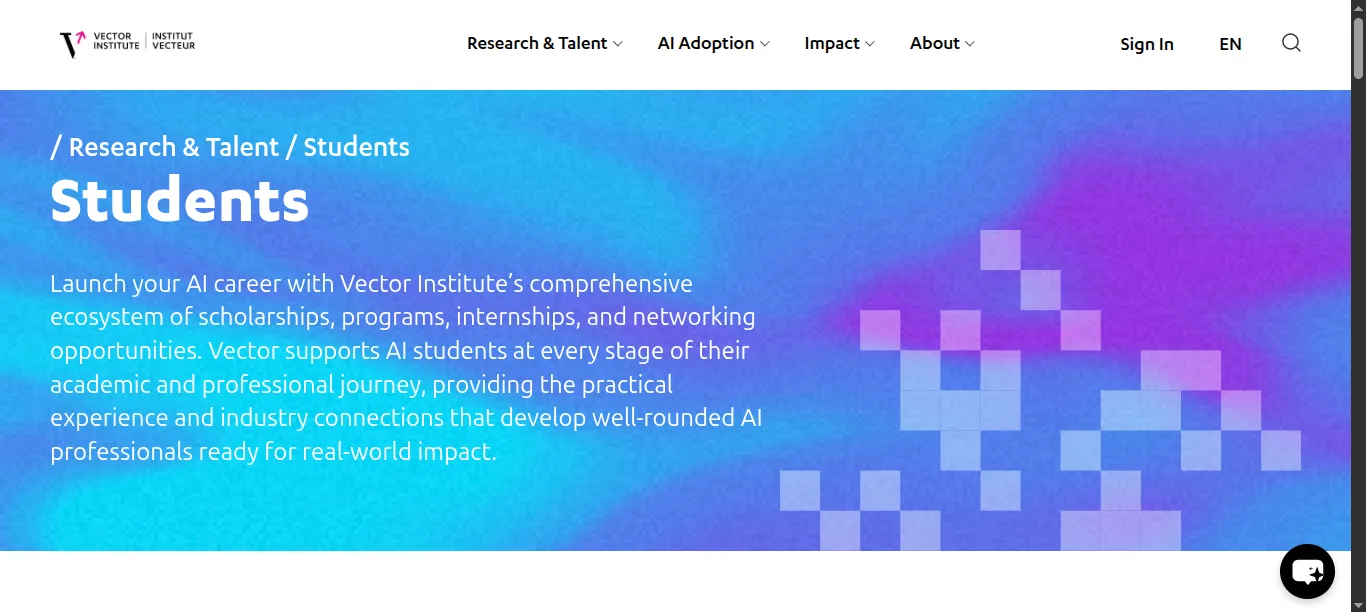
Vector Institute's student hub is a portfolio, not a single opportunity. It brings together a $21,000 entrance scholarship for AI master's students at Ontario universities, a graduate student programme that connects applicants with Vector faculty, paid research and applied internships, a four-month machine learning associates programme, and a set of Toronto networking events. The scholarship nomination window for 2027-28 runs from 4 January to 17 March 2027; the research and applied internships are currently closed.
The short answer
If you are an incoming AI master's student at an Ontario university, the relevant route is the Vector Scholarship in AI: $21,000, awarded through programme nomination, with a 17 March 2027 deadline. If you are looking for a supervisor for a master's or PhD, the Graduate Student Program is free and open, with a recommended submission date of 23 October 2026 and a portal closing on 15 January 2027. If you want a paid internship, the research internships are closed until the Summer 2027 cycle, and the applied internships are closed now. Vector is not a degree-granting institution; every academic route still runs through a university.
Quick Facts
| Item | What the official pages say as of 12 November 2026 |
|---|---|
| Host | Vector Institute |
| Location | Toronto, Ontario, Canada; some internships are remote or hybrid |
| Opportunity type | Hub of scholarships, internships, graduate supervision and networking |
| Duration | Varies: master's programme length, four months for MLA, 16 to 32 weeks for applied internships |
| Eligibility | Varies by programme; AI students at undergraduate, master's and PhD level |
| Funding | $21,000 scholarship; $32/hour applied internships; $25/hour MLA; research internships paid but rate not stated |
| Application status | Scholarship nominations open 4 January 2027; graduate programme open; internships closed |
| Deadlines | 17 March 2027 for scholarship nomination; 15 January 2027 for graduate portal |
| Official portal | Vector Institute Students |
What Vector Institute is
Vector Institute is an AI research institute headquartered in Toronto. Its student page describes "a comprehensive ecosystem of scholarships, programs, internships, and networking opportunities" and says Vector supports AI students "at every stage of their academic and professional journey". It works with faculty at universities across Canada and with industry partners.
The institute is not a university. The Graduate Student Program page states plainly: "the Vector Institute is not a degree-granting institution". If a Vector faculty member expresses interest in supervising you, you still apply to and are admitted by that person's university.
That structure explains the shape of the hub. The scholarship is an entrance award administered through university master's programmes, the graduate programme is a matching service, the internships are paid roles on Vector projects or with partners, and the networking events are open to students in Vector's ecosystem.
The Vector Scholarship in AI
The Vector Scholarship in AI is a $21,000 entrance award for students pursuing AI master's programmes in Ontario. It is not a research grant and not a general scholarship: it is awarded to incoming master's students who are nominated by their programme.
Who it is for. Nominees must be entering a full-time master's programme in an AI-related field at an Ontario university in the 2027-28 academic year. Start dates in Spring 2027, Fall 2027, or Winter 2028 are eligible. The programme must be Vector-recognised, or the student must be pursuing an individually approved study plan that is demonstrably AI-focused.
Academic threshold. Nominees must hold first-class standing, normally A- or equivalent, in the last two years of full-time equivalent study at a recognised university, typically 20 half-courses. The page says consideration will be given to nominees with upper second-class standing (B+) and relevant work experience, but only if the nomination package includes a written rationale.
Nomination, not application. Students cannot apply directly and cannot nominate themselves. An Ontario university master's programme submits the nomination. The 2027-28 nomination period is 4 January to 17 March 2027, and there is one nomination period per year. Programmes may set internal deadlines earlier than 17 March, so prospective nominees should tell their programme office of their interest as soon as they apply.
Package. The nomination package includes up-to-date transcripts, two references with at least one academic referee using the Referee Form, a one- to two-page CV, a 500-word statement on why the student is pursuing a master's in AI, relevant experience and career aspirations, and a self-identification questionnaire. If the programme is not Vector-recognised, a signed study plan with a course list and thesis or capstone description is also required.
Conditions. The scholarship is non-transferable. Recipients must register at the Ontario university and programme that nominated them. The funds are provided to the university, which disburses them to the recipient. A recipient may hold the Vector Scholarship and an Ontario Graduate Scholarship or a CGS-M simultaneously.
The page reports that more than 800 students have received the scholarship. It also reports that 1,010 new AI master's graduates came from Vector-recognised programmes in 2024-25, and that 17,196 AI jobs were created in Ontario in 2024-25. Those figures come from Vector's Ontario AI snapshot and annual report, not from the scholarship selection data.
The Graduate Student Program
The Graduate Student Program is a matching route for master's and PhD applicants. Vector faculty review applications from research-aligned candidates and contact those who are the strongest fit.
Who it is for. The programme is open to domestic and international students who are completing an undergraduate degree and intend to pursue a master's, or completing a master's and intend to pursue a PhD.
What it offers. Students in Vector's ecosystem get community and events, compute resources depending on research needs, desk space at Vector's Toronto hub when in the city, and connections to industry partners through the Talent Hub and career programming.
Documents. A complete application includes transcripts from undergraduate and graduate study, an academic CV of one to two pages, a research statement of one to two pages describing research experience, key questions, interest in specific faculty, and significant publications or projects, and contact details for two to three referees. At least two referees should be at the level of independent investigator, principal scientist, group leader, lecturer, or above. Referees upload a signed letter on institutional letterhead within two weeks of the application.
Faculty preferences. Applicants select up to five Vector faculty members or affiliates. The page warns that applying does not guarantee contact, an interview, supervision, funding, or admission. Faculty participation varies by year, research interests, funding, and capacity.
Timeline. Applications are open. Vector recommends submitting before 23 October 2026 at 12 p.m. ET for full consideration across participating faculty. Applications are released to faculty from November, and prospective students may hear from faculty as early as December. The portal remains open until 15 January 2027, but university deadlines may be earlier and are not aligned with Vector's timeline.
Cost. Submitting an application to Vector is free. University application fees are separate and paid directly to the university.
AI Research Internships
Vector's AI Research Internships are paid roles with Vector faculty members and top AI researchers. The research areas listed on the page include machine learning and deep learning, computer vision, generative models, health and computational biology, natural language processing, optimisation, reinforcement learning, statistical learning theory, sequential decision-making, security and privacy, quantum computing, and robotics.
Status. Applications for Summer Research Internships are currently closed. The page invites students to join the mailing list to be notified when Summer 2027 applications open. The page does not publish the exact opening date.
Eligibility. Internships may be offered to individuals in second year or higher at a university or college, studying a STEM programme or an adjacent discipline such as business, economics, or life sciences at undergraduate, master's, or PhD level. Applicants need experience in machine learning through coursework, personal projects, or work experience. At the time of the internship, they must be enrolled in a post-secondary institution in Canada or internationally, working with a Vector faculty member on a time-bound project, paid by the faculty member's funding at Vector and/or institutional funding, and not residing in a country subject to Canadian technical assistance prohibitions or identified as a significant cybersecurity threat.
The page lists exclusions: individuals employed by industry, employed by a university or institution as a research assistant, holding a contract through another programme, or currently enrolled at or affiliated with a Named Research Organization under Canada's sensitive technology research policy. Graduate students and postdoctoral fellows of a Vector faculty member are also excluded from the internship route.
Application. The documents are a CV, university transcripts or an offer letter, a research statement that is optional for undergraduates, and two letters of recommendation that are required for PhD and postdoc applicants but optional for undergraduates and master's students. Applicants select up to three faculty members they would like to work with. Faculty reach out to applicants they wish to pursue.
Terms. The page publishes a term table: Fall applications in April to May for a September to December internship; Winter applications in April to June for a January to April internship; Summer applications in November to January for a May to August internship. Internships can be remote or in person. International applicants coming to Canada in person travel under the 120-day work permit exemption for researchers.
Applied AI Internships and Machine Learning Associates
The Applied AI Internships are paid roles with Vector's professional staff on data-centric projects with industry and healthcare partners. They run for 16 to 32 weeks, full-time or part-time, in the Fall, Winter, or Summer terms. The page says interns are paid $32 an hour and that 36 interns have converted to full-time employees.
Eligibility is specific: applicants must self-identify as Black or Indigenous, be in second year or higher at a Canadian university or college, study a STEM programme or an adjacent discipline, and meet the qualifications in the individual job description. The programme is a special programme under the Ontario Human Rights Code, and preference in hiring is given to qualified Black and Indigenous candidates. Black and Indigenous interns who continue their studies at a Canadian post-secondary institution after the internship are eligible for a $1,500 award.
Applications for Applied AI Internships are currently closed. The page publishes approximate opening months: late May for Fall, late September for Winter, and late January for Summer.
The Machine Learning Associates programme is a four-month paid engagement with Canadian startups. Associates work on a working proof of concept, documentation, and a stakeholder presentation. Past cohort themes include generative AI and agentic AI, forecasting and time series, computer vision, and natural language processing. The programme pays $25 an hour.
Eligibility includes students or recent graduates within one year from AI-related graduate programmes in Canada, researchers working with Vector faculty, proficiency in Python and ML frameworks, experience with generative AI techniques and deployment, and legal eligibility to work in Canada. The page does not publish application dates; it directs interested students to the mailing list.
Master's programmes, Talent Hub and networking
Vector publishes a directory of recognised AI master's programmes at Ontario universities. It is the practical starting point for the scholarship: if your programme is not recognised, you can still be nominated under an individually approved AI-focused study plan, but the process is more document-heavy.
The Talent Hub is Vector's job board, with roles from more than 100 organisations. Vector also runs the annual AI Summit and Career Fair, Early Careers Week, information sessions, talent meetups, and the IMPACT Mentorship Program, which matches students with AI experts at sponsor organisations. These are benefits of being a Vector-affiliated student rather than separate applications, and access varies by programme.
How to apply, by programme
There is no single Vector application. The route depends on your stage.
Incoming AI master's student at an Ontario university. Apply to the university programme first, then tell its office you want to be nominated for the Vector Scholarship. Prepare transcripts, two references, a CV, a 500-word statement, and the self-identification questionnaire. The programme submits the nomination between 4 January and 17 March 2027, subject to its own deadline.
Prospective master's or PhD student. Apply through the Vector Graduate Student Application Portal with transcripts, a one- to two-page CV, a one- to two-page research statement, and two to three referees. Select up to five faculty preferences. Submit before 23 October 2026 for full consideration, or before 15 January 2027.
Research intern. Apply when the Summer 2027 window opens with a CV, transcripts or an offer letter, an optional research statement for undergraduates, and two letters for PhD or postdoc applicants.
Applied AI intern or Machine Learning Associate. Check the job descriptions when the next applied window opens, or join the mailing list for MLA cohorts. Both routes require Canadian study or work eligibility.
Timeline and current status
| Programme | Status on 12 November 2026 | Key date |
|---|---|---|
| Vector Scholarship in AI | Nominations open 4 January 2027 | 17 March 2027, 4 p.m. EST |
| Graduate Student Program | Open | Recommended 23 October 2026; portal closes 15 January 2027 |
| AI Research Internships | Closed | Summer 2027 opening to be announced |
| Applied AI Internships | Closed | Next window not dated |
| Machine Learning Associates | No dates published | Mailing list |
| AI Masters Programs | Directory available | Not applicable |
| Talent Hub and networking | Ongoing | Event-specific |
The scholarship deadline is the most concrete. The Graduate Student Program has a recommended date and a hard portal date. The internships are between cycles, and the page does not promise a specific opening date for the next one. If you are planning around an internship, the mailing list is the only official notification channel listed.
Selection and what makes a credible application
Vector does not publish a single selection rubric across the hub. Each programme has its own criteria.
For the scholarship, the first filter is the programme nomination. A strong nominee has the academic threshold, a coherent statement about why AI, and referees who can speak to academic performance. The 500-word statement should say what you have done in AI, what you want to do in the master's, and how the programme fits that goal.
For the Graduate Student Program, the research statement is the main signal. A statement that names five faculty members without explaining the connection is weak; one that names two or three and shows how your background fits their current work is stronger.
For research internships, the faculty member is the selector. The CV and research statement are the tools for getting a reply, so research faculty in advance and check their websites for preferred contact formats.
For applied internships and the MLA programme, the job description or cohort theme is the specification. Evidence of delivering a project matters for the applied roles; Python, ML frameworks, and generative AI deployment matter for the MLA programme.
One cross-cutting point: Vector is not a degree-granting institution. If your goal is a master's or PhD, the university application is the binding one, and Vector's programme is a connector or a funder.
What is confirmed and what is not yet announced
Confirmed: the $21,000 scholarship, the 2027-28 nomination window, the A- academic threshold, the nomination-only process, the Graduate Student Program's free application and 15 January 2027 portal close, the research internship term structure, the $32/hour applied internship rate, the $25/hour MLA rate, and the closed status of the internship programmes.
Not announced: the Summer 2027 research internship opening date, the next applied internship window, the next MLA cohort dates, the number of places, the research internship pay rate, and whether the scholarship rules will change in 2028-29.
Sources
- Vector Institute, "Students", accessed 12 November 2026
- Vector Institute, "The Vector Scholarship in AI", accessed 12 November 2026
- Vector Institute, "Information for Prospective Students", accessed 12 November 2026
- Vector Institute, "Graduate Student Program", accessed 12 November 2026
- Vector Institute, "AI Research Internships", accessed 12 November 2026
- Vector Institute, "Applied AI Internships", accessed 12 November 2026
- Vector Institute, "Machine Learning Associates Program", accessed 12 November 2026
Keep exploring
Compare this hub with other verified AI and data-science routes in the opportunity finder. The CERN Doctoral Studentship guide covers a European research route, and the research programmes directory groups listings by type. If you are preparing a graduate application, the Caltech SURF guide shows how a US research application separates eligibility from selection.
Frequently asked questions
- What is the Vector Institute?
- Vector Institute is an AI research institute based in Toronto, Ontario. It runs a portfolio of student programmes rather than a single internship: a master's scholarship, a graduate supervisor programme, research internships, applied internships, a machine learning associates programme, and networking events. It is not a degree-granting institution.
- Is the Vector Scholarship in AI open for 2027-28?
- The nomination period runs from 4 January to 17 March 2027. Students cannot apply directly; an Ontario university master's programme must nominate them. Individual programmes may set earlier internal deadlines, so contact your programme office as soon as you apply.
- How much is the Vector Scholarship in AI?
- It is a $21,000 entrance award for students entering a full-time AI-related master's programme at an Ontario university. The funds are provided to the university, which disburses them to the recipient, and the award is not transferable to another programme or university.
- Who is eligible for the Vector Scholarship in AI?
- Nominees must be entering a full-time AI-related master's at an Ontario university in 2027-28, in a Vector-recognised programme or an individually approved AI-focused study plan. They need first-class standing, normally A- or equivalent, in the last two years of full-time study. B+ nominees with relevant work experience may be considered with a written rationale.
- Are Vector research internships open?
- No. Applications for Vector Summer Research Internships are currently closed, and the page invites students to join the mailing list for the Summer 2027 opening. Research internships are paid, but the page does not publish a pay rate.
- Can international students apply to Vector programmes?
- It depends on the programme. The Graduate Student Program is open to domestic and international applicants, but Vector does not handle visas, housing, or relocation. Research internships accept students enrolled in Canada or internationally, subject to research-security restrictions. Applied AI Internships require study at a Canadian institution.
- Do I need a supervisor for a Vector research internship?
- Yes. Research internships are built around a time-bound project with a Vector Faculty Member, and the intern must be paid by the faculty member's funding at Vector and/or institutional funding. You select up to three faculty members in the application, and faculty contact applicants they wish to pursue.
- What is the difference between the Applied AI Internship and the Machine Learning Associates programme?
- Applied AI Internships are 16- to 32-week paid roles with Vector's professional teams, at $32 an hour, open to self-identified Black or Indigenous students at Canadian institutions. The Machine Learning Associates programme is a four-month paid engagement with Canadian startups, at $25 an hour, for students or recent graduates of AI-related graduate programmes in Canada.
Official application link
Open the official Vector Institute student hub
Vector runs several programmes with separate deadlines. The scholarship nomination window is 4 January to 17 March 2027, the Graduate Student Program portal closes 15 January 2027, and the research and applied internships are currently closed.
Open official page

