
Academic guides · Guide
CNIO Undergraduate Summer Training Programme: 2026 Guide and Application
StatusClosed
CNIO's Summer Training Programme awards 4–6 positions to final-year undergraduate students in biomedicine. The 2026 call ran 29 June–21 August with no published stipend.
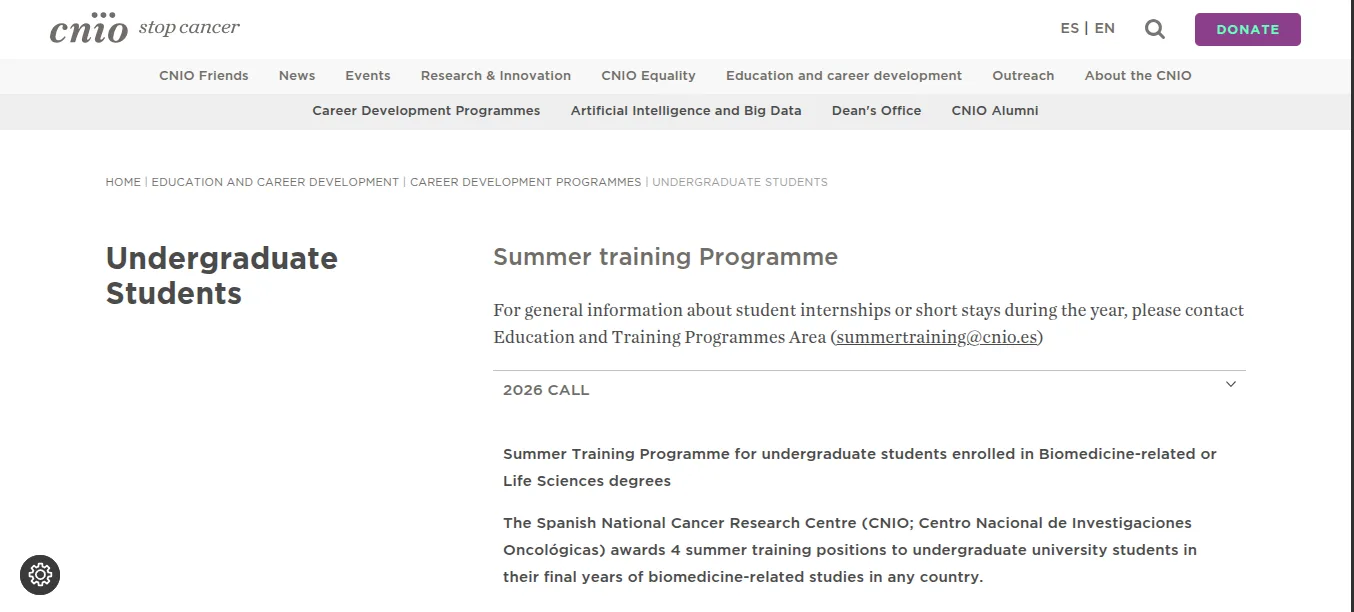
The CNIO Summer Training Programme is an annual summer placement at the Spanish National Cancer Research Centre (Centro Nacional de Investigaciones Oncológicas) in Madrid. The 2026 call awarded 4 positions to undergraduate students in their final years of biomedicine-related studies, with practical training running from 29 June to 21 August 2026. The page does not state a stipend, travel allowance, or accommodation support. The 2026 round is closed; no 2027 call has been announced as of 12 November 2026.
Quick Facts
| Item | What CNIO publishes |
|---|---|
| Host | Centro Nacional de Investigaciones Oncológicas (CNIO) |
| Location | Madrid, Spain |
| Opportunity type | Summer training programme for undergraduate students |
| Duration | ~8 weeks; 29 June – 21 August 2026 (2026 dates) |
| Who it is for | Undergraduate students in final years of biomedicine-related or life sciences degrees, any country |
| Positions awarded (2026) | 4 |
| Funding | Not stated on the 2026 call page |
| Application status | 2026 closed; 2027 not announced |
| 2026 deadline | Not published on the page |
| Official portal | CNIO Education & Career Development – Undergraduate Students page |
What the CNIO Summer Training Programme is
The CNIO is Spain's leading cancer research centre, part of the Carlos III Health Institute. Its Summer Training Programme is designed for undergraduate students who want hands-on research experience in cancer biology and related biomedicine fields. The programme places students in CNIO research groups for an eight-week period during the summer.
Since 2012, the programme has run annually with varying cohort sizes — from 1 position in the COVID-affected 2021 call to 9 in 2015. The 2026 call awarded 4 positions. Selected candidates come from universities worldwide; the 2026 cohort included students from Spain, China, and Serbia.
The programme is not a structured course but a research placement. Each student joins a specific CNIO group or unit and works on a project under the supervision of the group leader or unit head. The page lists the group assignments for each selected candidate, giving a clear picture of the research areas involved.
How students are matched with research groups
CNIO does not operate a centralised application form or applicant portal for the Summer Training Programme. Instead, the process relies on direct contact between the student and a prospective host group. Applicants are expected to:
- Review CNIO's research groups and units. Browse the CNIO faculty and research pages to identify groups whose work matches your interests — for example cancer genetics, metastasis, DNA repair, structural biology, bioinformatics, or clinical research units.
- Contact the group leader directly. The CNIO page explicitly states: "Students should approach the Group or Unit leaders to begin the application process." This means the group leader's agreement to host you is the primary gate for participation.
- Coordinate documents through the Education and Training Programmes Area. General inquiries and document submissions go to
summertraining@cnio.es. Specific required documents (CV, transcripts, motivation letter, references) are determined by the host group, not published as a standard list on the page.
Because there is no application portal, there is no published central deadline. Students should initiate contact well before the intended summer period to allow time for supervisor agreement and any administrative processing.
Research areas and host groups
CNIO's research spans molecular oncology, structural biology, bioinformatics, and clinical translation. The 2026 selected candidates were placed in:
- Brain Metastasis Group — Alicia Blanco Hermoso (University of Valencia, Spain)
- Organ Crosstalk in Metabolic Diseases Group — Huiwen Zhang (Peking University, China) and Yichen Xu (Sun Yat-sen University, China)
- Topology and DNA Breaks Group — Tea Savic (University of Belgrade, Serbia)
Previous years show a wider range of host groups, reflecting the breadth of CNIO's cancer research portfolio:
| Research area | Example groups (from 2012–2025 calls) |
|---|---|
| Brain metastasis | Brain Metastasis Group, Seve-Ballesteros Foundation Brain Tumours |
| Metabolism & cell signalling | Metabolic Interactions Group, Metabolism and Cell Signaling Group |
| DNA topology & repair | Topology and DNA Breaks Group, Structural Bases of Genome Integrity |
| Proteomics & genomics | Proteomics Unit, Bioinformatics Unit, Digital Genomic Group, Human Genotyping-CEGEN Unit |
| Telomeres & telomerase | Telomeres and Telomerase Group — Fundación Humanismo y Ciencia |
| Clinical research | Breast Cancer Clinical Research Unit |
| Microscopy & imaging | Confocal Microscopy Core Unit, Flow Cytometry Core Unit |
| Chromosome dynamics | Chromosome Dynamics Group |
| Kinases & signalling | Kinases, Protein Phosphorylation and Cancer Group |
| Epithelial carcinogenesis | Epithelial Carcinogenesis Group |
| Melanoma | Melanoma Group |
| Computational biology | Structural Computational Biology, Genetic & Molecular Epidemiology |
| Cell signalling & adhesion | Cell Signalling and Adhesion Group |
| Medicinal chemistry | Medicinal Chemistry Group |
| Prostate cancer | Prostate Cancer Group |
| Microenvironment & metastasis | Microenvironment & Metastasis Group |
| Tumour suppression | Tumour Suppression Group |
Applicants are expected to identify groups of interest and contact group leaders directly. The CNIO page says: "Students should approach the Group or Unit leaders to begin the application process."
Eligibility
The call is open to:
- Undergraduate university students in their final years of biomedicine-related or life sciences degrees
- Students from any country
- Students who will be enrolled at their university during the programme period
There is no explicit GPA requirement stated. The page does not specify whether students who have already graduated are eligible, but the wording "final years" and "enrolled during your stay" implies current enrolment is required.
Looking at the selected candidates from 2012–2026, successful applicants typically come from:
- Top universities worldwide (e.g., University of Valencia, Peking University, Sun Yat-sen University, University of Belgrade, University of Chicago, National Yang Ming Chiao Tung University, Medical University of Lodz, Complutense University of Madrid, Istanbul Technical University, Indonesia International Institute for Life Sciences, Goiás Federal University, Francisco de Vitoria University, University San Pablo CEU, Carlos III University of Madrid, Autonomous University of Madrid, Nile University, Polytechnic University of Valencia, Pablo de Olavide University, Sapienza University, Alcalá University, Peruana Cayetano Heredia University, UC Berkeley, University of Castilla-La Mancha, Al-Azhar University, University of Shiv Nadar, Complutense University, University of Science and Technology/Zewail City, University of Alcala, University of Córdoba, Columbia University, Wesleyan University, University of San Martin de Porres, Anna University, University of Arkansas, Francisco de Vitoria University, University of the Basque Country, University of Columbia, Yale University, University of Murcia, Jagiellonian University, William and Mary College, University of Guadalajara, University of Zagreb, Washington & Lee University, University of Turin, Russian-Armenian University, Seoul National University, Vanderbilt University, Jagellonian University, Cornell University, University of North Carolina)
This geographic diversity is a hallmark of the programme.
Funding and costs
The 2026 call page does not mention a stipend, travel allowance, or accommodation support. The archive screenshot also does not show funding details. This is a notable difference from many other summer programmes that provide a stipend or cover travel. Prospective applicants should contact summertraining@cnio.es to confirm whether any financial support is offered for the 2027 cycle.
The absence of stated funding on the public page may mean:
- Funding is negotiated individually with the host group
- The programme expects students to secure their own funding (e.g., through home university grants, Erasmus+, national scholarships)
- Funding details are communicated only after a host group agrees to take a student
Given that CNIO is a major national research centre with significant institutional funding, it is worth asking the Education and Training Programmes Area directly about any available support.
How to apply
The CNIO page does not publish a formal application form or a centralised portal. The process is:
- Identify a CNIO group or unit whose research matches your interests. Browse the CNIO faculty and group pages at
https://www.cnio.es/en/research-innovation/faculty/andhttps://www.cnio.es/en/research-innovation/research-projects/. - Contact the group leader directly to discuss a potential placement. The page explicitly states: "Students should approach the Group or Unit leaders to begin the application process."
- Submit required documents as requested by the group leader or the Education and Training Programmes Area (
summertraining@cnio.es).
Typical documents for research placements in Spain include:
- CV (European format preferred)
- Motivation letter explaining interest in the specific group
- Academic transcripts
- Proof of enrolment
- One or two academic references
- Copy of passport/ID
The page does not list a central deadline. The 2026 selected candidates were announced on the page, but the application deadline is not shown. For reference, many European summer programmes have deadlines between January and March. Given the 2026 programme ran 29 June – 21 August, a deadline in early 2026 (January–March) is likely.
Timeline and current status
- 2026 programme: Ran 29 June – 21 August 2026. Call closed. Four candidates selected and listed on the page.
- 2027 call: Not announced as of 12 November 2026.
- Next likely cycle: Based on the annual pattern since 2012, a 2027 call is plausible, but no dates are confirmed.
Historical timeline (2012–2026)
| Year | Positions | Dates | Notes |
|---|---|---|---|
| 2026 | 4 | 29 Jun – 21 Aug | 4 candidates from Spain, China, Serbia |
| 2025 | 6 | 23 Jun – 14 Aug | 6 candidates from Taiwan, Poland, Spain, USA, Egypt |
| 2024 | 3* | 24 Jun – 16 Aug | 4 candidates listed (Spain, USA, Spain) |
| 2023 | 4 | 26 Jun – 18 Aug | 4 candidates from Turkey, Indonesia, Spain, Brazil |
| 2022 | 5 | 27 Jun – 19 Aug | 5 candidates from Spain, Spain, Spain, Spain, Egypt |
| 2021 | 1 | 21 Jun – 13 Aug | COVID-19: only Spain-based students; 1 candidate |
| 2020 | 2 | 22 Jun – 14 Aug | COVID-19: only Spain residents; 2 candidates |
| 2019 | 6 | 24 Jun – 16 Aug | 6 candidates from Spain, Russia, Spain, Russia, Spain, Argentina |
| 2018 | 5 | 25 Jun – 17 Aug | 5 candidates from Spain, Spain, Italy, Spain, Spain |
| 2017 | 6 | 26 Jun – 18 Aug | 6 candidates from Peru, USA, Spain, Spain, Spain, Egypt |
| 2016 | 6 | 27 Jun – 19 Aug | 6 candidates from India, Spain, Egypt, Spain, Spain, Spain |
| 2015 | 9 | 22 Jun – 14 Aug | 9 candidates from Spain, USA, Peru, India, USA, Spain, Spain, Spain, USA |
| 2014 | 8 | 23 Jun – 14 Aug | 8 candidates from Spain, Spain, Bangladesh, India, Italy, Argentina, Spain, USA |
| 2013 | 8 | 24 Jun – 16 Aug | 8 candidates from USA, Spain, Spain, Poland, USA, Spain, Mexico, Croatia |
| 2012 | 8 | 18 Jun – 10 Aug | 8 candidates from USA, Italy, Armenia, South Korea, USA, Poland, USA, USA |
*2024 call text says 3 positions but lists 4 candidates.
The programme consistently runs late June to mid-August (8 weeks). Cohort size varies 1–9 depending on funding and circumstances (notably reduced during COVID-19).
Selection and what makes a credible application
The page does not describe the selection criteria in detail. However, the listed candidates are all in their final undergraduate years at recognised universities worldwide, in biomedicine-related fields. A credible application likely includes:
- Strong academic record in a relevant life sciences discipline
- Clear motivation for cancer research
- Alignment with a specific CNIO group's research focus
- Direct contact with a prospective supervisor who agrees to host you
The fact that students must contact group leaders first means the supervisor's agreement is the primary gate. A strong application therefore demonstrates:
- Familiarity with the group's recent publications
- A clear, specific research interest matching the group's work
- Relevant coursework or prior lab experience (even if not required)
- Professional communication in the initial outreach email
What is confirmed and what is not yet announced
| Confirmed (from 2026 call) | Not confirmed for 2027 |
|---|---|
| Programme exists and runs annually | 2027 dates |
| Open to international undergraduates | 2027 application opening date |
| Placements in CNIO research groups | 2027 deadline |
| Eight-week summer duration | Number of 2027 positions |
| Contact: summertraining@cnio.es | Stipend, travel, or accommodation support for 2027 |
Sources and verification
- CNIO Education and Career Development – Undergraduate Students — official programme page, accessed 12 November 2026
- Archive screenshot:
2026-11-07_CNIO_Summer_Training_Programme_Page_01.png
Keep exploring
- CSHL Undergraduate Research Program (URP) — US-based summer research with stipend
- NIST Summer Undergraduate Research Fellowship (SURF) — US federal research programme
- Summer@EPFL — EPFL computer science and engineering fellowship
Frequently asked questions
- Is the CNIO Summer Training Programme 2026 open for applications?
- No. The 2026 call has closed. The page lists the four selected candidates and the programme ran from 29 June to 21 August 2026.
- How many positions does CNIO award each year?
- The number varies. In 2026, CNIO awarded 4 positions; in 2025 it was 6; in 2024 it was 3 (though 4 candidates are listed). The call states the number of positions awarded for that year.
- Who is eligible for the CNIO Summer Training Programme?
- Undergraduate university students in their final years of biomedicine-related or life sciences degrees from any country. Students must be enrolled during the programme period.
- Does CNIO provide a stipend or travel funding for the Summer Training Programme?
- The CNIO page for the 2026 call does not mention a stipend, travel allowance, or accommodation support. The archive screenshot also does not show funding details. Check the official page or contact summertraining@cnio.es for confirmation.
- What is the application process for the CNIO Summer Training Programme?
- Students should approach CNIO Group or Unit leaders directly to begin the application process. The contact email for general information is summertraining@cnio.es. Specific application forms and documents are not detailed on the public page.
- Can international students apply to the CNIO Summer Training Programme?
- Yes. The call is open to undergraduate students from any country. The 2026 selected candidates included students from Spain, China, and Serbia.
- What research areas are covered by the CNIO Summer Training Programme?
- Projects span CNIO's research groups in cancer biology, including Brain Metastasis, Organ Crosstalk in Metabolic Diseases, Topology and DNA Breaks, Metabolic Interactions, Proteomics, Flow Cytometry, Digital Genomics, Telomeres and Telomerase, and Clinical Research units.
- When is the next CNIO Summer Training Programme call expected?
- CNIO has not published a 2027 call as of 12 November 2026. The programme has run annually since at least 2012, so a 2027 call is plausible, but dates and details are not confirmed.
Official application link
Check the official CNIO Summer Training Programme page
The 2026 round is closed and the 2027 call has not been announced. Contact summertraining@cnio.es for updates.
Open official page

