
Academic guides · Guide
CSHL Undergraduate Research Program (URP): 2027 Guide, Stipend and Eligibility
StatusOpen
CSHL's URP is a 9-week summer research programme in New York with a $7,000 stipend, housing and meals covered. The 2027 deadline is 15 January 2027 at 11:59 pm PST.
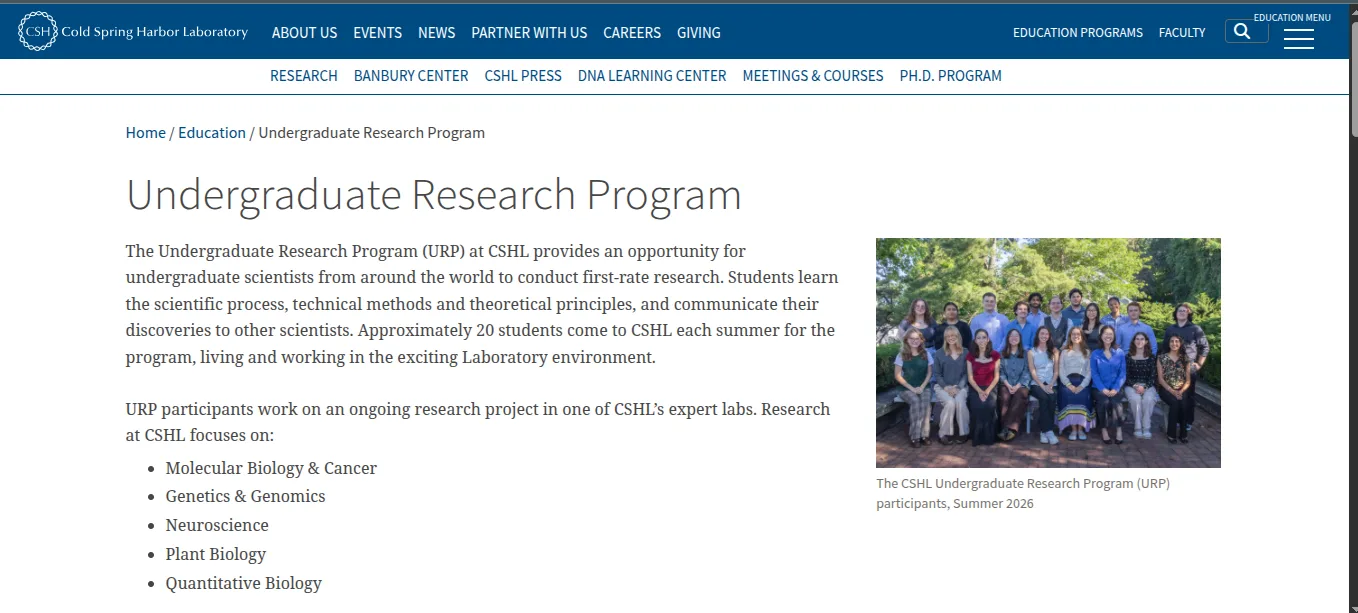
The Cold Spring Harbor Laboratory (CSHL) Undergraduate Research Program (URP) is a 9-week, fully residential summer research programme in Cold Spring Harbor, New York. The 2027 programme runs from 7 June to 7 August 2027. Approximately 20 students are selected each year. Each receives a $7,000 stipend, free housing in campus cabins, and three meals daily. Applications close on 15 January 2027 at 11:59 pm PST.
The URP is one of the longest-running undergraduate research programmes in the United States, established in 1959. It has produced an extraordinary lineage of alumni including Nobel laureates Dr. David Baltimore (Caltech), Dr. Gerry Rubin (HHMI/Janelia), Dr. Alfred Goldberg (Harvard Medical School), Dr. Geraldine Seydoux (Johns Hopkins), and Dr. Charles Gilbert (Rockefeller University), among many other leaders in academia, industry, and medicine.
Quick Facts
| Item | What CSHL publishes |
|---|---|
| Host | Cold Spring Harbor Laboratory (CSHL) |
| Location | Cold Spring Harbor, New York, United States |
| Opportunity type | Summer research programme for undergraduates |
| Duration | 9 weeks, 7 June – 7 August 2027 |
| Cohort size | ~20 students per year |
| Stipend | $7,000 |
| Housing & meals | Covered: campus cabins (2 per room, full bathroom) and three meals daily |
| Eligibility | Current sophomores/juniors at US institutions (or partner foreign universities); returning to undergrad after summer |
| Application status | Open for 2027 |
| Deadline | 15 January 2027, 11:59 pm PST |
| Official portal | CSHL Embark: cshl.embark.com/apply/urp2027 |
What the CSHL URP is
CSHL is a private, non-profit research institution on Long Island, New York, with a focus on molecular biology, genetics, cancer, neuroscience, plant biology, and quantitative biology. The URP has run since 1959 and counts Nobel laureates and leading scientists among its alumni.
The programme is not a lecture course. Each student undertakes an original research project mentored by a CSHL faculty member. Students have access to state-of-the-art facilities including genomics and microscopy cores. At the end, students write a scientific manuscript and present their work at the URP Symposium.
The programme includes:
- Research project in a CSHL expert lab
- Bioinformatics and Computational Neuroscience workshop — weekly Python programming workshops and lectures on computational biology topics
- Scientific communication training — research abstract, scientific report, and two research talks
- Career development — faculty perspectives, graduate school applications, non-research career panel
- Responsible Conduct of Research workshop
- Social activities — volleyball, kayaking, NYC weekend trips, dinner with CSHL President
Research areas
CSHL research focuses on five core areas:
- Molecular Biology & Cancer — mechanisms of tumour initiation, progression, and therapy resistance
- Genetics & Genomics — genome structure, regulation, and evolution
- Neuroscience — neural circuits, sensory processing, behaviour, and computational neuroscience
- Plant Biology — development, genetics, and environmental responses
- Quantitative Biology — mathematical modelling, bioinformatics, and systems biology
These areas are not silos; many URP projects sit at the intersection of two or more fields.
Prospective faculty mentors and research groups
The CSHL page lists over 40 faculty members who serve as prospective URP/REU mentors. Each runs an independent research group. A representative sample (full list on the official page):
| Faculty | Research focus |
|---|---|
| Dinu F. Albeanu | Neuronal circuits; sensory coding; olfactory processing |
| Arkarup Banerjee | Vocal communication, singing mice, systems neuroscience |
| Jeremy Borniger | Sleep, neuromodulators, cancer neuroscience |
| Lucas Cheadle | Synapse refinement, microglia, autism, 2-photon imaging |
| Benjamin Cowley | Computational neuroscience, closed-loop experiments, deep learning |
| Hiro Furukawa | Membrane proteins, x-ray crystallography, electrophysiology |
| Thomas Gingeras | Genome-wide transcription, non-coding RNAs |
| Helen Hou | Neural circuits, natural behaviours, brain-body interaction |
| Ivan Iossifov | Computational biology, human genetics, machine learning |
| David Jackson | Plant development, stem cell signalling, genomics |
| Leemor Joshua-Tor | Structural biology, RNAi, nucleic acid regulation |
| Justin Kinney | Sequence-function relationships, biophysics, deep sequencing |
| Peter Koo | Sequence-function relationships, deep learning, representation learning |
| Alexei Koulakov | Theoretical neurobiology, quantitative cortical design |
| Alexander Krasnitz | Cancer genomics, machine learning for biology |
| Zachary Lippman | Plant development, genetics, phase transitions |
| Rob Martienssen | Epigenetics, DNA methylation, transposons, plant genomics |
| David McCandlish | Computational biology, population genetics, protein evolution |
| W. Richard McCombie | Psychiatric/cancer genomics, computational genomics |
| Hannah Meyer | Spatial transcriptomics, immunology, central tolerance |
| Partha P. Mitra | Neuroinformatics, neural prostheses, brain mapping |
| Saket Navlakha | Algorithms in nature, biological computation, plant architectures |
| Ullas Pedmale | Plant growth, signalling, genomics, plant-environment interactions |
| Gabrielle Pouchelon | Neural circuits, development, gene regulation, plasticity |
| Stephen Shea | Olfaction, audition, communication behaviours |
| Adam Siepel | Biological statistics, population genomics, evolution |
| David L. Spector | Cell biology, gene expression, nuclear structure, microscopy |
| Jessica Tollkuhn | Transcriptional regulation, chromatin, neurodevelopment |
| Doreen Ware | Computational biology, comparative genomics, plant biology |
| Michael Wigler | Human genetic disorders, population genetics, cancer genomics |
| Anthony Zador | Cortical mechanisms of auditory attention, connectomics |
Applicants may list 2–3 preferred mentors in their personal statement. CSHL matches students to mentors based on mutual interest and project fit.
Bioinformatics and Computational Neuroscience workshop
CSHL's URP includes a dedicated two-part workshop in Bioinformatics and Computational Neuroscience, running alongside the research project:
Hands-on programming workshops (weekly)
- Training in Python for biological data analysis and visualisation
- Materials hosted at the CSHL URP GitHub repository (
github.com/iossifov/25e_urp) - Applied perspective: students investigate biological problems rather than abstract CS exercises
Lecture series
Sessions cover:
- Applications of computational analyses in biology
- Crop improvement through bioinformatics
- Modelling frameworks for interpreting deep neural networks in functional genomics
This workshop is open to all URP participants. NSF-supported REU students are selected from the URP cohort and must be US citizens/permanent residents; non-US students participate via non-restricted URP fellowships.
NSF REU in Bioinformatics and Computational Neuroscience
CSHL's REU programme (NSF-funded 2005–2014, 2016–present) provides early quantitative training to undergraduates who might not otherwise pursue computational approaches. Key points:
- Eligibility: All URP participants may take part; NSF-supported students must be US citizens/permanent residents
- Focus: Bioinformatics, computational neuroscience, large genomic/image dataset analysis
- Mentors: Faculty combining biology, information theory, and computational techniques (listed above)
- Outcomes: Nearly all REU alumni continue in scientific careers/advanced degrees at competitive institutions
- Alumni: Listed on the CSHL page by year
The REU does not require a separate application; students indicate interest during the URP application.
Eligibility
Must-have:
- Current sophomore or junior (or equivalent) — at least two years of undergraduate coursework completed by June 2027
- Returning to an undergraduate degree programme after the summer (graduating seniors are not eligible)
- Enrolled full-time at a U.S. college/university on a student visa, OR at a foreign university with a pre-existing CSHL agreement
- Strong academic background in science (biology, chemistry, computer science, engineering, math, physics)
- 18 years or older by programme start (implied by US lab regulations)
No minimum GPA required, but successful applicants typically have ~3.5+ in science/math courses. No TOEFL/IELTS required. Prior research experience helps but is not required.
Stipend and benefits
- Stipend: $7,000 for the 9-week period
- Housing: Campus cabins — 8 per cabin, 2 per room, full bathroom, linens/towels provided, Wi-Fi, air-conditioned
- Meals: Three meals daily, 7 days/week in Blackford Dining Hall; vegetarian/vegan options
- Facilities: Gym, tennis/volleyball courts, pool, private beach, canoes/kayaks, hiking trails
- Travel: Not explicitly covered by stipend; students arrange own travel to/from CSHL
How to apply
Applications are submitted only through the CSHL Embark portal: cshl.embark.com/apply/urp2027
Required components:
- Online application form with personal statement (≤500 words) covering:
- Career interests
- How URP helps your goals
- Research experience, employment, extracurriculars
- 2–3 preferred research mentors (optional)
- Two recommendation letters from professors (preferably math/science) uploaded by referees to Embark
- Letters from graduate students/postdocs are less effective
- No more than two letters accepted
- Unofficial transcripts (official not required)
- No CV or separate motivation letter — the personal statement replaces these
Key rules:
- Register as a user on Embark first ("New User? Register Here")
- You may submit before recommendation letters are uploaded
- Once submitted, changes cannot be made
- Faxed/mailed/emailed applications or letters are not accepted
Student perspectives (2026 cohort)
The CSHL page features testimonials from recent URP participants:
Nora Gilmer (Hammell Laboratory) — Studied developmental biology in C. elegans, investigating transcription factor MYRF-1. Describes the collaborative lab culture and mentorship from PI Chris Hammell and direct mentor Brett Pryor as transformational. Highlights cohort bonding through volleyball, NYC weekend trips.
Shira Goldhaber Gordon (Cowley Laboratory) — Exploratory analysis of macaque visual cortex data using machine learning. Valued the lab's weekly distill lectures and journal clubs. Enjoyed kayaking, picnics on the CSHL beach, and close cohort friendships.
Cindy Li (Banerjee/Zador Laboratories) — Project spanning bioinformatics and systems neuroscience. Emphasises independence gained and support from fellow URPs, labs, and CSHL community. Highlights Black Box chalk-talks, faculty seminars, cultural events, and winning the URP vs. faculty volleyball game.
These accounts illustrate the blend of rigorous research, structured training, and community that defines the URP experience.
Alumni network
Since 1959, the URP has produced exceptional alumni. Notable names include:
- Dr. David Baltimore — Nobel laureate (Physiology/Medicine 1975), Caltech
- Dr. Gerry Rubin — HHMI, Janelia Farm Research Campus
- Dr. Alfred Goldberg — Harvard Medical School
- Dr. Geraldine Seydoux — Johns Hopkins
- Dr. Charles Gilbert — Rockefeller University
Full alumni lists by year (2000–2026) are available on the CSHL page, with a complete PDF archive.
Timeline and current status
| Date | Event |
|---|---|
| Now | Applications open for 2027 |
| 15 Jan 2027, 23:59 PST | Application deadline (incl. recommendation letters) |
| End of March 2027 | Notification of results |
| 7 Jun – 7 Aug 2027 | Programme dates |
The 2026 cohort has completed; the 2027 cycle is open.
Selection and what makes a credible application
CSHL receives many applications for ~20 spots. Credible applications typically show:
- Strong personal statement linking career goals to CSHL's research environment
- Preference for specific faculty mentors (listed on the page with research areas)
- Recommendation letters from professors who know the applicant's scientific potential
- Academic record in relevant disciplines (biology, chemistry, CS, engineering, math, physics)
- For international applicants at US institutions: valid student visa status
The NSF REU track (Bioinformatics and Computational Neuroscience) is limited to US citizens/permanent residents, but non-US students can participate via non-restricted URP fellowships.
What the selection committee looks for
Based on the programme description and alumni outcomes, strong candidates demonstrate:
- Clear scientific narrative — the personal statement should explain why CSHL, why this research area, and how the URP fits the applicant's trajectory
- Mentor alignment — listing 2–3 specific faculty whose work the applicant has read and can discuss
- Recommendation quality — letters from professors who can speak to research aptitude, not just grades
- Academic readiness — while no minimum GPA exists, successful applicants typically have strong science/math records
- Resilience and curiosity — the programme values students who ask questions, troubleshoot, and persist
The selection process involves faculty review of applications, matching of student interests to available projects, and final cohort assembly to ensure disciplinary breadth.
What is confirmed and what is not yet announced
| Confirmed for 2027 | Not confirmed / historical |
|---|---|
| Programme dates: 7 Jun – 7 Aug 2027 | 2028 dates |
| Stipend: $7,000 | 2028 stipend amount |
| Housing and meals covered | 2028 application opening |
| Deadline: 15 Jan 2027, 23:59 PST | 2028 deadline |
| ~20 students selected | 2028 cohort size |
| Application via Embark portal | 2028 portal URL |
Sources and verification
- CSHL Undergraduate Research Program — official programme page, accessed 12 November 2026
- CSHL Embark Application Portal — application portal, accessed 12 November 2026
- Archive screenshot:
2026-11-06_CSHL_URP_Programme_Page_01.png
Keep exploring
- CNIO Undergraduate Summer Training Programme — Spain-based cancer research summer training
- NIST Summer Undergraduate Research Fellowship (SURF) — US federal research programme
- Caltech SURF 2027 — 10-week Pasadena programme with $8,354 award
Frequently asked questions
- Is the CSHL URP 2027 open for applications?
- Yes. Applications for the 2027 URP opened on the CSHL Embark portal and close on 15 January 2027 at 11:59 pm Pacific Standard Time.
- How much does the CSHL URP pay in 2027?
- Students receive a $7,000 stipend. Room and board expenses are covered by CSHL — housing in campus cabins and three meals daily in the dining hall.
- Who is eligible for the CSHL URP?
- Current sophomores and juniors (or equivalent) enrolled at a U.S. college or university on a student visa, or at a foreign university with a pre-existing agreement with CSHL. Students must be returning to an undergraduate degree programme after the summer. First-year students are only considered in exceptional cases with prior independent research experience.
- What are the 2027 CSHL URP dates?
- The 2027 URP runs from Monday, 7 June to Saturday, 7 August 2027.
- Can international students apply to CSHL URP?
- Foreign students are eligible only if they are currently enrolled full-time at a U.S. college or university on a student visa, or in limited cases if they attend a foreign university with a pre-existing agreement with CSHL.
- What is the application deadline for CSHL URP 2027?
- 15 January 2027 at 11:59 pm PST (equivalent to 16 January 2027, 07:59 UTC). Recommendation letters are also due by this deadline.
- What research areas does CSHL URP cover?
- Molecular Biology & Cancer, Genetics & Genomics, Neuroscience, Plant Biology, and Quantitative Biology. Students can also participate in Bioinformatics and Computational Neuroscience workshops.
- Does CSHL URP require prior research experience?
- Previous laboratory research experience will help your application but is not required. No minimum GPA is required, though successful applicants generally have GPAs around 3.5 or higher in science and math courses.
Official application link
Apply via CSHL Embark portal
Applications close 15 January 2027 at 11:59 pm PST. Two recommendation letters required by the same deadline.
Open official page

